Employee Benefits
2026 Benefits State of the Union: High-Cost Drugs and What They Mean for Your Health Plan
According to Mployer Insights’ 2026 analysis of 50,000+ employer health plans, prescription drugs account for over 25% of total benefit expenses, with Tier 4 specialty drugs driving the majority of high-cost claims. While Tier 4 copays average $123 with coinsurance requirements in 31% of plans, individual oncology therapies like Darzalex Faspro ($170,800/yr) and Keytruda ($158,200/yr) frequently exceed average individual stop-loss deductibles ($141,938). To mitigate exposure, self-funded employers are increasingly turning to independent, transparent PBM models and biosimilar substitution—which yields up to a 73% net cost reduction per patient.
August 9, 2026

The Likely Fastest-Growing Line in Your Benefits Budget

Modern medicine has produced remarkable advances. Cancer therapies that were not available five years ago are now extending and saving lives. Treatments for autoimmune diseases, multiple sclerosis, and rare genetic conditions are giving employees and their families real options where few existed before. As an employer, providing access to these treatments through your benefit plan is one of the most meaningful things your organization does for the people who work there.

It also comes with a financial reality that every benefits decision maker needs to understand clearly. Over 25% of total employer health benefit expenses are now driven by prescription drugs, and within that figure, a small number of specialty drugs account for an outsized share of the cost. A single covered employee on an oncology therapy can generate $100,000 to $170,000 or more in annual drug spend. A handful of members on these treatments can represent a larger budget impact than the entire pharmacy spend of the rest of your workforce combined. The goal is not to restrict access to these medications. The goal is to understand how the system works, how costs flow, and how to structure your plan so that both your employees and your organization are best positioned for the long term.

This piece covers how the pharmacy benefit system works, how your plan’s tier structure determines who pays what, how stop-loss insurance interacts with high-cost drug claims, and what employers can do to manage this exposure thoughtfully.
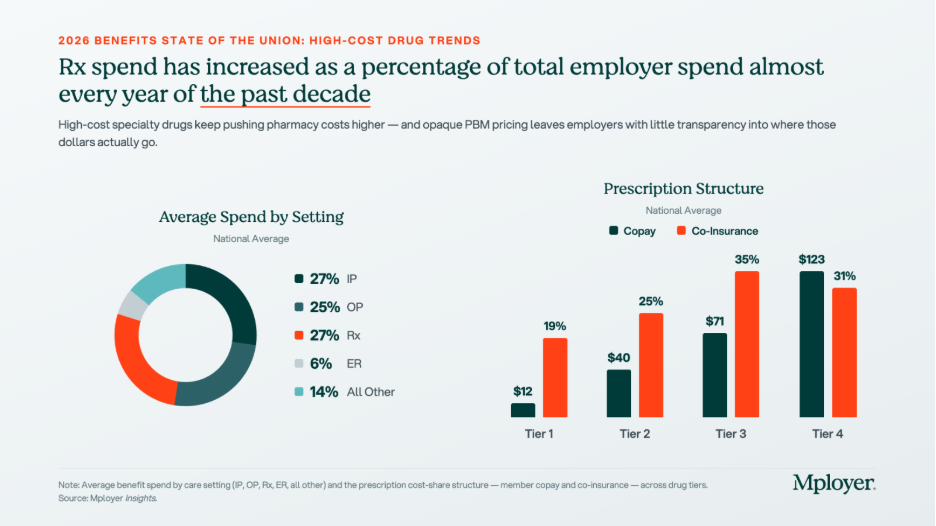
The tier structure in the chart above reflects how plans already account for the cost complexity of specialty drugs. Tier 4, which is where specialty biologics and injectables are typically placed, carries significantly higher cost-sharing than the other tiers: an average employee copay of $123 and coinsurance requirements in 31% of plans. But Tier 4 behaves very differently from the other tiers. On Tier 1, 2, and 3 drugs, cost-sharing is relatively predictable and manageable. On Tier 4, the combination of high drug cost and percentage-based coinsurance can generate out-of-pocket exposure that approaches or exceeds a patient’s annual out-of-pocket maximum in a single month of therapy. How Tier 4 is structured, what controls are in place, and how the plan manages cost is one of the most consequential design decisions an employer makes.

Understanding Your Benefit Plan’s Pharmacy Options

How Pharmacy Benefit Managers Work

Most employer health plans do not manage pharmacy benefits directly. That function is delegated to a Pharmacy Benefit Manager, or PBM, which acts as the intermediary between the health plan, the pharmacy, and the drug manufacturer. The PBM builds and maintains the formulary, negotiates drug prices and rebates with manufacturers, contracts with pharmacy networks, and processes pharmacy claims. The three dominant PBMs, Express Scripts (owned by Cigna), CVS Caremark (owned by CVS Health / Aetna), and OptumRx (owned by UnitedHealth Group), together manage the pharmacy benefits of approximately 80% of covered lives in the United States. Each is affiliated with a major carrier, meaning that employers who use an ASO medical arrangement often default to the carrier’s affiliated PBM without realizing it. Independent PBMs such as Capital Rx, Navitus, and MedOne Pharmacy Benefit Solutions operate on transparent, pass-through pricing models that return all rebates to the plan rather than retaining them as PBM revenue. PBMs are compensated through administrative fees, spread pricing (charging the plan more than the pharmacy receives and keeping the difference), manufacturer rebates in exchange for formulary placement, and specialty pharmacy margin. For any employer managing meaningful specialty drug spend, understanding which of these revenue sources applies to your contract is essential.

How Drug Tiers and Cost-Sharing Work

Every pharmacy benefit plan organizes covered drugs into tiers, with cost-sharing that increases as you move from Tier 1 generics (avg. $12 copay) through Tier 2 preferred brands ($40), Tier 3 non-preferred brands ($71), and into Tier 4 specialty drugs ($123 copay, with coinsurance in 31% of plans). The tier placement of a drug affects both what the employee pays and, indirectly, what the plan pays, since tier placement drives utilization patterns. Plan sponsors have real levers here: step therapy (requiring a patient to try a lower-cost drug first), prior authorization, specialty pharmacy channel mandates, and formulary exclusions all affect Tier 4 cost without eliminating clinical access. These controls require balancing cost management with the reality that for many specialty drugs, no lower-cost alternative achieves the same clinical outcome.

How Stop-Loss Insurance Interacts with High-Cost Drug Claims

For self-funded employers, specialty drug claims are now among the most common triggers for individual stop-loss reimbursement. A single employee on a cancer therapy or rare disease treatment can generate pharmacy claims that exceed the plan’s specific stop-loss deductible, which averages $141,938 nationally for self-insured plans, within a single plan year. The mechanics: the employer pays all claims up to the deductible threshold, and the stop-loss carrier reimburses costs above it. Several dynamics are specific to high-cost drugs. At renewal, stop-loss carriers may laser a known high-cost member by raising their individual deductible or excluding them from coverage. Some carriers now specifically carve out GLP-1 medications or other high-utilization drug categories from stop-loss reimbursement, so employers adding new drug coverage should verify what their contract covers. Specialty drugs can also be administered under either the pharmacy benefit or the medical benefit depending on whether they are self-administered or clinic-administered, and some stop-loss contracts apply different terms to each channel. Employers should model their actual specialty drug cost distribution against their stop-loss deductible at every renewal to understand where the plan’s real exposure sits.

The Costliest Specialty Drugs: What They Treat and What They Cost

The chart below shows the highest-cost specialty and biologic drugs by average cost per patient, ranked from most to least expensive. Cancer therapies dominate the top of the list, but treatments for autoimmune conditions, MS, and inflammatory disease also appear, reflecting how broadly specialty drug spending is distributed across a workforce.
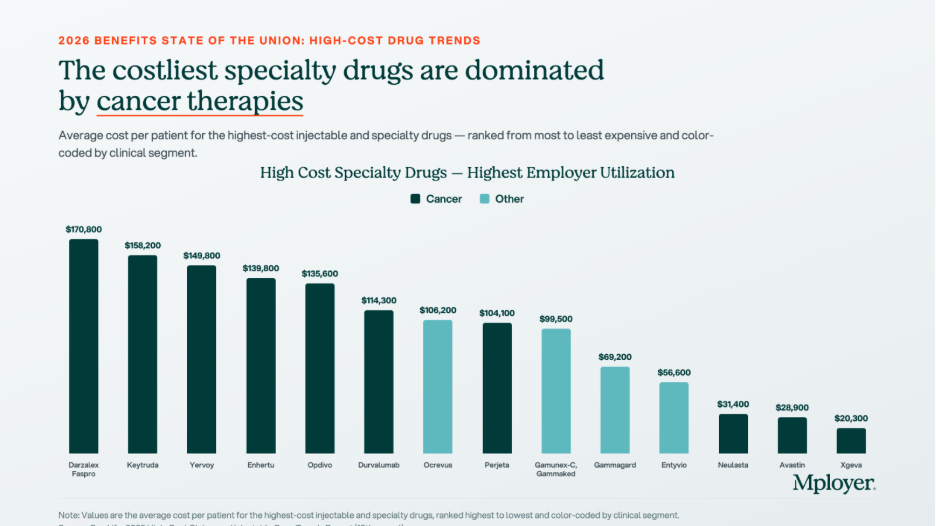
  • Darzalex Faspro (daratumumab/hyaluronidase) | $170,800 avg. annual cost per patient. Janssen (J&J). Multiple myeloma, a blood cancer. The highest-cost drug on the list by average patient cost. The subcutaneous formulation allows home administration, increasing the likelihood it flows through the pharmacy benefit rather than the medical benefit.
  • Keytruda (pembrolizumab) | $158,200 avg. annual cost per patient. Merck. FDA-approved across more than 40 cancer indications including lung, melanoma, head and neck, and bladder cancers. One of the most prescribed oncology drugs globally and one of the most common high-cost pharmacy claims in large employer plans.
  • Yervoy (ipilimumab) | $149,800 avg. annual cost per patient. Bristol-Myers Squibb. Melanoma and in combination with Opdivo for lung and other cancers. Combination Yervoy plus Opdivo therapy is among the highest per-patient drug cost regimens in common use.
  • Enhertu (trastuzumab deruxtecan) | $139,800 avg. annual cost per patient. AstraZeneca / Daiichi Sankyo. HER2-positive and HER2-low breast and gastric cancers. A significant recent clinical advance for patients with cancers that previously had limited options after first-line treatment.
  • Opdivo (nivolumab) | $135,600 avg. annual cost per patient. Bristol-Myers Squibb. Melanoma, lung, kidney, bladder, and other cancers. Frequently used in combination with Yervoy, compounding cost significantly when both are prescribed together.
  • Ocrevus (ocrelizumab) | $106,200 avg. annual cost per patient. Genentech. Relapsing and primary progressive multiple sclerosis. MS therapies are a persistent specialty drug cost driver because patients remain on therapy for years, making each diagnosed member a multi-year plan cost.
  • Entyvio (vedolizumab) | $56,600 avg. annual cost per patient. Takeda. Moderate-to-severe Crohn’s disease and ulcerative colitis. Inflammatory bowel disease therapies are among the most common specialty drug claims in employer plans because the conditions are prevalent in working-age adults.

Biosimilars: The Cost Opportunity Most Employers Are Not Fully Using

A biosimilar is a biologic drug that is highly similar to an already-approved reference biologic, with no clinically meaningful differences in safety, purity, or potency. Biosimilars are not generic drugs in the traditional sense, because biologic drugs are complex proteins manufactured from living cells and cannot be chemically replicated exactly. But they go through an FDA approval pathway that confirms their clinical equivalence to the reference product, and they cost significantly less. The biosimilar market has expanded rapidly as major biologic patents have expired. Humira, the world’s best-selling drug for much of the past decade, now has multiple biosimilar competitors in the U.S. Stelara has followed. The oncology biosimilar pipeline is maturing, with more approvals expected in the next two to three years.
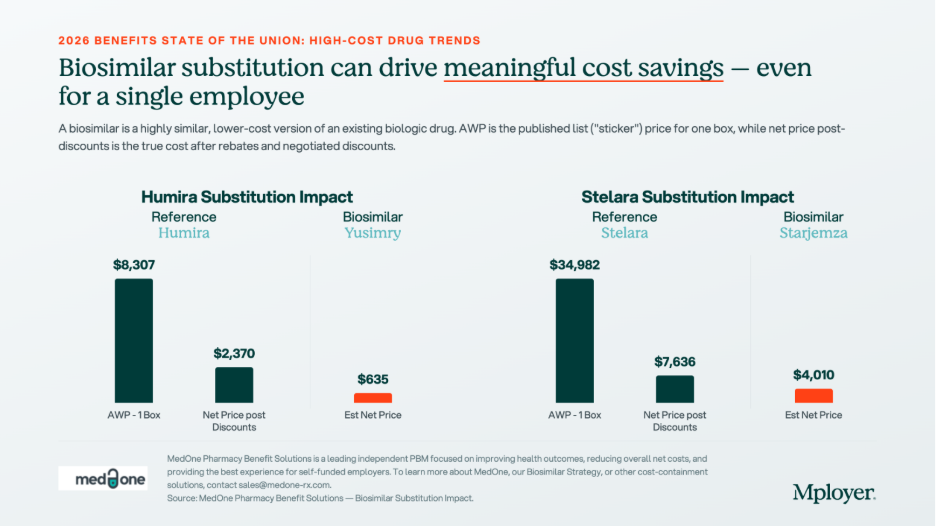
The chart above shows what biosimilar substitution looks like in dollar terms. For Humira, the net price after rebates and negotiated discounts is $2,370 per box. The biosimilar Yusimry has an estimated net price of $635, a 73% reduction. For Stelara, the reference drug net price is $7,636 per box. The biosimilar Starjemza has an estimated net price of $4,010, a 47% reduction. For an employee on monthly Humira therapy, the difference between the reference drug and the biosimilar is approximately $21,000 per year in net plan cost. For a Stelara patient, the annual difference is approximately $43,500. Across even a small number of members on these therapies, biosimilar substitution is one of the highest-return cost management interventions available.

Plan sponsors have four main tools to drive biosimilar adoption: preferred formulary placement (putting the biosimilar on a lower tier and the reference drug on a higher tier), step therapy for new patients, automatic substitution where state law permits, and formulary exclusion of the reference drug entirely. The most important variable in any biosimilar strategy is whether your PBM has a financial incentive to keep the reference drug preferred. A PBM earning a large rebate on Humira has a direct financial reason to keep Humira on the preferred formulary, even when the biosimilar costs the plan less on a net basis. Independent PBMs operating on pass-through pricing remove this conflict entirely, because all rebates return to the plan and formulary decisions are made without a competing financial interest.

What Employers Should Be Asking About Their Pharmacy Benefit

High-cost drug management requires active decisions about PBM contract structure, formulary design, specialty pharmacy strategy, and stop-loss alignment. The questions worth asking at every renewal:

  • Is your PBM contract pass-through or spread-based? A pass-through model means you pay exactly what the pharmacy receives and all rebates come back to the plan. A spread-based model means the PBM earns revenue that is not visible in the administrative fee. Request full compensation disclosure under the CAA requirements.
  • Are you receiving all available biosimilar savings? Ask your PBM for a net cost comparison of each reference drug plus rebate against the available biosimilar net price. The answer will tell you whether your formulary is designed around the plan’s cost interest or the PBM’s rebate interest.
  • What is your specialty drug channel strategy? Are specialty prescriptions being filled through your PBM’s affiliated specialty pharmacy? Carving specialty to an independent pharmacy or using a white-bagging program for clinic-administered drugs can generate meaningful cost differences.
  • How does your stop-loss deductible interact with your specialty drug exposure? Model your actual specialty drug claims against your stop-loss threshold. If most of your high-cost drug claims fall below the deductible, the plan is absorbing those costs without triggering reimbursement.
  • Does your formulary have appropriate Tier 4 controls? Step therapy, prior authorization, and quantity limits on specialty drugs reduce cost without eliminating clinical access. Without these controls, high-cost therapies can be approved and dispensed without any plan-level review of whether a lower-cost alternative exists.

Know How Your Pharmacy Benefit Compares

Pharmacy is now one of the two or three most consequential cost management decisions in health plan design. The employers managing it well are not restricting access to the medications their employees need. They are ensuring that the structure of the benefit, the PBM contract, the formulary design, and the stop-loss coverage work together in the plan’s interest, and that every dollar spent on high-cost drugs is spent as efficiently as possible.

Mployer’s benefits rating evaluates pharmacy benefit design as part of the Medical pillar score, benchmarked against a custom cohort matched by size, region, and industry. Knowing where your pharmacy benefit stands relative to employers who actually look like you is the starting point for making better decisions.

See how your benefits package compares to your custom cohort at MployerAdvisor.com.

Sources

Mployer Insights: Average Spend by Setting, Prescription Structure, and High-Cost Specialty Drugs. Source: Mployer Insights analysis.

MedOne Pharmacy Benefit Solutions: Biosimilar substitution impact data for Humira/Yusimry and Stelara/Starjemza. MedOne is a leading independent PBM focused on improving health outcomes and reducing net costs for self-funded employers. [email protected].

Mployer 2025 and 2026 Employee Benefit Plan Design Study, covering 50,000+ employer plans. Individual stop-loss avg $141,938 self-insured.

Consolidated Appropriations Act of 2021, Section 202: broker/consultant compensation disclosure requirements for group health plans.

FDA Biosimilar approval framework: 42 U.S.C. Section 262(k).

Mployer Advisor Announces San Antonio, Texas’ ‘Top Employee Benefits Consultant Awards’ Winners for 2022
Nashville, Tenn.– September 7, 2022 – Mployer Advisor, the leading independent platform for employers to research, review, and evaluate insurance brokers is pleased to announce the winners of its “Top Employee Benefits Consultant Awards” based in San Antonio, Texas.
Author:
Abbey Dean

Nashville, Tenn.– September 7, 2022Mployer Advisor, the leading independent platform for employers to research, review, and evaluate insurance brokers is pleased to announce the winners of its “Top Employee Benefits Consultant Awards” based in San Antonio, Texas. Mployer Advisor has named more than 600 winners in over 50 regions as part of its second annual 2022 awards. The class of 2022 winners account for less than 5% of all brokerages nationwide.  

Mployer Advisor’s Top Employee Benefits Consultant Awards Program evaluates brokerages based on the breadth and depth of their experience across employer industries, sizes, insurance products, and employer reviews. We recognize esteemed brokers that demonstrate market-leading competencies and a proven track record of success among employers, insurance providers, and peers. 

“The team at Mployer Advisor is proud to honor this group of top insurance consultants as part of the 2022 class for our second annual Top Employee Benefits Consultant Awards,” said Brian Freeman, the Founder and CEO of Mployer Advisor. “Employer-sponsored healthcare and benefits cover over 150M Americans. Who an employer selects as their benefits advisor has more impact on cost and quality than who they choose as the insurance carrier. We scored these brokerages utilizing sophisticated, industry-first algorithms, and we applaud the winners’ demonstrated commitment to service, quality, and positive employer feedback.” 

Mployer Advisor determined the winners of the second annual “Top Employee Benefits Consultant Awards” by analyzing each brokerage based on historical data, online reviews, their M Score rating, and demonstrated business experience.  

The San Antonio, Texas job market is one of the most competitive in the U.S. Southwest, employing almost 1.2 million people. Offering competitive employee benefits is a critical factor in hiring top talent for the region’s employers. Finding and partnering with a highly rated insurance consultant is imperative to retaining talent in any market.   

The recipients of the 2022 “Top Employee Benefits Consultant Awards” for San Antonio, Texas are as follows:   

The above winners are a snapshot of Mployer Advisor’s matrices and proprietary M Score on June 1, 2022. To view a full list of consultants in San Antonio, Texas, visit MployerAdvisor.com.  

To view a complete list of the 2022 recipients of Mployer Advisor’s “Top Employee Benefits Consultant Awards,” visit https://mployeradvisor.com/best-insurance-brokers. 

About Mployer Advisor:  

Mployer Advisor is changing the way employers search, evaluate, and select insurance advisors. The intuitive platform connects employers and employees to great benefits and insurance plans by providing employers with actionable data to easily evaluate and select the best advisor for a company’s specific needs. Most brokerages have a profile on Mployer Advisor, which provides independent ratings of insurance advisors to support employers. Insurance brokers cannot pay to influence their Mployer Advisor rating. Only highly rated brokerages are allowed to advertise on the platform. To learn more about Mployer Advisor, visit https://mployeradvisor.com and follow us on LinkedIn.  

Disclaimer: Rankings are dynamic, and this report may not reflect the rankings currently listed on Mployer Advisor’s website. Because Mployer Advisor’s research is ongoing, interested companies that want to join next year’s list are encouraged to claim their free profile on Mployer Advisor. 

Media Contact:   

Abbey Dean (Director of Content) 

[email protected]     

### 

Market Insights
The Inflation Game
While inflation has slowed substantially already, economists have mixed opinions about whether or not we will be returning to pre-pandemic inflationary rates at any point in the near future.
Author:

Reuters has an interesting piece that looks at the evidence on both sides of the argument as to whether or not we can expect our global inflationary woes to be sticking around for a while. 

Making the case that inflation is fleeting and that the latest flare up has largely been snuffed at this point, the author points to falling energy prices, supply chain improvements, and wages that aren’t seeing the kind of upward pressure that might normally coincide with labor markets being tight as they are.

On the other hand, those who predict that inflationary problems will remain ongoing can reinforce their position by pointing to increased demand as a result of China’s lockdown abating, as well as historical precedent from the last period of comparable inflation in the 1970’s, which took about 6 years to recede down to a 3% annual rate.

You can read more about this analysis here.

Workforce Management
Why Employees Should Appreciate Their Employer
In conclusion, employees should appreciate their employers for providing them with a salary, benefits, access to a larger mission, and opportunities for growth and development. Employers play a vital role in the lives of their employees, and they should be recognized and appreciated for the value they provide. Don’t be shy about communicating that. Everyone is replaceable, from the CEO to the receptionist or top physician at a hospital.

Employer and Employee – it’s a symbiotic relationship.Neither party is there just to take from the other; if that’s the case, it will not work out. Employees work hard daily to support the broader mission of the employer, and employers work hard to support their employees. Often that part can go unnoticed and unappreciated. This discussion talks about why an employee should appreciate their employer and how to foster that knowledge in employees.

We all know what bad situations look like -

Employer – We have all seen or heard of employers where it is “a grind.” Little PTO, no schedule flexibility, 50+ hours a week, always on call, low compensation, low development opportunities, and a mission that may not be worth fighting for.

Employees – We have all seen or heard of employees that are not enjoyable to work with and don’t give; they just take. Productivity is low, they have a bad attitude, and there is little gratitude and no proactive approach to anything.

What good looks like from an employer-

Compensation - A salary that enables employees to meet their financial needs, support their families, and live a comfortable life for their job duty. Compensation is often market-driven, if you’re performing services highly unique and not easily replicable by another, then expect higher compensation – we all want higher compensation, be realistic with expectations.  

Medical benefits - Employers also provide, for the most part, some type of medical insurance to ensure the employee is covered both in case of an accident as well as if a chronic or more serious condition appears.

Leave and flexibility – Opportunities for employees to take time as needed with vacation and holidays.

Training & Development – Employers also invest in employees' training and development. Every day at work, a skill is honed, or a new skill is developed. That’s why years of experience are important on a resume.

Positive work environment – Outside of sleep, you will spend more time at work than any other item. Well, maybe being a parent, because that job is seemingly never-ending. Work should not feel like a prison. In addition to schedule and location flexibility, make sure there is a positive and proactive environment.

Opportunity to work on a larger mission -Employers have a vision and a mission for their company, and they hire employees who share their values and are committed to achieving their goals. This one cannot be understated.


That’s a large investment by the average employer into their employee and is generally what is made available by most employers.

Given all the great, how do you help ensure it is actually appreciated by the employees?

  1. Communicate the hard dollar and total compensation value: Employees think in salary terms – I make X thousands per year. They have a hard time     understanding employers’ contributions to their medical, retirement, and other benefits. Total investment in an employee is usually 1.25 – 1.5X actual salary each year. Don’t let it just be a salary discussion. This can help employees feel more valued and appreciated, as well as help them make more informed financial decisions.
  2. Communicate how their total compensation stacks up against the market: Comparing an employee's compensation package to the market can help them understand how competitive their pay and benefits are. An employer who covers 75% of medical expenses vs. an employer who only covers 25% can make a huge     difference financially – especially if a family – but most employees don’t know the hard value of their medical benefits and how that stacks up to the market.
  3. Communicate the employee's individual part and contribution to the overall mission: By clearly communicating an employee's individual contribution to the     company's overall mission and success, employees can better understand how their work impacts the company. This can help employees feel more connected and motivated to contribute to the company's success. It can also help employees feel more valued and appreciated for their individual contributions.

If you are an employer, you can also be proud of yourself and make that known. A large company in our market asked all their employees to return to the office full-time. The premise was – “It's an honor to work here, we invest heavily in you, the employee, and you have an opportunity to make an impact. To be most effective, we need teams in the office. If that’s not for you, that’s ok.”

In conclusion, employees should appreciate their employers for providing them with a salary, benefits, access to a larger mission, and opportunities for growth and development. Employers play a vital role in the lives of their employees, and they should be recognized and appreciated for the value they provide. Don’t be shy about communicating that. Everyone is replaceable, from the CEO to the receptionist or top physician at a hospital.

Mployer Advisor Secures $1.6M in Funding to Revolutionize the Insurance Broker Marketplace
NASHVILLE, TN – November 2, 2021 – Mployer Advisor, the leading independent platform for employers to research, review and evaluate insurance brokers, announced today that it has secured an additional $1.6 million in funding from Martin Ventures and other well-known investors.
Author:
Abbey Dean

NASHVILLE, TN – November 2, 2021 – Mployer Advisor, the leading independent platform for employers to research, review and evaluate insurance brokers, announced today that it has secured an additional $1.6 million in funding from Martin Ventures and other well-known investors. This is the second round of funding Martin Ventures has led in Mployer Advisor in the past twelve months. This new round of funding will enable Mployer Advisor to deploy new features on its platform, hire additional leadership roles and expand its insurance broker and carrier network.

"Mployer Advisor is changing the way employers purchase over $1 trillion in benefits each year,” said Devin Carty, CEO of Martin Ventures. "We are excited to partner with the leadership team and other investors to grow and scale Mployer Advisor nationally.”

Since its launch in early 2020, Mployer Advisor has transformed the employee benefits space by prioritizing transparency and empowering employers, top brokers and consultants. Through its proprietary analytics, Mployer Advisor offers employers access to:  

  • 84,000+ A.I.-driven benefit design data points to use in negotiating and planning
  • 15,000+ detailed brokerage profiles including employer experience
  • 25,000+ peer employer reviews of brokers

These analytics, combined with the industry’s first localized benefit plan design and cost benchmark reporting for employers, have resulted in an exponential increase in employers utilizing the platform to evaluate and connect with top insurance brokers and consultants.  

"This investment will accelerate Mployer Advisor’s mission to create greater transparency for employers into their $1 trillion benefit spend annually, and connect them with the right resources to achieve high-quality, cost-effective benefits,” said Brian Freeman, Founder and CEO of Mployer Advisor. “Few employers realize that who they select as their insurance broker has a more significant impact on cost and quality than who they select as their carrier. We are fortunate to be partnering with the Martin Ventures team and other industry leaders to drive value to employers and top brokers.”  

Mployer Advisor has added several seasoned healthcare and SaaS professionals to its senior leadership team, including Aaron Clifford as Chief Marketing Officer (formerly with Press Ganey), Weller Emmons as Vice President of Operations (formerly with HCA), Jenny Gensler as Vice President of Sales (formerly with HCA), and Gabriel Sterling as Vice President of Technology (formerly with L3 Technologies). Moreover, Mployer Advisor continues to recruit top talent to propel its mission and impact forward. Over the past six months, Mployer Advisor has more than doubled its employee base and plans to continue hiring aggressively. To accommodate its growing workforce, Mployer Advisor recently opened a new office inside Cummins Station in downtown Nashville.  

Mployer Advisor has established itself as a trusted, free-to-use marketplace for businesses to access information and insights on brokers and benefit plan design. To learn more about Mployer Advisor and understand how your employee benefits compare, visit MployerAdvisor.com.  

About Mployer Advisor:  

Mployer Advisor is changing the way employers search, evaluate and select insurance advisors. The intuitive platform connects employers and employees to exceptional benefits and insurance plans by providing employers with actionable data to easily evaluate and select the best advisor for a company’s specific needs. Most brokerages have a profile on Mployer Advisor, which provides independent ratings of insurance advisors to support employers. Insurance brokers cannot pay to influence their Mployer Advisor rating. Only highly rated brokerages are allowed to advertise on the platform. To learn more about Mployer Advisor, visit https://mployeradvisor.com or follow us on LinkedIn.  

Media Contact:  

Jacob Westfall (Public Relations Consultant)  

[email protected]    

###  

Employee Benefits
Are Temporary Full-Time Employees Eligible for Benefits?
To manage insurance and benefit costs, employers often structure their benefits plans to differentiate
Author:
Abbey Dean

To manage insurance and benefit costs, employers often structure their benefits plans to differentiate employee populations regarding their level of benefits. Part-time employees generally are not eligible for benefits, but many businesses often have questions about the eligibility requirements for temporary and seasonal full-time employees.

Temporary full-time employees are typically eligible for benefits when they work for at least 30 hours per week and are hired into a position for less than 12 months.

Employee eligibility depends on several factors, including whether the temporary work is paid or unpaid, if they are seasonal or variable-hour workers, and whether the size of your company applies for regulations under the Affordable Care Act (ACA). Federal laws do not require you to provide the same benefit coverage to all employees, but, some states have laws and requirements on certain benefits, like paid sick leave, that apply to every employee.

In this post, we will define the different types of temporary full-time employees and explain when these employees are eligible for benefits.

What Is a Temporary Full-Time Employee?

Temporary full-time employees (called short-term employees in the ACA) are typically eligible for the same benefits as regular full-time employees. So, employers need to know how to classify these workers.

The IRS defines a temporary full-time employee as an employee who works at least 30 hours per week on average (130 hours of service per month) and accepts a position for less than one year.

To avoid potential penalties, applicable large employers (ALEs), with 50+ employees, should understand which temporary employees are “full-time” under the ACA and therefore eligible for benefits. Even if you have fewer than 50 full-time employees, you may need to comply with ACA requirements surrounding full-time equivalent employees.

The IRS does not allow exemptions for penalties for variable-hour, seasonal, temporary/short-term employees, unless the employee meets specific requirements applicable for each type. However, non-employees like 1099s and independent contractors are not categorized as "employees" under the ACA, so they do not require health benefits. In addition, volunteer and student employees may be excluded.

Variable-Hour Employees

If you are unsure at the time you hire an employee whether they will work full-time hours, they can be deemed a variable-hour employee. Employees with variable hours may be considered full-time, benefits-eligible employees if they work 30-plus hours per week on average.

Applicable large employers can identify which variable-hour employees should be eligible for benefits by:

  • Calculating average weekly hours worked during a look-back measurement period, such as six or 12 months, to establish an employee’s eligible or ineligible status.
  • Locking in the employee’s status for a subsequent stability period of several months, regardless of the number of hours worked during the stability period.

Seasonal Employees

A seasonal employee is hired into a position where the typical annual employment is less than six months and occurs during the same part of the year, such as winter or summer.

For seasonal employee eligibility, employers should use the initial measurement period, even if they work more than 30 hours per week. New seasonal employees are treated similarly to new variable-hour employees, using the look-back measurement period.

It is possible for interns or temporary workers to fit into these exempt seasonal or variable-hour categories. Employers should consult a benefits broker, health insurance agent and/or legal counsel for clarification around categorizing these different groups of employees.

Connect me with a broker.

How Long Can I Employ a Temporary Full-Time Employee Without Offering Them Benefits?

The ACA requires applicable large employers to either offer health insurance benefits to its full-time employees or pay a fine. Temporary workers who are not variable-hour or seasonal employees and work 30 hours a week should be classified as full-time, benefits-eligible employees.

You can employ a temporary full-time employee for a maximum 90 days without offering them benefits by creating a separate class for specific temporary workers or interns. Within the 90 day waiting period, an ALE should offer coverage to temporary employees or interns who you anticipate will work full-time hours. See separate classes below.

Using the look-back measurement, employers can take three to 12 months from the hiring date to evaluate an employee’s status before making an offer of coverage. But, if the temporary employee works 30-plus hours per week during this time, employers need to offer benefits.

If you fail to offer health coverage to seasonal employees during an initial measurement period, you are generally not liable for ACA penalties, even if they end up working full-time hours during that period.

For an ALE, failure to offer minimum essential coverage to 95% of full-time employees can carry a penalty of $2,500 per year for every employee. If you meet the 95% threshold but still do not offer coverage to certain workers, a penalty of $3,750 per year could apply for each employee.

Can I Provide Benefits to a Temporary Full-Time Employee?

Large employers can establish separate employee classes to deal with benefits for temporary workers or interns with the 90 day waiting period. Due to this short-term employment, many of these employees do not satisfy the waiting period before leaving the company, therefore never becoming eligible for coverage.

For employers that are not ALEs under the Affordable Care Act, determining whether temporary employees should receive benefits requires reviewing the terms of their contract and state regulations. Here are questions to consider:

What are your provisions for eligibility? Do the temporary full-time employees meet those requirements? Do they have exclusions for seasonal or variable-hour work?

The answers will help you determine eligibility under your benefits plan for temporary employees.

Human resources professionals implementing benefit plans should assess their employee population to understand who is eligible. And remember, when establishing separate classes of employees for benefits, it is imperative to remain compliant with HIPAA nondiscrimination rules.

Of course, each hiring situation is different, and staffing agencies frequently work with employers to provide temporary benefits. A benefits broker can help you decide when your employees are eligible for benefits in each situation.

Want to see how your comprehensive benefits package compares to companies like yours nationwide? Take our Employee Benefits Scorecard Quiz.

Interested in reading more relatable content? Read Everything You Need to Know About Offering Employees Health Insurance.

Mployer Advisor Announces Atlanta’s ‘Top Employee Benefits Consultant Awards’ Winners for 2022
Mployer Advisor has named more than 600 winners in over 50 regions as part of its second annual 2022 Top Employee Benefits Consultant Awards Program, with the winners accounting for less than 5% of all brokerages nationwide. The award program evaluates brokerages based on the breadth and depth of their experience across employer industries, sizes, insurance products, and employer reviews.
Author:
Abbey Dean

Nashville, Tenn.– July 27, 2022Mployer Advisor, the leading independent platform for employers to research, review, and evaluate insurance brokers is pleased to announce the winners of its “Top Employee Benefits Consultant Awards” based in Atlanta, GA. Mployer Advisor has named more than 600 winners in over 50 regions as part of its second annual 2022 awards. The class of 2022 winners account for less than 5% of all brokerages nationwide.  

Mployer Advisor’s Top Employee Benefits Consultant Awards Program evaluates brokerages based on the breadth and depth of their experience across employer industries, sizes, insurance products, and employer reviews. We recognize esteemed brokers that demonstrate market-leading competencies and a proven track record of success among employers, insurance providers, and peers. 

“The team at Mployer Advisor is proud to honor this group of top insurance consultants as part of the 2022 class for our second annual Top Employee Benefits Consultant Awards,” said Brian Freeman, the Founder and CEO of Mployer Advisor. “Employer-sponsored healthcare and benefits cover over 150M Americans. Who an employer selects as their benefits advisor has more impact on cost and quality than who they choose as the insurance carrier. We scored these brokerages utilizing sophisticated, industry-first algorithms, and we applaud the winners’ demonstrated commitment to service, quality, and positive employer feedback.” 

Mployer Advisor determined the winners of the second annual “Top Employee Benefits Consultant Awards” by analyzing each brokerage based on historical data, online reviews, their M Score rating, and demonstrated business experience.  

The Atlanta job market is one of the most competitive in the U.S. Southeast, employing over 3 million people with an unemployment rate of only 2.6 percent. Offering competitive employee benefits is a critical factor in hiring top talent for the region’s employers. Finding and partnering with a highly rated insurance consultant is imperative to retaining talent in any market.   

The recipients of the 2022 “Top Employee Benefits Consultant Awards” for Atlanta are as follows:   


The above winners are a snapshot of Mployer Advisor’s matrices and proprietary M Score on June 1, 2022. To view a full list of consultants in Atlanta, visit MployerAdvisor.com.  

To view a complete list of the 2022 recipients of Mployer Advisor’s “Top Employee Benefits Consultant Awards,” visit https://mployeradvisor.com/best-insurance-brokers. 

About Mployer Advisor:   

Mployer Advisor is changing the way employers search, evaluate, and select insurance advisors. The intuitive platform connects employers and employees to great benefits and insurance plans by providing employers with actionable data to easily evaluate and select the best advisor for a company’s specific needs. Most brokerages have a profile on Mployer Advisor, which provides independent ratings of insurance advisors to support employers. Insurance brokers cannot pay to influence their Mployer Advisor rating. Only highly rated brokerages are allowed to advertise on the platform. To learn more about Mployer Advisor, visit https://mployeradvisor.com and follow us on LinkedIn.  

Disclaimer: Rankings are dynamic, and this report may not reflect the rankings currently listed on Mployer Advisor’s website. Because Mployer Advisor’s research is ongoing, interested companies that want to join next year’s list are encouraged to claim their free profile on Mployer Advisor. 

Media Contact:   

Abbey Dean (Head of Content) 

[email protected]     

###