Employee Benefits
2026 Benefits State of the Union: High-Cost Drugs and What They Mean for Your Health Plan
According to Mployer Insights’ 2026 analysis of 50,000+ employer health plans, prescription drugs account for over 25% of total benefit expenses, with Tier 4 specialty drugs driving the majority of high-cost claims. While Tier 4 copays average $123 with coinsurance requirements in 31% of plans, individual oncology therapies like Darzalex Faspro ($170,800/yr) and Keytruda ($158,200/yr) frequently exceed average individual stop-loss deductibles ($141,938). To mitigate exposure, self-funded employers are increasingly turning to independent, transparent PBM models and biosimilar substitution—which yields up to a 73% net cost reduction per patient.
August 9, 2026

The Likely Fastest-Growing Line in Your Benefits Budget

Modern medicine has produced remarkable advances. Cancer therapies that were not available five years ago are now extending and saving lives. Treatments for autoimmune diseases, multiple sclerosis, and rare genetic conditions are giving employees and their families real options where few existed before. As an employer, providing access to these treatments through your benefit plan is one of the most meaningful things your organization does for the people who work there.

It also comes with a financial reality that every benefits decision maker needs to understand clearly. Over 25% of total employer health benefit expenses are now driven by prescription drugs, and within that figure, a small number of specialty drugs account for an outsized share of the cost. A single covered employee on an oncology therapy can generate $100,000 to $170,000 or more in annual drug spend. A handful of members on these treatments can represent a larger budget impact than the entire pharmacy spend of the rest of your workforce combined. The goal is not to restrict access to these medications. The goal is to understand how the system works, how costs flow, and how to structure your plan so that both your employees and your organization are best positioned for the long term.

This piece covers how the pharmacy benefit system works, how your plan’s tier structure determines who pays what, how stop-loss insurance interacts with high-cost drug claims, and what employers can do to manage this exposure thoughtfully.
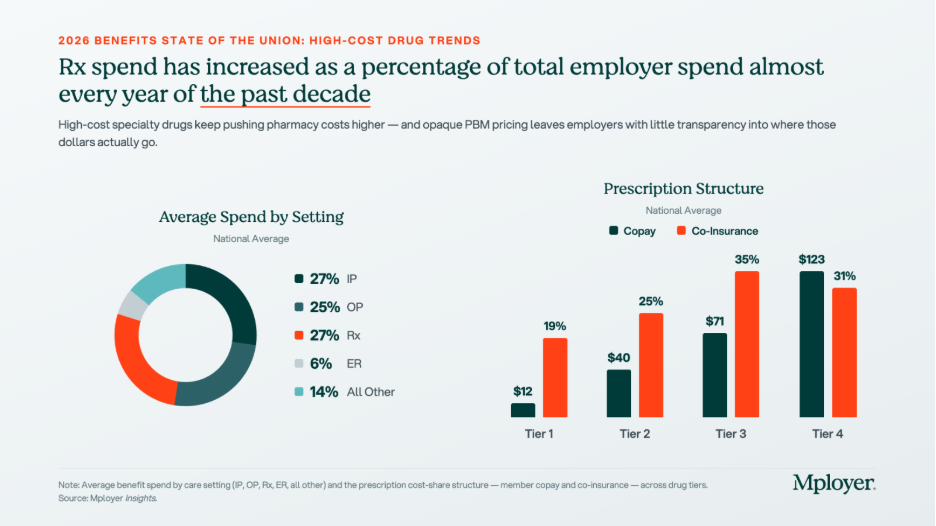
The tier structure in the chart above reflects how plans already account for the cost complexity of specialty drugs. Tier 4, which is where specialty biologics and injectables are typically placed, carries significantly higher cost-sharing than the other tiers: an average employee copay of $123 and coinsurance requirements in 31% of plans. But Tier 4 behaves very differently from the other tiers. On Tier 1, 2, and 3 drugs, cost-sharing is relatively predictable and manageable. On Tier 4, the combination of high drug cost and percentage-based coinsurance can generate out-of-pocket exposure that approaches or exceeds a patient’s annual out-of-pocket maximum in a single month of therapy. How Tier 4 is structured, what controls are in place, and how the plan manages cost is one of the most consequential design decisions an employer makes.

Understanding Your Benefit Plan’s Pharmacy Options

How Pharmacy Benefit Managers Work

Most employer health plans do not manage pharmacy benefits directly. That function is delegated to a Pharmacy Benefit Manager, or PBM, which acts as the intermediary between the health plan, the pharmacy, and the drug manufacturer. The PBM builds and maintains the formulary, negotiates drug prices and rebates with manufacturers, contracts with pharmacy networks, and processes pharmacy claims. The three dominant PBMs, Express Scripts (owned by Cigna), CVS Caremark (owned by CVS Health / Aetna), and OptumRx (owned by UnitedHealth Group), together manage the pharmacy benefits of approximately 80% of covered lives in the United States. Each is affiliated with a major carrier, meaning that employers who use an ASO medical arrangement often default to the carrier’s affiliated PBM without realizing it. Independent PBMs such as Capital Rx, Navitus, and MedOne Pharmacy Benefit Solutions operate on transparent, pass-through pricing models that return all rebates to the plan rather than retaining them as PBM revenue. PBMs are compensated through administrative fees, spread pricing (charging the plan more than the pharmacy receives and keeping the difference), manufacturer rebates in exchange for formulary placement, and specialty pharmacy margin. For any employer managing meaningful specialty drug spend, understanding which of these revenue sources applies to your contract is essential.

How Drug Tiers and Cost-Sharing Work

Every pharmacy benefit plan organizes covered drugs into tiers, with cost-sharing that increases as you move from Tier 1 generics (avg. $12 copay) through Tier 2 preferred brands ($40), Tier 3 non-preferred brands ($71), and into Tier 4 specialty drugs ($123 copay, with coinsurance in 31% of plans). The tier placement of a drug affects both what the employee pays and, indirectly, what the plan pays, since tier placement drives utilization patterns. Plan sponsors have real levers here: step therapy (requiring a patient to try a lower-cost drug first), prior authorization, specialty pharmacy channel mandates, and formulary exclusions all affect Tier 4 cost without eliminating clinical access. These controls require balancing cost management with the reality that for many specialty drugs, no lower-cost alternative achieves the same clinical outcome.

How Stop-Loss Insurance Interacts with High-Cost Drug Claims

For self-funded employers, specialty drug claims are now among the most common triggers for individual stop-loss reimbursement. A single employee on a cancer therapy or rare disease treatment can generate pharmacy claims that exceed the plan’s specific stop-loss deductible, which averages $141,938 nationally for self-insured plans, within a single plan year. The mechanics: the employer pays all claims up to the deductible threshold, and the stop-loss carrier reimburses costs above it. Several dynamics are specific to high-cost drugs. At renewal, stop-loss carriers may laser a known high-cost member by raising their individual deductible or excluding them from coverage. Some carriers now specifically carve out GLP-1 medications or other high-utilization drug categories from stop-loss reimbursement, so employers adding new drug coverage should verify what their contract covers. Specialty drugs can also be administered under either the pharmacy benefit or the medical benefit depending on whether they are self-administered or clinic-administered, and some stop-loss contracts apply different terms to each channel. Employers should model their actual specialty drug cost distribution against their stop-loss deductible at every renewal to understand where the plan’s real exposure sits.

The Costliest Specialty Drugs: What They Treat and What They Cost

The chart below shows the highest-cost specialty and biologic drugs by average cost per patient, ranked from most to least expensive. Cancer therapies dominate the top of the list, but treatments for autoimmune conditions, MS, and inflammatory disease also appear, reflecting how broadly specialty drug spending is distributed across a workforce.
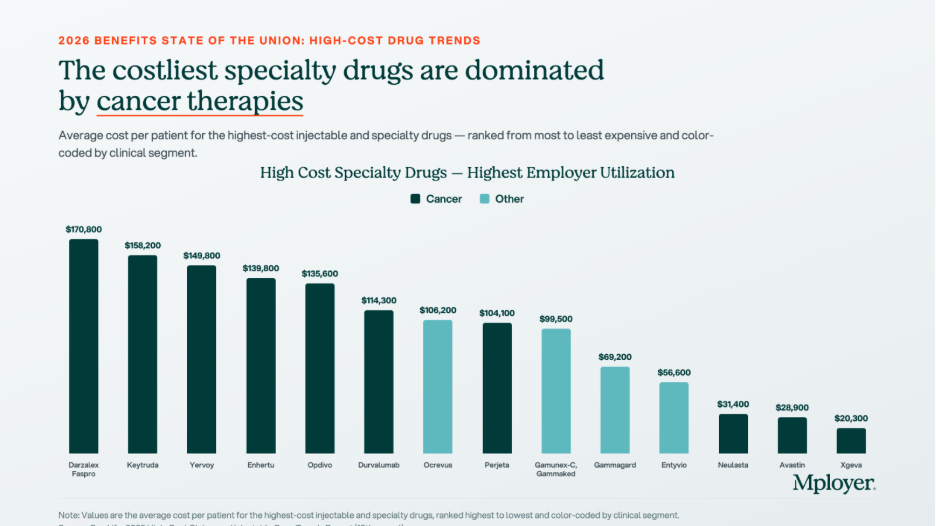
  • Darzalex Faspro (daratumumab/hyaluronidase) | $170,800 avg. annual cost per patient. Janssen (J&J). Multiple myeloma, a blood cancer. The highest-cost drug on the list by average patient cost. The subcutaneous formulation allows home administration, increasing the likelihood it flows through the pharmacy benefit rather than the medical benefit.
  • Keytruda (pembrolizumab) | $158,200 avg. annual cost per patient. Merck. FDA-approved across more than 40 cancer indications including lung, melanoma, head and neck, and bladder cancers. One of the most prescribed oncology drugs globally and one of the most common high-cost pharmacy claims in large employer plans.
  • Yervoy (ipilimumab) | $149,800 avg. annual cost per patient. Bristol-Myers Squibb. Melanoma and in combination with Opdivo for lung and other cancers. Combination Yervoy plus Opdivo therapy is among the highest per-patient drug cost regimens in common use.
  • Enhertu (trastuzumab deruxtecan) | $139,800 avg. annual cost per patient. AstraZeneca / Daiichi Sankyo. HER2-positive and HER2-low breast and gastric cancers. A significant recent clinical advance for patients with cancers that previously had limited options after first-line treatment.
  • Opdivo (nivolumab) | $135,600 avg. annual cost per patient. Bristol-Myers Squibb. Melanoma, lung, kidney, bladder, and other cancers. Frequently used in combination with Yervoy, compounding cost significantly when both are prescribed together.
  • Ocrevus (ocrelizumab) | $106,200 avg. annual cost per patient. Genentech. Relapsing and primary progressive multiple sclerosis. MS therapies are a persistent specialty drug cost driver because patients remain on therapy for years, making each diagnosed member a multi-year plan cost.
  • Entyvio (vedolizumab) | $56,600 avg. annual cost per patient. Takeda. Moderate-to-severe Crohn’s disease and ulcerative colitis. Inflammatory bowel disease therapies are among the most common specialty drug claims in employer plans because the conditions are prevalent in working-age adults.

Biosimilars: The Cost Opportunity Most Employers Are Not Fully Using

A biosimilar is a biologic drug that is highly similar to an already-approved reference biologic, with no clinically meaningful differences in safety, purity, or potency. Biosimilars are not generic drugs in the traditional sense, because biologic drugs are complex proteins manufactured from living cells and cannot be chemically replicated exactly. But they go through an FDA approval pathway that confirms their clinical equivalence to the reference product, and they cost significantly less. The biosimilar market has expanded rapidly as major biologic patents have expired. Humira, the world’s best-selling drug for much of the past decade, now has multiple biosimilar competitors in the U.S. Stelara has followed. The oncology biosimilar pipeline is maturing, with more approvals expected in the next two to three years.
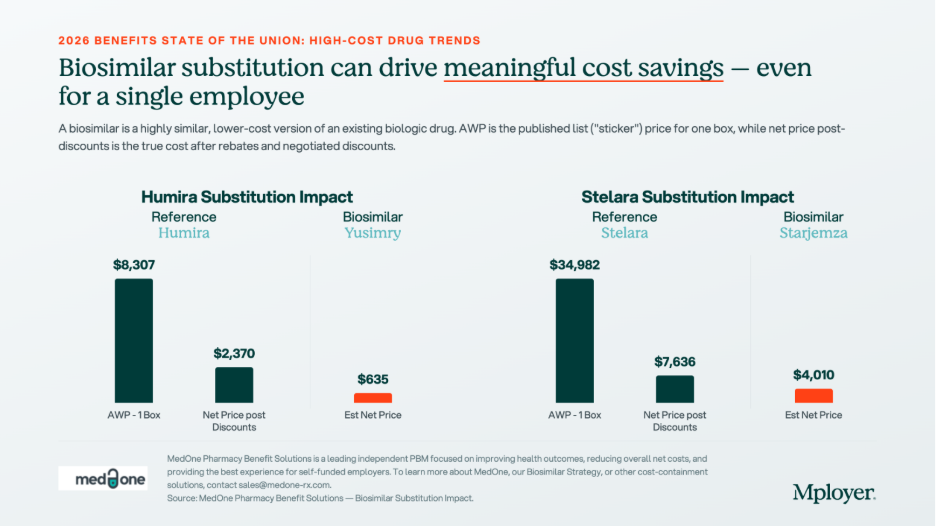
The chart above shows what biosimilar substitution looks like in dollar terms. For Humira, the net price after rebates and negotiated discounts is $2,370 per box. The biosimilar Yusimry has an estimated net price of $635, a 73% reduction. For Stelara, the reference drug net price is $7,636 per box. The biosimilar Starjemza has an estimated net price of $4,010, a 47% reduction. For an employee on monthly Humira therapy, the difference between the reference drug and the biosimilar is approximately $21,000 per year in net plan cost. For a Stelara patient, the annual difference is approximately $43,500. Across even a small number of members on these therapies, biosimilar substitution is one of the highest-return cost management interventions available.

Plan sponsors have four main tools to drive biosimilar adoption: preferred formulary placement (putting the biosimilar on a lower tier and the reference drug on a higher tier), step therapy for new patients, automatic substitution where state law permits, and formulary exclusion of the reference drug entirely. The most important variable in any biosimilar strategy is whether your PBM has a financial incentive to keep the reference drug preferred. A PBM earning a large rebate on Humira has a direct financial reason to keep Humira on the preferred formulary, even when the biosimilar costs the plan less on a net basis. Independent PBMs operating on pass-through pricing remove this conflict entirely, because all rebates return to the plan and formulary decisions are made without a competing financial interest.

What Employers Should Be Asking About Their Pharmacy Benefit

High-cost drug management requires active decisions about PBM contract structure, formulary design, specialty pharmacy strategy, and stop-loss alignment. The questions worth asking at every renewal:

  • Is your PBM contract pass-through or spread-based? A pass-through model means you pay exactly what the pharmacy receives and all rebates come back to the plan. A spread-based model means the PBM earns revenue that is not visible in the administrative fee. Request full compensation disclosure under the CAA requirements.
  • Are you receiving all available biosimilar savings? Ask your PBM for a net cost comparison of each reference drug plus rebate against the available biosimilar net price. The answer will tell you whether your formulary is designed around the plan’s cost interest or the PBM’s rebate interest.
  • What is your specialty drug channel strategy? Are specialty prescriptions being filled through your PBM’s affiliated specialty pharmacy? Carving specialty to an independent pharmacy or using a white-bagging program for clinic-administered drugs can generate meaningful cost differences.
  • How does your stop-loss deductible interact with your specialty drug exposure? Model your actual specialty drug claims against your stop-loss threshold. If most of your high-cost drug claims fall below the deductible, the plan is absorbing those costs without triggering reimbursement.
  • Does your formulary have appropriate Tier 4 controls? Step therapy, prior authorization, and quantity limits on specialty drugs reduce cost without eliminating clinical access. Without these controls, high-cost therapies can be approved and dispensed without any plan-level review of whether a lower-cost alternative exists.

Know How Your Pharmacy Benefit Compares

Pharmacy is now one of the two or three most consequential cost management decisions in health plan design. The employers managing it well are not restricting access to the medications their employees need. They are ensuring that the structure of the benefit, the PBM contract, the formulary design, and the stop-loss coverage work together in the plan’s interest, and that every dollar spent on high-cost drugs is spent as efficiently as possible.

Mployer’s benefits rating evaluates pharmacy benefit design as part of the Medical pillar score, benchmarked against a custom cohort matched by size, region, and industry. Knowing where your pharmacy benefit stands relative to employers who actually look like you is the starting point for making better decisions.

See how your benefits package compares to your custom cohort at MployerAdvisor.com.

Sources

Mployer Insights: Average Spend by Setting, Prescription Structure, and High-Cost Specialty Drugs. Source: Mployer Insights analysis.

MedOne Pharmacy Benefit Solutions: Biosimilar substitution impact data for Humira/Yusimry and Stelara/Starjemza. MedOne is a leading independent PBM focused on improving health outcomes and reducing net costs for self-funded employers. [email protected].

Mployer 2025 and 2026 Employee Benefit Plan Design Study, covering 50,000+ employer plans. Individual stop-loss avg $141,938 self-insured.

Consolidated Appropriations Act of 2021, Section 202: broker/consultant compensation disclosure requirements for group health plans.

FDA Biosimilar approval framework: 42 U.S.C. Section 262(k).

Employee Benefits
The Ultimate Guide to a Good Benefit Plan for Employees
To draw in and keep the best professionals, companies need an excellent benefits package. This should cover health insurance, retirement savings options, and allotted paid leave—key factors that can greatly boost employee satisfaction and efficacy at work. Other perks like wellness initiatives, monetary advantages, and adaptable working hours also contribute significantly to employees’ overall well-being as well as their ability to balance personal life with professional responsibilities.
Author:

The Ultimate Guide to a Good Benefit Plan for Employees

As an employee, your benefits package is one of the most important aspects of your overall compensation. Beyond just salary, your benefits have real monetary value that contributes significantly to your financial well-being. A good benefits plan not only supports your health and security but also helps you plan for the future. Whether it's health insurance, retirement savings, paid time off, or additional perks like wellness programs and flexible work hours, understanding the financial value of these offerings can greatly enhance your job satisfaction and loyalty to your employer.

Key Takeaways

  • A comprehensive benefits package can greatly enhance your job satisfaction and long-term success.
  • Core benefits like health insurance, retirement savings, and paid time off are essential for your well-being and financial security.
  • Perks such as wellness programs, financial assistance, and flexible work schedules can improve your overall quality of life.
  • Regularly reviewing and using your benefits helps you maximize their value as your needs change.
  • Regularly reviewing and understanding the financial worth of your benefits helps you maximize their value as your needs evolve.
  • Use the Mployer Advisor Employee Benefits Calculator to compare your benefits with industry standards and ensure you're getting the most from your package.

Understanding the Dollar Value of Employee Benefits

Your benefits aren’t just a bonus—they make up a significant portion of your total compensation. Many employees underestimate the financial value their benefits bring, but these offerings often account for a sizable portion of your overall earnings. For example, health insurance, retirement contributions, and paid leave all have measurable dollar amounts attached to them. Recognizing their worth can help you make more informed decisions about your job and long-term financial health.

A comprehensive benefits plan can also reduce your out-of-pocket expenses for medical care, save you money on taxes through retirement savings plans, and provide paid time off that allows you to take necessary breaks without losing income. By knowing the exact value of each benefit, you can better appreciate how much your employer is investing in your overall well-being.

There’s a noticeable difference between the actual value of employee benefits and what employees perceive. On average, companies invest $23,200 annually in individual benefits, but employees tend to perceive the value as only $11,200. This gap illustrates why it's crucial to fully understand the true worth of your benefits.

Key Components of a Strong Benefits Package

Diagram of key components of a comprehensive benefits package.

Understanding the dollar value of your benefits can give you a clearer sense of your true compensation. Often, benefits are viewed as just additional perks, but they can make up a significant portion of your overall earnings. In some cases, the value of your benefits can be worth tens of thousands of dollars annually, making it essential to not only understand what’s included but also how each benefit impacts your financial health and long-term well-being. Here’s a detailed breakdown of the key benefits you should expect from a robust package and how each of these contributes to your financial security:

Health Insurance Plans

Health insurance is a cornerstone of any benefits package, and its financial value should not be underestimated. In the U.S., where healthcare costs can be extraordinarily high, having employer-sponsored health insurance can save you thousands—if not tens of thousands—of dollars annually in medical expenses. For example, the average premium for an individual health plan is about $7,000 annually, and for a family plan, it can reach over $21,000. If your employer covers a portion of these premiums, that’s a significant cost you’re avoiding. Some employers even cover the full amount, which can add substantial value to your overall compensation.

Additionally, many plans offer dental and vision insurance, which, although sometimes viewed as minor, can help cover the costs of dental cleanings, orthodontics, glasses, and eye exams—costs that can add up quickly. Understanding the structure of your health insurance, including premiums, deductibles, copayments, and out-of-pocket maximums, can help you assess the full financial value of the health benefits your employer provides. For example, an employer covering a high-deductible health plan (HDHP) with contributions to a Health Savings Account (HSA) can provide you with both immediate healthcare savings and long-term tax advantages.

In total, the annual value of a good health insurance plan could easily exceed $10,000, and understanding how this fits into your overall compensation helps you make smarter decisions regarding your health and finances.

Retirement Savings Plans

Retirement savings plans, such as a 401(k) or 403(b), are another critical component of your benefits package, offering significant financial benefits both in the present and for your future. Many employers offer matching contributions, typically between 3% and 5% of your salary. If you’re earning $50,000 annually and your employer offers a 5% match, that’s an additional $2,500 going into your retirement account each year. Over time, with the power of compound interest, these contributions can grow exponentially, potentially adding hundreds of thousands of dollars to your retirement fund.

Beyond employer matching, many retirement plans come with tax advantages. Contributions are typically tax-deferred, meaning you don’t pay taxes on the money you contribute until you withdraw it in retirement, which can significantly lower your current taxable income. Some employers may also offer Roth 401(k) options, allowing you to pay taxes upfront and enjoy tax-free withdrawals in retirement. These benefits, when combined with employer contributions, can substantially improve your financial future.

Using tools like the Mployer Advisor Employee Benefits Calculator, you can calculate the full financial impact of these contributions and tax benefits on your long-term wealth. With smart planning, your employer’s retirement benefits could easily add tens of thousands of dollars to your overall compensation over the course of your career.

you’re ready to stop working.

Paid Time Off (PTO)

Paid Time Off (PTO) is often an overlooked aspect of a benefits package, but it holds both intrinsic and financial value. PTO allows you to take time off without sacrificing your income, providing crucial rest and recovery time that supports your mental and physical health. PTO policies vary widely across employers, but let’s consider a typical scenario: if you earn $60,000 annually and receive 15 days of PTO, that’s the equivalent of being paid $3,460 for time you’re not working. For many employees, this can make a huge difference in their ability to balance work and personal life.

Some employers are even moving towards unlimited PTO policies, giving employees the flexibility to take time off as needed, which can lead to increased job satisfaction and improved productivity. Understanding the financial value of your PTO, whether it’s a set number of days or an unlimited policy, helps you better appreciate the compensation you receive beyond your regular paycheck.

Additional Employee Benefits to Consider

Illustration showcasing additional employee benefits.

In today’s competitive job market, employers are increasingly recognizing the value of offering a robust and diverse benefits package that goes beyond the basics of health insurance and retirement savings. Additional employee benefits, such as wellness programs, financial perks, flexible working hours, and other unique incentives, can significantly enhance the overall value of your compensation. These extras not only address various aspects of your well-being—physical, mental, and financial—but also help create a more supportive and productive work environment.

For employees, these added benefits can make a huge difference in day-to-day life, contributing to greater job satisfaction, reducing stress, and fostering a healthier work-life balance. Employers offering such perks are often more attractive to top talent, and these benefits can lead to higher retention rates as employees feel more supported in both their professional and personal lives. From wellness programs that promote a healthy lifestyle to financial benefits that alleviate concerns about long-term security, these additional offerings are becoming an essential part of modern benefits packages. Here's a closer look at how these extra perks can positively impact your work experience and why they’re worth taking full advantage of.

Wellness Programs

Wellness programs have gained significant popularity in recent years as employers recognize the importance of both physical and mental health. Many companies now offer free or subsidized access to fitness centers, which could save you hundreds or even thousands of dollars annually, depending on membership costs. Other wellness perks include access to mental health resources, such as therapy sessions or meditation apps, which may be otherwise expensive or difficult to access.

Wellness programs also extend to on-site health screenings, flu shots, and ergonomic assessments, helping you avoid out-of-pocket healthcare costs. Additionally, these programs can contribute to better long-term health, potentially reducing the need for more costly medical treatments down the line. In the long run, participating in wellness initiatives could not only save you money but also improve your quality of life and productivity at work.

Financial Benefits

Many employers offer financial assistance programs, such as student loan repayment, tuition reimbursement, or down payment assistance for homebuyers. These benefits provide immediate financial relief and help you achieve major life goals without taking on additional debt. For instance, if your employer reimburses $5,000 in tuition costs each year, you’re effectively adding that amount to your annual compensation without the burden of educational loans.

Some companies also offer financial wellness programs, providing tools like budgeting apps and access to financial advisors who can help you manage debt, plan for retirement, or save for major purchases. These resources, while not direct cash benefits, have measurable value in improving your long-term financial security.

Flexible Work Schedules

Flexible work schedules are increasingly seen as a highly desirable benefit, especially in today’s evolving work environment. Remote work options or flexible hours can lead to substantial savings on commuting costs, child care, and even meals. For example, if you work from home three days a week and save $50 per week on gas and parking, that’s a $2,600 annual savings. Additionally, the flexibility to structure your workday around your most productive hours can improve work performance and job satisfaction.

Flexible work schedules also contribute to work-life balance, reducing stress and burnout, which can lead to higher productivity and a more fulfilling work experience. While the financial savings might not be as immediately apparent, the long-term value of this benefit can be substantial in terms of mental health and job satisfaction.

How to Maximize the Financial Value of Your Benefits

Illustration of best practices for implementing a benefit plan.

Your benefits package holds significant financial value, but it’s up to you to take full advantage of it. One of the first steps in maximizing your benefits is to calculate their total worth. Using the Mployer Advisor Employee Benefits Calculator, you can input your benefits and compare them against industry standards, giving you a clearer understanding of how much your employer is investing in your compensation.

It’s also important to regularly review and adjust your benefits as your personal and financial circumstances change. If you’re nearing retirement, for example, increasing your 401(k) contributions will allow you to maximize your employer’s matching contributions, effectively adding more money to your retirement savings. If you experience a significant life change, such as getting married or having a child, review your health insurance coverage to ensure it still meets your needs without overpaying for unnecessary coverage.

Additionally, fully leveraging PTO, wellness programs, and financial perks can significantly enhance the value you derive from your benefits. By being proactive, staying informed, and using tools like the Mployer Advisor Employee Benefits Calculator, you can ensure that your benefits are working for you in the best possible way.

Measuring the Success of Your Benefit Plan

To ensure your benefits plan is working for you, it’s important to regularly evaluate its effectiveness. One of the best ways to do this is by understanding how often you and your colleagues are using the various benefits offered. Are health insurance plans being utilized? Are employees taking full advantage of PTO and wellness programs? Tracking this information helps employers make necessary adjustments, ensuring the benefits offered continue to meet employee needs.

At Mployer Advisor, we make this process easier with our Employee Benefits Calculator. This tool allows you to input your current benefits and compare them against industry benchmarks, helping you evaluate if your package is competitive and truly supports your well-being. It’s a simple way to see if your employer's offerings match up with what’s available in the market and can help you identify areas for improvement in your benefits.

In addition to usage, companies often assess how benefits impact employee retention and job satisfaction. A strong, comprehensive benefits package typically results in lower turnover and happier employees. If your employer’s benefits are lacking, it may lead to dissatisfaction and higher turnover rates. With Mployer Advisor’s insights, you can gain valuable data on how your benefits package compares and provide feedback that could lead to enhancements in your workplace offerings.

Another critical measure is how benefits programs influence overall workplace engagement and employee health. For instance, wellness programs can improve your work-life balance and reduce sick days. The result is a healthier, more engaged workforce—and a more positive work environment for everyone. Mployer Advisor helps you see these connections clearly, so you can ensure your benefits are truly working for you.

Summary

A strong benefits package goes far beyond just being a part of your job—it’s an essential investment in your health, your future, and your overall well-being. Whether it's comprehensive health insurance, retirement savings plans, or wellness programs, the benefits you receive from your employer are designed to support you in all aspects of your life, both inside and outside of work. It’s not just about financial perks or insurance coverage; it's about creating a foundation for long-term personal and professional success.

Taking the time to fully understand your benefits package is crucial. Every option available to you—whether it's health insurance, paid time off, or financial support programs—has the potential to impact your quality of life. These benefits are more than just add-ons; they can reduce stress, improve your work-life balance, and help you plan for major life events like retirement, family growth, or health challenges. By familiarizing yourself with the details of your benefits and how they work, you’re ensuring that you’re making informed decisions about your health, your financial security, and your personal growth.

Furthermore, by taking full advantage of these offerings, you’re not just receiving compensation—you’re investing in yourself and your future. Whether it’s contributing to a retirement fund that will provide security in your later years, using wellness programs to maintain your mental and physical health, or leveraging flexible work schedules to create a better work-life balance, these benefits provide real, tangible value that goes well beyond your paycheck.

The benefits you receive today can have a lasting impact on your tomorrow. So, take the time to engage with them fully, ask questions when you need clarity, and regularly reassess how your benefits align with your current needs and future goals. In doing so, you are not only maximizing the value of your compensation package but also taking control of your well-being and setting yourself up for long-term success, both personally and professionally. Remember, investing in your employee benefits is, ultimately, an investment in yourself—an investment that can pay dividends for years to come.

Frequently Asked Questions

Why are employee benefits important for you?

Employee benefits play a significant role in boosting your overall job satisfaction and productivity. They go beyond just salary to support your well-being and contribute to a positive work environment. A strong benefits package helps attract and retain skilled employees like you, ensuring that you feel valued and supported in both your professional and personal life.

What are the key components of a comprehensive benefits package?

A complete benefits package typically includes health insurance, retirement savings options, and paid time off. These core components are essential for helping you maintain a balance between your work responsibilities and personal life. Health coverage supports your physical well-being, retirement plans ensure long-term financial security, and PTO gives you the flexibility to take care of yourself and your loved ones.

How can you assess the success of your benefits plan?

It’s important to understand how well your benefits are working for you. Regularly reviewing your benefits usage, comparing it to your needs, and staying informed about what’s available can help you maximize their value. Companies often measure the success of their benefits plan by tracking how often employees use them and how they impact job satisfaction and retention. As an employee, providing feedback on what works and what doesn’t can help ensure your employer tailors the benefits to better meet your needs.

What additional benefits could enhance your experience?

Beyond the standard offerings, additional perks like wellness programs, financial assistance, flexible work schedules, pet insurance, and commuter benefits can significantly improve your experience. These extra benefits are designed to support different aspects of your life, contributing to greater satisfaction, work-life balance, and engagement at work. If your employer offers unique perks, take advantage of them to get the most out of your benefits package.

What are some best practices for implementing a benefit What are the best practices for making the most of your benefits?

To get the most from your benefits, it’s essential to understand your options and how they apply to your personal needs. Regularly check your benefits package, ask questions when unclear, and take advantage of resources like your HR department or benefits portal to stay informed. Providing feedback on your benefits also helps your employer tailor their offerings to better support you and your colleagues. By engaging with your benefits, you’re ensuring they work for you in the best way possible.

Employee Benefits
Mployer Announces 2024 Winners of Fourth Annual ‘Top Employee Benefits Consultant Awards’ in Tampa, St. Pete, and Sarasota
Nashville, Tenn.– August 20, 2024 – Mployer, the industry-leader in providing employee benefits research, ratings, and reviews, has named over 750 brokerage office winners nationally in more than 50 regions as part of its fourth annual “Top Employee Benefits Consultant Awards” for 2024.
Author:

Nashville, Tenn.– August 20, 2024 – Mployer, the industry-leader in providing employee benefits research, ratings, and reviews, has named over 750 brokerage office winners nationally in more than 50 regions as part of its fourth annual “Top Employee Benefits Consultant Awards” for 2024.  

Mployer’s Top Employee Benefits Consultant Award Program evaluates each benefits broker and consultant office based on their depth of experience across employer industries, sizes, and plan design features, as well as employer client ratings and reviews.  

“We are proud to recognize this distinct group of 2024 top-rated insurance advisors as part of our fourth annual Top Employee Benefits Consultant Awards,” said Brian Freeman, CEO of Mployer. “Employer-sponsored healthcare and benefits provide care for over 160M Americans. Who an employer selects as their benefits advisor and their plan design has more impact on employee cost and satisfaction than who an employer chooses as the insurance carrier. We have rated each broker using our proprietary M Score and applaud the winners’ demonstrated commitment to service, quality, and positive employer experience.”

In Tampa, St. Pete, and Sarasota, Mployer has named over 25 benefit brokerages as top brokerages with several of the highest-scoring winners in the market listed below. The Tampa-St. Petersburg-Clearwater job markets are among the most competitive in the U.S. Southeast region, employing more than 1.6 million people. Offering competitive employee benefits is a critical factor in hiring top talent for the region’s employers. Finding and partnering with a highly-rated insurance consultant is imperative to attracting and retaining talent in any market.    

Several of the “Top Employee Benefits Consultant Awards” for Tampa, St. Pete, and Sarasota include:  

To see the full list of Top Employee Benefit Consultant Award winners for Tampa, St. Pete, and Sarasota, visit Mployer. The above winners are a snapshot of Mployer's matrices and proprietary M Score as of July 2024.

About Mployer:  

Mployer is transforming employee benefits by empowering employers and leading benefit consultants to easily assess, rate, and communicate the value of employee benefits. Providing industry-first transparency through unbiased research, benchmarking, and advanced analytics, our goal is to support employers and brokers in providing benefit plans that optimize costs and employee-employer relationships. To learn more about Mployer, visit https://mployeradvisor.com and follow us on LinkedIn.  

Disclaimer: Rankings are dynamic, and this report may not reflect the rankings currently listed on Mployer’s website. Because Mployer’s research is ongoing, interested companies that want to join next year’s list are encouraged to claim their free profile on Mployer.

Media Contact:  

Anthony Waters

[email protected]

Employee Benefits
Evaluating Good Benefits: A Guide for Employers
Understanding what constitutes good benefits is crucial for employee satisfaction and well-being. In this guide, we’ll cut to the chase, helping you assess your current benefits package or those provided in a job offer. We cover the why, the what, and the how—from vital health insurance details to work-life perks—equipping you with the knowledge to evaluate or negotiate your benefits effectively. Whether you’re considering a new job or reviewing your current offerings, it’s essential to understand how your benefits compare.
Author:

Evaluating Good Benefits: A Guide for Employers

Introduction

Understanding what constitutes good benefits is crucial for employee satisfaction and well-being. In this guide, we help you assess your current benefits package or those provided in a job offer. We cover the why, the what, and the how—from vital health insurance details to work-life perks—equipping you with the knowledge to evaluate or negotiate your benefits effectively. Whether you’re considering a new job or reviewing your current offerings, it’s essential to understand how your benefits compare.

Stay informed about important news related to federal benefits, deadlines, and health insurance updates to ensure you don't miss out on crucial information.

Key Takeaways

Employee benefits are essential for job satisfaction, loyalty, and retention, and can affect overall well-being. Therefore, evaluating comprehensive benefits alongside salary is crucial. Understanding if you are eligible for receiving these benefits is also important.

A complete benefits package typically includes five key components:

  1. Health insurance
  2. Ancillary benefits like dental, vision, life, and disability
  3. Retirement savings plans
  4. Leave or paid time off (PTO)
  5. Other perks that support work-life balance

The average employee benefits package is worth $15K for singles and $25K for families. It represents a large percentage of compensation and varies greatly by employer.

To properly value your current benefits package or a new job offer, compare it with industry standards, calculate its monetary value, and assess how well it meets your personal needs. Mployer provides online, easy-to-use tools for employees and employers to do just that, as well as information to help you better understand how it all works together.

Why Having Great Benefits is Important

Employee benefits are more than just perks; they’re a critical part of the employment relationship, ensuring job satisfaction and fostering loyalty and retention. Employers also support job seekers through specialized services and programs tailored to various demographics. Benefits account for over 20% of an employee’s total compensation. That’s a significant chunk! So, when weighing a job offer or thinking about your current job, it’s crucial to consider not just the paycheck but also the following benefits and perks that come with it. Considering these factors will give you a more comprehensive understanding of your total compensation package.

The Five Key Components of a Good Benefits Package

Before we delve into the evaluation, let’s first understand the key components of a great benefits package. These components include:

  1. Health Insurance
  2. Ancillary Benefits
  3. Paid Time Off (PTO)
  4. Retirement Benefits
  5. Work-Life Balance Perks

Comprehensive coverage for medical care is crucial in a benefits package, ensuring that employees have access to necessary healthcare services and compliance with regulations.

Remember, the value of these benefits is dependent on your personal life and career stage, making a big difference in how you perceive them and the pay you receive.

1. Health Insurance

Health insurance is a cornerstone of any benefits package. Employers must evaluate their contribution towards health insurance carefully. Individual coverage contributions typically range from 70% to 90%, while family coverage contributions range from 55% to 85%.

Large employers often have the advantage of negotiating better rates with insurance providers due to their higher volume of employees. This can result in more comprehensive health insurance plans for employees. When evaluating health insurance options, consider the following:

  • Plan Design: Examine deductibles, maximum out-of-pocket expenses, copays, and coinsurance. A well-designed plan should minimize out-of-pocket costs for employees. Health care costs can significantly impact employees’ financial well-being, making the design of health insurance plans a crucial aspect.
    • Prescription Drugs: Ensure the plan includes coverage for prescription drugs. This coverage allows employees to obtain medications prescribed by doctors from pharmacies, with insurance typically covering a portion of the costs. Including prescription drug coverage can enhance the overall value of the health insurance plan by helping employees manage their healthcare expenses more effectively.
  • Employer Contribution: The higher the employer’s contribution, the more attractive the health insurance plan will be to employees. Strive to offer a high contribution percentage to enhance job satisfaction. Employer contributions to health insurance can make a big difference in the overall value of the benefits package.
  • Network Coverage: Ensure the health insurance plan includes a broad network of healthcare providers. Employees value access to a wide range of doctors and specialists. A comprehensive network can significantly improve the perceived value of health insurance.
  • Tax-Advantaged Options: Offer Health Savings Accounts (HSAs) or Health Reimbursement Accounts (HRAs). These accounts provide significant tax benefits and can cover out-of-pocket healthcare costs. HSAs are particularly beneficial for employees with high-deductible health plans, offering a financial cushion for medical expenses.

2. Ancillary Benefits

Ancillary benefits, including dental, vision, disability, and life insurance, are essential additions to any benefits package. These benefits may seem like minor perks, but they can add significant value for employees. For example, dental and vision insurance can cover routine care and major procedures, while disability and life insurance provide financial security in case of unexpected events.

  • Dental and Vision Plans: Evaluate employer contributions and the coverage provided. Dental insurance is almost a commodity, with most plans offering similar benefits. Vision insurance, while not as common, is highly valued by employees who require corrective lenses. Ancillary benefits like dental and vision insurance are critical components of a comprehensive benefits package. Comprehensive medical care coverage, including dental and vision insurance, is essential for addressing various healthcare needs and ensuring compliance with regulations.
  • Disability and Life Insurance: Ensure adequate coverage, especially for high-risk job roles. Short-term and long-term disability insurance are critical for employees in physically demanding jobs. Life insurance offers peace of mind and financial security for employees’ families. Offering comprehensive ancillary benefits can make your benefits package stand out in the job market.

3. Paid Time Off (PTO) and Paid Holidays

Paid time off (PTO) and paid holidays are crucial for maintaining a healthy work-life balance. Employers should offer competitive PTO policies, considering both industry standards and employee needs.

  • Consolidated vs. Non-Consolidated Leave: Understand the impact on employee well-being. Consolidated leave packages, which combine vacation and sick leave, provide flexibility and can contribute significantly to employee satisfaction. PTO policies should be designed to support employees' need for rest and recuperation.
  • Average PTO: Offer competitive PTO policies. The average number of PTO days offered for one year of service is 14 days for consolidated leave and 9 days for non-consolidated leave. After five years, these numbers typically increase to 18 days and 13 days, respectively. Paid holidays should also be generous to enhance job satisfaction.
  • Paid Holidays: Offer a generous number of paid holidays to enhance job satisfaction. The number of paid holidays can vary greatly from one company to the next. Aim to provide a competitive number of paid holidays to attract and retain employees. Paid holidays contribute to a positive work-life balance, which is crucial for employee retention.

4. Retirement Savings Plans

Retirement savings plans, such as 401(k)s, are essential components of a good benefits package. Employers should offer competitive match rates and plan features, such as auto-enrollment and auto-escalation. These features encourage employees to save for the future and ensure that they are financially prepared for retirement.

  • Match Rates: Offer competitive employer contributions, ranging from 0% to 8%+. The higher the match rate, the more attractive the retirement plan will be to employees. For example, a 6% match is significantly more beneficial than a 1% match, making a big difference in employees' long-term savings. Employer contributions to retirement plans can significantly impact employees' financial security in the future.
  • Plan Features: Include auto-enrollment, auto-escalation, and low-interest loans against 401(k)s. These features can enhance employee participation and savings rates. Auto-enrollment ensures that new employees start saving immediately, while auto-escalation gradually increases their contribution rates over time. Retirement savings plans should be designed to support employees' long-term financial goals.

5. Work-Life Balance Perks

Work-life balance perks, such as flexible schedules and employee assistance programs, play a crucial role in supporting employee well-being. These perks help employees manage their work and personal responsibilities, leading to higher job satisfaction and productivity.

  • Flexible Schedules: Allow employees to adapt their work hours to better fit personal responsibilities. This flexibility is highly valued, especially by employees with families or other significant commitments. Flexible schedules can significantly improve employees' work-life balance.
  • Employee Assistance Programs: Provide support for employees’ personal needs. These programs can include counseling services, financial planning assistance, and wellness programs. Employee assistance programs can help employees manage stress and improve overall well-being.
  • Childcare Assistance: Help employees manage their work and family responsibilities. Offering on-site childcare or childcare subsidies can significantly enhance job satisfaction for employees with young children. Work-life balance perks are essential for creating a supportive and productive work environment.

Evaluating Your Benefits Package

Employers should regularly evaluate their benefits packages to ensure they meet industry standards and employee needs. Using tools like Mployer’s benefits calculator can help employers assess the monetary value of their benefits and compare them with industry peers. By understanding the full value of their benefits, employers can make informed decisions and negotiate better offerings for their employees.

  • Comparison with Industry Standards: Use industry-specific cohort reports to compare your benefits with those offered by other companies in your sector. This comparison helps you understand where your package stands relative to your peers. Evaluating your benefits package against industry standards is crucial for maintaining competitiveness. Additionally, understanding eligibility for various benefits is important when comparing packages.
  • Monetary Value Calculation: Calculate the total value of your benefits package, including employer costs for health insurance, ancillary benefits, retirement plans, and PTO. This calculation helps you understand the true cost and value of your offerings. Understanding the monetary value of your benefits package is essential for effective evaluation and negotiation.
  • Employee Feedback: Regularly gather feedback from employees about their satisfaction with the current benefits package. Use this feedback to make necessary adjustments and improvements. Employee feedback is a valuable tool for evaluating the effectiveness of your benefits package.

Conclusion

Providing a comprehensive and competitive benefits package is crucial for attracting and retaining top talent. Regularly evaluating and adjusting your offerings to meet employee needs and industry standards can make a significant difference in employee satisfaction and retention. By ensuring your benefits package is robust, you can create a positive work environment that supports employee well-being and productivity.

Stay informed about important news related to federal benefits, deadlines, and health insurance updates to ensure you are always up-to-date with crucial information.

Why Health Insurance is a Cornerstone of Employee Benefits

Health insurance is often the most valued part of any benefits package. Not only does it provide essential health care coverage, but it also significantly impacts overall job satisfaction. When evaluating health insurance options, consider the coverage network, plan details, and employer contributions. Large employers often provide more comprehensive health insurance plans due to their larger budgets and ability to negotiate better rates with insurance providers. Health insurance is a critical component of employee benefits that requires careful evaluation and planning.

The Role of Health Savings Accounts (HSAs)

In addition to health insurance, offering Health Savings Accounts (HSAs) can be a significant perk. HSAs allow employees to save money tax-free for medical expenses. These accounts can cover out-of-pocket costs, making health care more affordable. HSAs are particularly beneficial for employees with high-deductible health plans, providing a financial cushion for medical expenses. Including HSAs in your benefits package can enhance its overall value and appeal.

Paid Time Off and Holidays: Essential for Work-Life Balance

Paid time off (PTO) and paid holidays are crucial for maintaining a healthy work-life balance. Employers should offer competitive PTO policies, considering both industry standards and employee needs. Consolidated leave packages, which combine vacation and sick leave, are becoming increasingly popular. These packages provide flexibility and can contribute significantly to employee satisfaction. Paid time off and holidays are essential for promoting employee well-being and productivity.

Retirement Savings Plans: Investing in the Future

Retirement savings plans, such as 401(k)s, are essential components of a good benefits package. Employers should offer competitive match rates and plan features, such as auto-enrollment and auto-escalation. These features encourage employees to save for the future and ensure that they are financially prepared for retirement. Evaluating the match

Frequently Asked Questions

What are the key components of a good benefits package? A good benefits package should include health insurance, ancillary benefits, retirement plans, paid time off, and other perks like flexible schedules and childcare assistance. These components can help employees feel supported and valued in the workplace.

How do I evaluate the quality of health insurance? To evaluate the quality of health insurance, consider factors such as premiums, deductibles, copays, coinsurance, network coverage, tax strategy approach, and the employer's contribution. These factors play a key role in determining the overall quality of the insurance plan.

How can I calculate the monetary value of my benefits package? The easy way is to use Mployer's free calculator. The complicated way to calculate the monetary value of your benefits package is to sum the annual employer costs for each benefit. You can also divide that total value by your annual salary to express benefits as a percentage of your salary. This will give you a clear understanding of the value of your benefits package.

How can I negotiate better benefits? To negotiate better benefits, start with your job offer. Research, prepare, prioritize your needs, and effectively communicate your value to the employer. Approach the negotiations with confidence and respect for a successful outcome.

What online tools can I use to evaluate benefits? Mployer provides a simple calculator to grade and value your benefits. Other sites provide summary information if you want to do research, such as Glassdoor, PayScale, or Indeed. Mployer is the only platform available to compare benefits packages, which include calculators and rating systems to make an informed decision.

Employee Benefits
Mployer Announces 2024 Winners of Fourth Annual ‘Top Employee Benefits Consultant Awards’ in Chicago, Illinois
Nashville, Tenn.– August 6, 2024 – Mployer, the industry-leader in providing employee benefits research, ratings, and reviews, has named over 750 brokerage office winners nationally in more than 50 regions as part of its fourth annual “Top Employee Benefits Consultant Awards” for 2024.
Author:

Nashville, Tenn.– August 6, 2024 – Mployer, the industry-leader in providing employee benefits research, ratings, and reviews, has named over 750 brokerage office winners nationally in more than 50 regions as part of its fourth annual “Top Employee Benefits Consultant Awards” for 2024.  

Mployer’s Top Employee Benefits Consultant Award Program evaluates each benefits broker and consultant office based on their depth of experience across employer industries, sizes, and plan design features, as well as employer client ratings and reviews.  

“We are proud to recognize this distinct group of 2024 top-rated insurance advisors as part of our fourth annual Top Employee Benefits Consultant Awards,” said Brian Freeman, CEO of Mployer. “Employer-sponsored healthcare and benefits provide care for over 160M Americans. Who an employer selects as their benefits advisor and their plan design has more impact on employee cost and satisfaction than who an employer chooses as the insurance carrier. We have rated each broker using our proprietary M Score and applaud the winners’ demonstrated commitment to service, quality, and positive employer experience.”

In Chicago, Illinois, Mployer has named over 50 benefit brokerages as top brokerages with several of the highest-scoring winners in the market listed below. The Chicago-Naperville-Elgin, IL-IN-WI job markets are among the most competitive in the U.S. Midwest region, employing more than 4.8 million people. Offering competitive employee benefits is a critical factor in hiring top talent for the region’s employers. Finding and partnering with a highly-rated insurance consultant is imperative to attracting and retaining talent in any market.    

Several of the “Top Employee Benefits Consultant Awards” for Chicago, Illinois include:  


To see the full list of Top Employee Benefit Consultant Award winners for Chicago, Illinois, visit Mployer. The above winners are a snapshot of Mployer's matrices and proprietary M Score as of July 2024.

About Mployer:  

Mployer is transforming employee benefits by empowering employers and leading benefit consultants to easily assess, rate, and communicate the value of employee benefits. Providing industry-first transparency through unbiased research, benchmarking, and advanced analytics, our goal is to support employers and brokers in providing benefit plans that optimize costs and employee-employer relationships. To learn more about Mployer, visit https://mployeradvisor.com and follow us on LinkedIn.  

Disclaimer: Rankings are dynamic, and this report may not reflect the rankings currently listed on Mployer’s website. Because Mployer’s research is ongoing, interested companies that want to join next year’s list are encouraged to claim their free profile on Mployer.

Media Contact:  

Anthony Waters

[email protected]

Employee Benefits
Are your employee benefits good? The Definitive Guide & Calculator
The average employee benefits package is worth $15K if you are single, and $25K if you are covering a family. It represents a large percentage of your compensation and ranges greatly by employer. To properly value your current benefits package or for a new job, compare it with industry standards, calculate its monetary value, and assess how well it meets your personal needs. Mployer provides online, easy-to-use tools for employees and employers to do just that as well as information to help you better understand how it all works together.
Author:

Are your employee benefits good? The Definitive Guide & Calculator

Understanding what constitutes good benefits is crucial for job satisfaction and well-being. In this guide, we’ll cut to the chase, helping you assess your current benefits package or those provided in a job offer. We cover the why, the what, and the how—from vital health insurance details to work-life perks—equipping you with the knowledge to evaluate or negotiate your benefits effectively. Before you take a new job, understand how your benefits compare.

Key Takeaways

Employee benefits are essential for job satisfaction, loyalty, and retention, and can affect overall well-being, making it important to evaluate the comprehensive benefits along with salary.

A complete benefits package typically includes five things:

  • Health insurance
  • Ancillary benefits like dental, vision, life, and disability
  • Retirement savings plans
  • Leave or paid time off (PTO)
  • Other perks that support work-life balance

The average employee benefits package is worth $15K if you are single, and $25K if you are covering a family. It represents a large percentage of your compensation and ranges greatly by employer.

To properly value your current benefits package or for a new job, compare it with industry standards, calculate its monetary value, and assess how well it meets your personal needs. Mployer provides online, easy-to-use tools for employees and employers to do just that as well as information to help you better understand how it all works together.

Why having great benefits is important

Employee benefits are more than just perks; they’re a critical part of the employment relationship, ensuring job satisfaction and fostering loyalty and retention. Benefits account for over 20% of an employee’s total compensation. That’s a significant chunk! So, when weighing a job offer or thinking about your current job, it’s crucial to consider not just the paycheck but also the following benefits and perks that come with it.

Considering these factors will give you a more comprehensive understanding of your total compensation package.

The Five Key Components of a Good Benefits Package

Before we delve into the evaluation, let’s first understand the key components of a great benefits package. These components include:

  • Health insurance
  • Ancillary benefits
  • Paid time off (leave benefits)
  • Retirement benefits
  • Work-life balance perks

But remember, the value of these benefits is dependent on your personal life and career stage, making a big difference in how you perceive them and the pay you receive.

1. Health Insurance

The average dollar value health insurance paid by an employer for an individual is $9,000 if you are single, $15,000 for a family. See below to understand how to value your employer's offering.

There are three main components to evaluate when you are looking at the medical insurance an employer offers:

  1. Employer's percent contribution towards health insurance - The percent varies widely, depending on factors such as company policy, budget constraints, and competitive practices.
    • For individual coverage, the contribution percentage typically ranges from 70% on the lower end to as high as 90% in more comprehensive benefit packages.
    • However, for family coverage, the contribution percentage tends to be lower, ranging from 55% to 85%. This discrepancy often arises from the primary focus on covering the employee rather than their dependents.
    • Large employers tend to provide a high coverage percentage of medical compared to smaller employers.
  2. Plan design - This covers items like your deductible, maximum out of pocket, copays and coinsurance. Generally, it is the lower the better for these items. Your employer decides what type of plan design to provide here.
  3. Tax strategy and options - Depending on your life cycle phase, a high deductible health plan with a savings option may be best for you, which include a health savings account (HSA) or a health reimbursement account (HRA). These plans are a smart way to reduce an employee's monthly premium and give a vehicle to give an employee money towards their healthcare in a tax advantaged account.

2. Ancillary benefits like dental & vision

The average value for an individual of ancillary benefits is $1,500 but can vary significantly. See below to understand how to value your employer's offering.

Ancillary benefits do not cost an employer a lot of money but they can add up, especially to the specific employee and depending on the job role. Do you wear contacts or glasses? Then you, along with almost 75% of Americans, get it. Are you in commercial construction? Short-term disability and life insurance are two items that your company should provide given the nature of the work.

To unpack the ancillary benefits, there are several core ones to evaluate -

  1. Dental - 90% of employers offer dental insurance. Dental benefits are almost like commodities these days, the plans don't vary too much. Ask your employer what percent they contribute or the dollar amount monthly to get an idea. If you have children and it's braces time, ask that question. That is a meaningful amount.
  2. Vision - Similar to dental, 80% of employers offer a vision plan and the designs are almost a commodity. Again, ask your employer what percent they contribute or the dollar amount monthly to get an idea. It is not a lot each month, but it adds up.
  3. Disability - Coming in two forms, both short-term, offered by about 40% of employers, and long-term, offered by about 35%. Most large companies offer some form, smaller companies it depends. Short-term disability is the primary insurance type used for birth giving parents. If your employer industry or job function has a high percent of females in child-bearing years, short-term disability is important.
  4. Life - About 60% of employers offer life insurance. It is nice to have for piece of mind and security for your family. Life insurance is something most people need to maintain individually. It is priced based on the individual at the time. People in the workforce now will likely work with five to six companies over their life cycle and the amount, cost, and employer contribution will change drastically by employer. In short, do not depend on employer-sponsored life insurance to meet your family's needs. Ask if it is offered, and the employer's contributions.

3. Leave & Paid Time Off  (Leave Benefits)(PTO)

The average value for an individual of ancillary benefits is $5,000 as an example but can vary significantly based on your income. See below to understand how to value your employer's offering.

We all need a break from work, right? That’s where paid time off (PTO) policies and paid holidays come in. Generous PTO policies contribute significantly to the mental health of employees, but it also has a hard dollar value. It’s not just about taking a vacation; it’s about achieving a healthy work-life balance, which is a critical aspect of overall job satisfaction.

  1. Type of PTO - Do you have a "consolidated" leave package, non-consolidated or do you have unlimited PTO? Consolidated leave means that the employer combines your sick leave and PTO into one group of days, unlimited means you have no set cap (or carryover) on your benefits.  into two separate buckets of days
    • Positives - you get more days, it incentivizes you to stay healthy and it is easier to administer
    • Negatives - if you get sick a lot, this could hamper your total PTO days
    • The average number of days offered for one year of service for those on Consolidated Leave is 14 days, 18 days after five years. For non-consolidated, it is 9 days of PTO after one year and 13 days after five years. About 55% of employers nationally provide consolidated leave benefits.
  2. Paid holidays - The number of paid holidays can vary greatly from one company to the next

4. Retirement Savings Plans

The average value for retirement benefits are $3,200 as an example but can vary significantly. See below to understand how to value your employer's offering.

Planning for your future is a long-term endeavor, and employer-sponsored retirement plans are a key part of that journey. These can come in different forms. Most employers today offer a defined contribution plan, such as 401(k)s, but pensions still exist, especially with governmental entities. In each of these retirement plans, they involve regular contributions from both employers and employees.

But buyer beware, even if two employers offer a 401(k), the plans can be very different and have a significant impact on your retirement and savings. There are two main components to consider -

  1. Match rate -  How much your employer contributes to your 401K can range from 0% to 8%+ and have a large impact on your overall financial health and future well-being.
  2. Plan features - Does your plan have an auto-enrollment feature for new hires? Is there an auto-escalation feature to encourage savings? Can you take a loan against your 401K with a low interest rate if you need. When does your employer match vest - is it monthly, quarterly or annually?

Over a five year period, for an $80K salary, the difference between a 1% match and a 6% match is the difference between an employer contribution of $4,500 for 1% and $27,000 for 6%, assuming modest investment returns. The difference is $20K+ for an $80K year employee. That is just five years, imagine if that were compounded over 20-30 years. Plan features can then escalate that even higher and or lower. The higher match, the more money it costs your employer.

5. Work-Life Balance Perks

Work-life balance and other benefits perks are one of the most important factors to make the full plan work together. They are the interior features of a car and the paint color and while not expensive to an employer (for the most part), they can bring it all together. Some of these perks include:

  • Flexible schedules, allowing employees to adapt their work hours to better fit personal responsibilities and preferences
  • Employee assistance programs, providing support for employees’ personal needs
  • Childcare assistance, helping employees manage their work and family responsibilities

These perks play a crucial role in supporting employees’ needs and promoting a healthy work-life balance. Similar to the above benefits though, each of these also costs money for your company to cover these benefits.

Evaluating Your Benefits Package

Illustration of evaluating benefits package

Now that we’ve identified the key components of a strong benefits package, let’s dive into how to evaluate your current benefits or those being offered for a new job. An effective evaluation involves assessing the entire spectrum of benefits offered, including both employee-paid and employer-paid options.

Grading Your Benefits

Use online tools to grade and evaluate your benefits package. Mployer offers a useful calculator that helps you assess your benefits across various categories. If you want to calculate it yourself, below is a high-level example of just a few of the simple (and complex) elements to evaluate:

  1. Provide us with your plan documents. We will run them through our plan grader and in 24 hours send you back a full plan evaluation. The medical component is free, we charge $39 for the full plan. A part of our mission is greater transparency into employee benefits for employees so we give away most of it for free.
  2. Calculate it yourself using the guide below.

If you want to calculate it yourself, below is a high-level example of just a few of the simple (and complex) elements Mployer evaluates -

  1. Medical benefits - Look at how much of the premium your employer covers each month, the total premium cost, and the specifics of your plan like deductibles, maximum out-of-pocket expenses, and copays. Is there a tax strategy like a health savings account and contribution? If so great, that plays a huge impact.
  2. Ancillary benefits like dental, vision, life and disability - Ask if they are offered and what the employer contributes.
  3. Retirement benefits - Consider what percentage of your savings is matched and or contributed by an employer each year.
  4. Leave benefits - The type and amount of leave provided (including vacation and sick days), total days and holidays.

Furthermore, to put your benefits into perspective, Mployer enables you to download an industry-specific cohort report. This report compares your benefits with those offered by other companies in your industry, helping you understand where your package stands relative to your peers. By considering these comprehensive factors, you can make more informed decisions about your employment offers and negotiations.

Tips for Negotiating Better Benefits

Illustration of negotiating better benefits

Were you paying less out of pocket monthly with your last job compared to this job offer? Did you have access to things like dental, vision and a 401k but don't with this offer?

The good news and the bad - an employer is not going to change their benefit plans just for you. Benefit costs are significant for an employer and large percent of your overall pay. But, what they can do is adjust your salary up (or down?) to make it comparable. Armed with all this knowledge, you’re now ready to negotiate better benefits. But where do you start? Let’s explore some tips to help you navigate this often daunting process.

Large employers typically provide a richer package than smaller employers. This is due to two main items -

  1. Legislation - Large employers over 50 people or 100 people depending on the state, are required to make certain benefits available.
  2. Budget - Large employers often have a higher budget and ability to pay for richer benefits for their employees.

Summary

Employee benefits can range in value from a few thousand dollars to $20,000+ plus depending on the employer based on our peer reviewed studies - that is material. Remember to ask for the employee benefit plan details before accepting a position to get a clear understanding of the benefits offered. Review detailed benefit sheets and seek clarification on any unclear points before engaging in salary and benefit negotiations.

By confirming benefit options prior to accepting a job offer, you’ll ensure that they meet your needs and provide an opportunity to request negotiations.

Understanding, evaluating, and negotiating your employee benefits package is a crucial aspect of your employment journey. From health insurance and retirement plans and other benefits perks, each component of your benefits package plays a vital role in your overall job satisfaction and well-being. Remember to consider industry standards, calculate the monetary value, and assess your personal needs when evaluating your benefits. By utilizing online tools and prioritizing your needs, you can effectively negotiate a benefits package that aligns with your personal and professional goals.

Frequently Asked Questions

What are the key components of a good benefits package?

An example of a good benefits package should include health insurance, ancillary benefits, retirement plans, paid time off, and other perks like flexible schedules and childcare assistance. These components can help employees feel supported and valued in the workplace.

How do I evaluate the quality of health insurance?

To evaluate the quality of health insurance, consider example factors such as premiums, deductibles, copays, coinsurance, network coverage, tax strategy approach and the employer's contribution. These factors play a key role in determining the overall quality of the insurance plan.

How can I calculate the monetary value of my benefits package?

The easy way is to use Mployer's free calculator. The complicated way to calculate the monetary value of your benefits package is to sum the annual employer costs for each benefit. You can also divide that total value by your annual salary to express benefits as a percentage of your salary. This will give you a clear understanding of the value of your benefits package.

How can I negotiate better benefits?

To negotiate better benefits, it starts in your job offer. you should research, prepare, prioritize your needs, and effectively communicate your value to the employer. Approach the negotiations with confidence and respect for a successful outcome.

What online tools can I use to evaluate benefits?

Mployer provides a simple calculator to grade and value your benefits. Other sites provide summary information if you want to do research like Glassdoor, PayScale, or Indeed. Mployer is the only platform available to compare benefits packages, which include calculators and rating systems to make an informed decision.

Employee Benefits
Enhancing Workplace Productivity Through Good Sleep Habits
This expanded guide underscores the importance of sleep in the workplace and provides employers with a variety of strategies to promote healthy sleep habits among their employees. From immediate actions to long-term wellness initiatives, these approaches contribute to a more productive, satisfied, and health-conscious workforce.

Section 1: The Significance of Quality Sleep

In the modern workplace, sleep is a crucial, yet oftenneglected, component of employee well-being and productivity. Quality sleep isfundamental for employees as it plays a critical role in both their physicaland mental well-being, which in turn significantly impacts their workperformance and productivity. Adequate sleep rejuvenates the body and mind,leading to improved cognitive functions such as memory, attention, anddecision-making. This enhancement in mental faculties is crucial in a workplacesetting where focus and accuracy are paramount.

Moreover, quality sleep contributes to emotional stabilityand stress management. Employees with sufficient rest are more likely to havebetter mood regulation, which is vital in managing workplace relationships andnavigating stressful situations. This emotional balance fosters a positive workenvironment and enhances teamwork and collaboration.

Physically, good sleep strengthens the immune system,reducing the likelihood of illness and absenteeism. It also helps inmaintaining energy levels throughout the day, allowing employees to stay alertand engaged in their tasks.

Inadequate sleep, on the other hand, can lead to decreasedproductivity, errors, and accidents at work. It can also contribute to serioushealth issues over time, such as heart disease, obesity, and depression, whichfurther affect an employee's ability to perform effectively.

Therefore, promoting quality sleep among employees is notjust beneficial for their personal health, but it's also a strategic move fororganizations aiming to optimize performance, reduce health-related costs, andcultivate a productive, happy, and healthy workforce.


Section 2: Immediate Strategies for Enhancing Sleep

Implementing short-term strategies to enhance employee sleepquality can have a significant impact on their overall well-being andproductivity. Here are some approaches, including your suggestions:

  1. Email     Culture Modification: Introducing a 'no-email' policy after 9 PM can be     highly effective. This policy helps employees disconnect from work-related     stress in the evenings, creating a clear boundary between work and     personal time. Such a practice encourages relaxation and unwinding before     bedtime, which is crucial for quality sleep.
  2. Screen     Time Reduction: Encouraging employees to reduce screen time, especially     before bed, is another beneficial strategy. The use of blue light filters     on digital devices can mitigate the negative effects of blue light on     sleep patterns. Promoting regular breaks from screens throughout the day     can also help reduce eye strain and mental fatigue, leading to better     sleep quality.
  3. Promotion     of Wearable Sleep Trackers: Introducing and encouraging the use of     wearable sleep trackers like an Apple Watch or Whoop can be     transformative. These devices help employees become more aware of their     sleep patterns and the quality of sleep they are getting. By tracking     sleep stages and durations, employees can make informed adjustments to     their routines to improve sleep quality. Your personal experience with a     Garmin tracker exemplifies the potential benefits of this approach.
  4. Mindfulness     and Relaxation Techniques: Offering workshops or resources on mindfulness     and relaxation techniques, such as meditation or deep breathing exercises,     can also aid in improving sleep. These practices help in managing stress     and anxiety, which are common barriers to restful sleep.
  5. Promoting     Consistent Bedtimes (and sleep schedules): Consistent bedtimes and wake-up     times are important as they help regulate the body's internal clock,     leading to better sleep quality and making it easier to fall asleep and     wake up naturally. Regular sleep schedules also ensure adequate time is     spent in each crucial stage of sleep for optimal health and functioning.


Section 3: Long-term Wellness Initiatives

Implementing long-term wellness strategies in the workplace not only enhance overall well-being but also boost productivity and job satisfaction.

  1. Nutrition     Programs: Offer information and access to foods and drinks that help with     sleep. This could be through the company cafeteria or wellness workshops.
  2. Exercise     and Yoga: Support physical activities like gym memberships, group     exercises, or yoga classes at work. Exercise helps improve sleep quality.
  3. Mental     Health Support: Provide services like counseling or stress management     programs. Good mental health is key to good sleep.
  4. Flexible     Work Hours: Let employees have flexible schedules. This helps them work     when they feel most alert and balances work with personal life, aiding     better sleep.
  5. Better     Work Environment: Make the workplace more relaxing. This includes quiet     spaces, good lighting, and comfortable temperatures.
  6. Sleep     Education: Regularly share information about the importance of sleep and     tips for better sleep. This could be through seminars or newsletters.
  7. Health     Check-ups: Encourage employees to have regular health check-ups that     include sleep assessments to catch and treat any sleep issues early.

Section 4: Demystifying Sleep - Key Concepts Explained

  1. REM     Sleep (Rapid Eye Movement Sleep): Occupying about 20-25% of an adult's     sleep cycle, REM sleep is known for rapid eye movements, vivid dreams, and     increased brain activity. It's crucial for cognitive functions like     memory, learning, and creativity, typically occurring in longer periods toward     the morning.
  2. Deep     Sleep: Making up roughly 13-23% of sleep in adults, deep sleep is the most     restorative stage. It's vital for physical recovery, immune system     strengthening, and hormonal balance. This stage is more prominent in the     first half of the night.
  3. Light     Sleep: This initial stage comprises about 50-60% of sleep. It's important     for relaxation and minor bodily recovery, serving as a transition into     deeper sleep stages.

An average adult should aim for 6-8 hours of sleep per night, though this can vary based on individual needs.


Section 5: Getting some shut-eye

Fostering good sleep habits in the workplace is a win-win for both employees and employers. It leads to a healthier, more engaged, and more productive workforce. Implementing both short-term and long-term strategies can create a supportive environment that values and promotes quality sleep. In the end, when employers invest in their employees' sleep, they are investing in the very heart of their organization’s success.