Welcome to our latest release. We are excited for you to try the new features.
Author:
August 3, 2026
August Release Notes: Catalyst and Insights
Welcome to our latest release. We are excited for you to try the new features. This release focused on four things: making Mployer AI available throughout every product, rebuilding each product's home page to put the AI assistant front and center, adding new filters in Catalyst to help you find more opportunities, and opening free tiers on all products. Below is a summary of the major changes.
Mployer AI throughout Catalyst
The Mployer AI panel is now available on every Catalyst search grid: Employer, Commercial P&C, Broker, Carrier, Company, PEO, and Retirement. You can ask questions about your results without leaving the search.
The home page search bar has been replaced with the same AI chat. You can ask about companies, OSHA data, or benefits in plain language from the top of the page, and your chat history is retained on your device.
All AI surfaces in Catalyst, including the in-app chatbot and home page search, now run on an updated MCP backend, making every assistant significantly smarter.
Commercial Search
Experience Mod, carrier relationship, modeled payroll, and premium are now available as filters and columns in Commercial Search. OSHA and DOT records show violation gravity, the number of employees exposed, and 12-month trend direction across violations, crashes, and drivers. P&C brokers can now build prospect lists around financial exposure and compliance risk directly in the grid.
PEO Search
PEO Search, Snapshot, and Company Snapshot now show a single view of an employer's most recent PEO affiliation, with full switching history available from the same place. Previously, multiple affiliations could appear as separate records. Filters, columns, and exports now include Filing Source, PEO status, Benefits and Overall Rating, Most Recent Filing, EIN, and NAICS, bringing PEO Search in line with Employer Search.
Export and contact visibility
The export modal now shows your remaining credit balance and the actual record count and cost after exclusions, before you confirm. The "Exclude Previously Exported" option now covers the past 12 months rather than your full export history.
Contact records display an email verification status at all times, and you can filter contacts by that status when prioritizing outreach.
Mployer AI on the Insights home page
You can now ask questions about your book of business directly from the Insights home page. An AI assistant sits alongside your submissions and works against your client data, so you can ask which clients scored below benchmark, which reports are complete, which clients qualify for an award, or "show me completed reports where voluntary STD is offered," and get the answer without building filters by hand.
You can filter submissions by benchmark score, lifecycle state, and award eligibility, run reports from the same view, and export any filtered result to CSV.
Free tiers on all products
Every product now includes a free tier. We encourage you to try out all the resources now available to you.
AI panel on Insights+ reports
The Mployer AI panel on Insights+ HTML reports has been redesigned to match the AI panels in the rest of the platform, with the same layout, controls, and prompt patterns. Generate recommendations and ask any questions about the report and data, and get answers instantly.
Help Center
A new Help Center is live, with a home page, per-product detail pages, and a video tutorial library. Webinars, product updates, a glossary, and FAQs will be added within the same structure.
If you have questions about any of these changes, contact Partner Success or reach us through the Help Center.
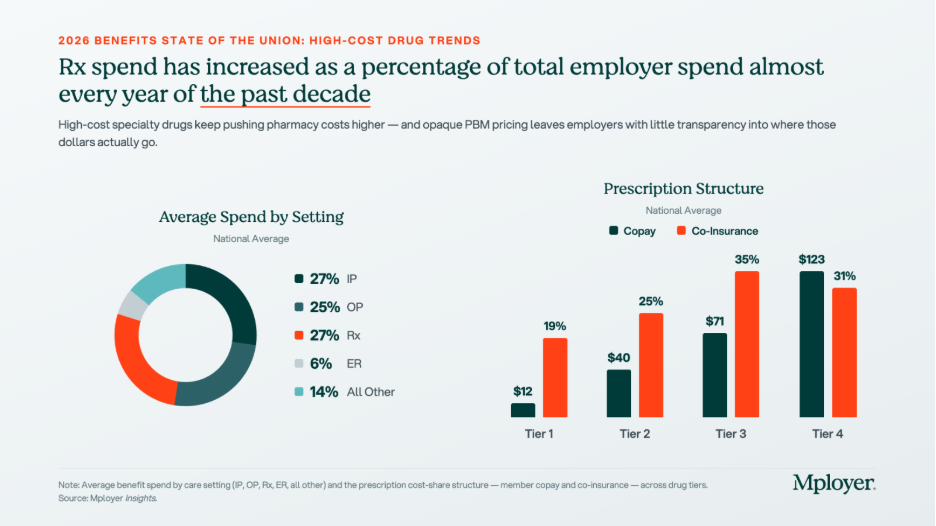
According to Mployer Insights’ 2026 analysis of 50,000+ employer health plans, prescription drugs account for over 25% of total benefit expenses, with Tier 4 specialty drugs driving the majority of high-cost claims. While Tier 4 copays average $123 with coinsurance requirements in 31% of plans, individual oncology therapies like Darzalex Faspro ($170,800/yr) and Keytruda ($158,200/yr) frequently exceed average individual stop-loss deductibles ($141,938). To mitigate exposure, self-funded employers are increasingly turning to independent, transparent PBM models and biosimilar substitution—which yields up to a 73% net cost reduction per patient.
The Likely Fastest-Growing Line in Your Benefits Budget
Modern medicine has produced remarkable advances. Cancer therapies that were not available five years ago are now extending and saving lives. Treatments for autoimmune diseases, multiple sclerosis, and rare genetic conditions are giving employees and their families real options where few existed before. As an employer, providing access to these treatments through your benefit plan is one of the most meaningful things your organization does for the people who work there.
It also comes with a financial reality that every benefits decision maker needs to understand clearly. Over 25% of total employer health benefit expenses are now driven by prescription drugs, and within that figure, a small number of specialty drugs account for an outsized share of the cost. A single covered employee on an oncology therapy can generate $100,000 to $170,000 or more in annual drug spend. A handful of members on these treatments can represent a larger budget impact than the entire pharmacy spend of the rest of your workforce combined. The goal is not to restrict access to these medications. The goal is to understand how the system works, how costs flow, and how to structure your plan so that both your employees and your organization are best positioned for the long term.
This piece covers how the pharmacy benefit system works, how your plan’s tier structure determines who pays what, how stop-loss insurance interacts with high-cost drug claims, and what employers can do to manage this exposure thoughtfully.
The tier structure in the chart above reflects how plans already account for the cost complexity of specialty drugs. Tier 4, which is where specialty biologics and injectables are typically placed, carries significantly higher cost-sharing than the other tiers: an average employee copay of $123 and coinsurance requirements in 31% of plans. But Tier 4 behaves very differently from the other tiers. On Tier 1, 2, and 3 drugs, cost-sharing is relatively predictable and manageable. On Tier 4, the combination of high drug cost and percentage-based coinsurance can generate out-of-pocket exposure that approaches or exceeds a patient’s annual out-of-pocket maximum in a single month of therapy. How Tier 4 is structured, what controls are in place, and how the plan manages cost is one of the most consequential design decisions an employer makes.
Understanding Your Benefit Plan’s Pharmacy Options
How Pharmacy Benefit Managers Work
Most employer health plans do not manage pharmacy benefits directly. That function is delegated to a Pharmacy Benefit Manager, or PBM, which acts as the intermediary between the health plan, the pharmacy, and the drug manufacturer. The PBM builds and maintains the formulary, negotiates drug prices and rebates with manufacturers, contracts with pharmacy networks, and processes pharmacy claims. The three dominant PBMs, Express Scripts (owned by Cigna), CVS Caremark (owned by CVS Health / Aetna), and OptumRx (owned by UnitedHealth Group), together manage the pharmacy benefits of approximately 80% of covered lives in the United States. Each is affiliated with a major carrier, meaning that employers who use an ASO medical arrangement often default to the carrier’s affiliated PBM without realizing it. Independent PBMs such as Capital Rx, Navitus, and MedOne Pharmacy Benefit Solutions operate on transparent, pass-through pricing models that return all rebates to the plan rather than retaining them as PBM revenue. PBMs are compensated through administrative fees, spread pricing (charging the plan more than the pharmacy receives and keeping the difference), manufacturer rebates in exchange for formulary placement, and specialty pharmacy margin. For any employer managing meaningful specialty drug spend, understanding which of these revenue sources applies to your contract is essential.
How Drug Tiers and Cost-Sharing Work
Every pharmacy benefit plan organizes covered drugs into tiers, with cost-sharing that increases as you move from Tier 1 generics (avg. $12 copay) through Tier 2 preferred brands ($40), Tier 3 non-preferred brands ($71), and into Tier 4 specialty drugs ($123 copay, with coinsurance in 31% of plans). The tier placement of a drug affects both what the employee pays and, indirectly, what the plan pays, since tier placement drives utilization patterns. Plan sponsors have real levers here: step therapy (requiring a patient to try a lower-cost drug first), prior authorization, specialty pharmacy channel mandates, and formulary exclusions all affect Tier 4 cost without eliminating clinical access. These controls require balancing cost management with the reality that for many specialty drugs, no lower-cost alternative achieves the same clinical outcome.
How Stop-Loss Insurance Interacts with High-Cost Drug Claims
For self-funded employers, specialty drug claims are now among the most common triggers for individual stop-loss reimbursement. A single employee on a cancer therapy or rare disease treatment can generate pharmacy claims that exceed the plan’s specific stop-loss deductible, which averages $141,938 nationally for self-insured plans, within a single plan year. The mechanics: the employer pays all claims up to the deductible threshold, and the stop-loss carrier reimburses costs above it. Several dynamics are specific to high-cost drugs. At renewal, stop-loss carriers may laser a known high-cost member by raising their individual deductible or excluding them from coverage. Some carriers now specifically carve out GLP-1 medications or other high-utilization drug categories from stop-loss reimbursement, so employers adding new drug coverage should verify what their contract covers. Specialty drugs can also be administered under either the pharmacy benefit or the medical benefit depending on whether they are self-administered or clinic-administered, and some stop-loss contracts apply different terms to each channel. Employers should model their actual specialty drug cost distribution against their stop-loss deductible at every renewal to understand where the plan’s real exposure sits.
The Costliest Specialty Drugs: What They Treat and What They Cost
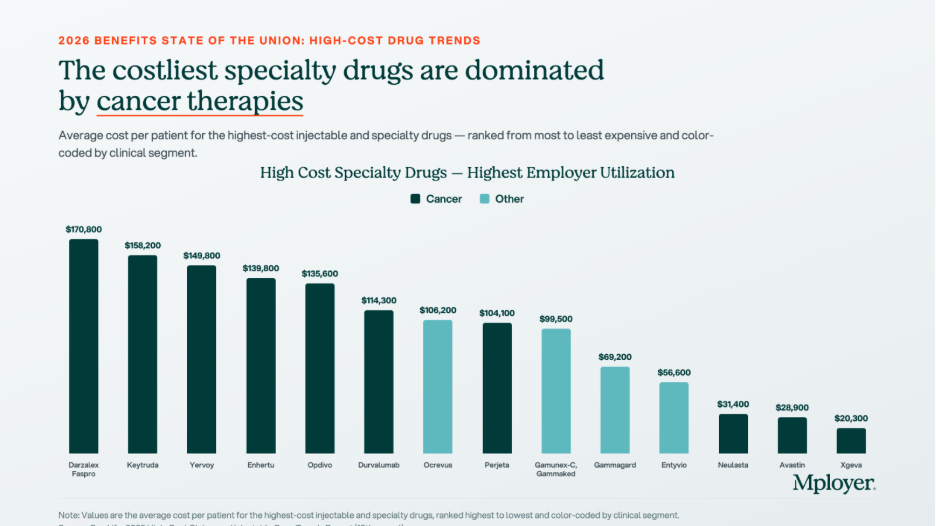
The chart below shows the highest-cost specialty and biologic drugs by average cost per patient, ranked from most to least expensive. Cancer therapies dominate the top of the list, but treatments for autoimmune conditions, MS, and inflammatory disease also appear, reflecting how broadly specialty drug spending is distributed across a workforce.
Darzalex Faspro (daratumumab/hyaluronidase) | $170,800 avg. annual cost per patient. Janssen (J&J). Multiple myeloma, a blood cancer. The highest-cost drug on the list by average patient cost. The subcutaneous formulation allows home administration, increasing the likelihood it flows through the pharmacy benefit rather than the medical benefit.
Keytruda (pembrolizumab) | $158,200 avg. annual cost per patient. Merck. FDA-approved across more than 40 cancer indications including lung, melanoma, head and neck, and bladder cancers. One of the most prescribed oncology drugs globally and one of the most common high-cost pharmacy claims in large employer plans.
Yervoy (ipilimumab) | $149,800 avg. annual cost per patient. Bristol-Myers Squibb. Melanoma and in combination with Opdivo for lung and other cancers. Combination Yervoy plus Opdivo therapy is among the highest per-patient drug cost regimens in common use.
Enhertu (trastuzumab deruxtecan) | $139,800 avg. annual cost per patient. AstraZeneca / Daiichi Sankyo. HER2-positive and HER2-low breast and gastric cancers. A significant recent clinical advance for patients with cancers that previously had limited options after first-line treatment.
Opdivo (nivolumab) | $135,600 avg. annual cost per patient. Bristol-Myers Squibb. Melanoma, lung, kidney, bladder, and other cancers. Frequently used in combination with Yervoy, compounding cost significantly when both are prescribed together.
Ocrevus (ocrelizumab) | $106,200 avg. annual cost per patient. Genentech. Relapsing and primary progressive multiple sclerosis. MS therapies are a persistent specialty drug cost driver because patients remain on therapy for years, making each diagnosed member a multi-year plan cost.
Entyvio (vedolizumab) | $56,600 avg. annual cost per patient. Takeda. Moderate-to-severe Crohn’s disease and ulcerative colitis. Inflammatory bowel disease therapies are among the most common specialty drug claims in employer plans because the conditions are prevalent in working-age adults.
Biosimilars: The Cost Opportunity Most Employers Are Not Fully Using
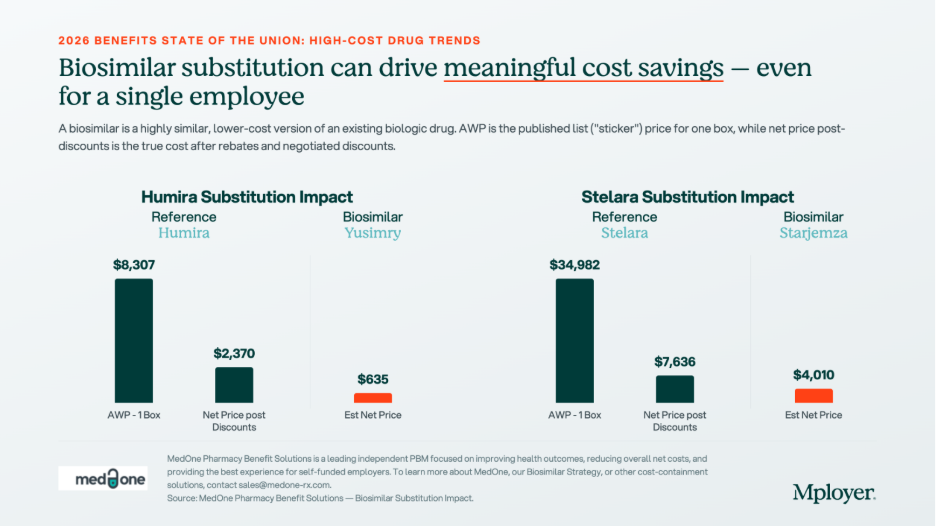
A biosimilar is a biologic drug that is highly similar to an already-approved reference biologic, with no clinically meaningful differences in safety, purity, or potency. Biosimilars are not generic drugs in the traditional sense, because biologic drugs are complex proteins manufactured from living cells and cannot be chemically replicated exactly. But they go through an FDA approval pathway that confirms their clinical equivalence to the reference product, and they cost significantly less. The biosimilar market has expanded rapidly as major biologic patents have expired. Humira, the world’s best-selling drug for much of the past decade, now has multiple biosimilar competitors in the U.S. Stelara has followed. The oncology biosimilar pipeline is maturing, with more approvals expected in the next two to three years.
The chart above shows what biosimilar substitution looks like in dollar terms. For Humira, the net price after rebates and negotiated discounts is $2,370 per box. The biosimilar Yusimry has an estimated net price of $635, a 73% reduction. For Stelara, the reference drug net price is $7,636 per box. The biosimilar Starjemza has an estimated net price of $4,010, a 47% reduction. For an employee on monthly Humira therapy, the difference between the reference drug and the biosimilar is approximately $21,000 per year in net plan cost. For a Stelara patient, the annual difference is approximately $43,500. Across even a small number of members on these therapies, biosimilar substitution is one of the highest-return cost management interventions available.
Plan sponsors have four main tools to drive biosimilar adoption: preferred formulary placement (putting the biosimilar on a lower tier and the reference drug on a higher tier), step therapy for new patients, automatic substitution where state law permits, and formulary exclusion of the reference drug entirely. The most important variable in any biosimilar strategy is whether your PBM has a financial incentive to keep the reference drug preferred. A PBM earning a large rebate on Humira has a direct financial reason to keep Humira on the preferred formulary, even when the biosimilar costs the plan less on a net basis. Independent PBMs operating on pass-through pricing remove this conflict entirely, because all rebates return to the plan and formulary decisions are made without a competing financial interest.
What Employers Should Be Asking About Their Pharmacy Benefit
High-cost drug management requires active decisions about PBM contract structure, formulary design, specialty pharmacy strategy, and stop-loss alignment. The questions worth asking at every renewal:
Is your PBM contract pass-through or spread-based? A pass-through model means you pay exactly what the pharmacy receives and all rebates come back to the plan. A spread-based model means the PBM earns revenue that is not visible in the administrative fee. Request full compensation disclosure under the CAA requirements.
Are you receiving all available biosimilar savings? Ask your PBM for a net cost comparison of each reference drug plus rebate against the available biosimilar net price. The answer will tell you whether your formulary is designed around the plan’s cost interest or the PBM’s rebate interest.
What is your specialty drug channel strategy? Are specialty prescriptions being filled through your PBM’s affiliated specialty pharmacy? Carving specialty to an independent pharmacy or using a white-bagging program for clinic-administered drugs can generate meaningful cost differences.
How does your stop-loss deductible interact with your specialty drug exposure? Model your actual specialty drug claims against your stop-loss threshold. If most of your high-cost drug claims fall below the deductible, the plan is absorbing those costs without triggering reimbursement.
Does your formulary have appropriate Tier 4 controls? Step therapy, prior authorization, and quantity limits on specialty drugs reduce cost without eliminating clinical access. Without these controls, high-cost therapies can be approved and dispensed without any plan-level review of whether a lower-cost alternative exists.
Know How Your Pharmacy Benefit Compares
Pharmacy is now one of the two or three most consequential cost management decisions in health plan design. The employers managing it well are not restricting access to the medications their employees need. They are ensuring that the structure of the benefit, the PBM contract, the formulary design, and the stop-loss coverage work together in the plan’s interest, and that every dollar spent on high-cost drugs is spent as efficiently as possible.
Mployer’s benefits rating evaluates pharmacy benefit design as part of the Medical pillar score, benchmarked against a custom cohort matched by size, region, and industry. Knowing where your pharmacy benefit stands relative to employers who actually look like you is the starting point for making better decisions.
See how your benefits package compares to your custom cohort at MployerAdvisor.com.
Sources
Mployer Insights: Average Spend by Setting, Prescription Structure, and High-Cost Specialty Drugs. Source: Mployer Insights analysis.
MedOne Pharmacy Benefit Solutions: Biosimilar substitution impact data for Humira/Yusimry and Stelara/Starjemza. MedOne is a leading independent PBM focused on improving health outcomes and reducing net costs for self-funded employers. [email protected].
Mployer 2025 and 2026 Employee Benefit Plan Design Study, covering 50,000+ employer plans. Individual stop-loss avg $141,938 self-insured.
Consolidated Appropriations Act of 2021, Section 202: broker/consultant compensation disclosure requirements for group health plans.
FDA Biosimilar approval framework: 42 U.S.C. Section 262(k).
Most U.S. employers now offer paid maternity leave beyond the legal minimum, but coverage varies widely once you look past the basics. According to Mployer Insights' 2026 analysis of more than 50,000 employer benefit plans, 68% of employers provide paid maternity leave on top of short-term disability, typically adding 8 extra weeks, and half now cover 100% of salary during the disability period. Support drops off from there: only 41% of employers offer paid bonding leave for non-birth parents, and advanced family-building benefits remain even less common, with just 28% covering IVF and 11% offering adoption financial assistance. The data suggests that while baseline maternity leave has become standard, more comprehensive family-building support is still the exception rather than the norm.
Parental and Maternity Leave: What Employers Need to Know
If there is one area of employee benefits where employer decisions signal values as loudly as economics, it is parental leave. How an organization treats employees who are growing a family, both during the leave itself and in how it structures the financial support, tells candidates and employees a great deal about whether the organization means what it says about supporting its people.
This is Part 2 of our leave benefits series. Part 1 covered the foundations: vacation, paid holidays, sick leave, consolidated vs. non-consolidated plans, workplace flexibility, and the federal and state legal framework. This post goes deeper on maternity and parental leave specifically: what the terms mean, how the programs are structured, what federal and state law requires vs. what employers choose to provide, and how the data from 50,000+ employer plans describes the current state of the market.
The data in this post is at the national all-employer average. The variation beneath that headline, by industry, employer size, and region, is significant. A technology employer in a major metro area competing for mid-career talent faces a very different parental leave benchmark than a regional manufacturer or a healthcare employer in a mid-size market. Both contexts are worth knowing. The national benchmarks in this post show where the floor and the ceiling are. Knowing where your specific cohort sits requires a custom comparison.
Key Terms Every Benefits Decision Maker Should Know
Maternity leave. In the benefits context, dedicated maternity leave refers to paid leave provided by the employer beyond what statutory short-term disability covers. It is separate from FMLA job protection and typically layered on top of the disability benefit. When this post refers to maternity leave being offered by 68% of employers, it means employers providing additional paid leave beyond statutory disability.
Short-term disability (STD). Short-term disability insurance replaces a portion of an employee’s income when they are unable to work due to a medical condition, including childbirth recovery. For birth parents, STD typically covers six weeks for a vaginal delivery and eight weeks for a cesarean section. STD is the foundation on which most employer maternity leave programs are built. Without STD, there is no paid component to maternity leave unless the employer provides it directly.
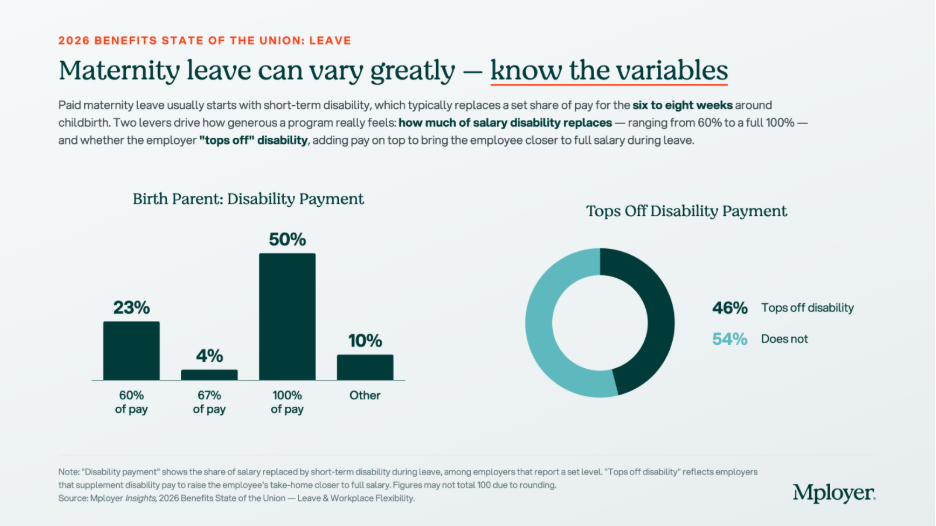
Disability payment rate. The percentage of the employee’s salary replaced by the STD benefit during leave. The most common rates nationally are 60% of pay (the traditional standard) and 100% of pay (full salary replacement). The disability payment rate is one of the two primary levers that determine how much an employee actually receives financially during maternity leave.
Top-off. An employer top-off is a supplemental payment that brings the employee’s total income during leave closer to their full salary. An employer whose STD benefit pays 60% of salary and who tops off to 100% is effectively covering the remaining 40% from their own budget. Top-off is the second primary lever, alongside the disability payment rate, and it is the one that most visibly distinguishes generous programs from basic ones.
Bonding leave. Leave provided to allow a parent to bond with a new child. Bonding leave is typically the vehicle for non-birth parent leave and for any leave taken by the birth parent after the disability period ends. It is distinct from the disability-based component of maternity leave and may or may not be paid depending on the employer’s policy and any applicable state paid leave benefit.
Parental leave. The broader term covering leave for all parents of a new child, including birth parents after recovery, non-birth parents, adoptive parents, and foster parents. Some employers use parental leave to describe a unified program available to all parents; others have separate maternity and paternity or bonding leave policies.
Adoption assistance. Financial support provided by an employer to help cover the costs of adopting a child, which can include legal fees, agency fees, home study costs, and travel. This is distinct from adoption-related parental leave and is offered by only a small share of employers nationally.
What the Law Requires: Federal and State Baseline
Federal FMLA
Federal FMLA, covered in depth in Part 1, provides the baseline: up to 12 weeks of unpaid, job-protected leave for the birth, adoption, or foster placement of a child. This applies to employers with 50 or more employees. The critical word, again, is unpaid. FMLA does not require the employer to pay anything during parental leave. It only requires that the job be protected and that group health insurance continue during the leave period on the same terms as if the employee had not taken leave.
FMLA also applies to both parents, which is a point often overlooked. The non-birth parent, whether an adoptive parent, a same-sex partner, or a non-birth parent of any kind, is entitled to the same 12 weeks of unpaid job protection under federal FMLA as the birth parent, assuming all eligibility requirements are met.
State Paid Family Leave Programs
The paid leave piece, when it exists at state level, comes from state paid family and medical leave programs. These are state-administered insurance programs that pay a wage replacement benefit, typically 60 to 90 percent of the employee’s wage up to a weekly cap, to employees on qualifying parental or family leave. The most established programs are in California, New Jersey, New York, Washington, Massachusetts, Connecticut, Oregon, Colorado, Rhode Island, and the District of Columbia, with additional states phasing in programs in the coming years.
These programs are funded through payroll contributions, typically deducted from employee wages, sometimes matched by employers. The benefit is paid by the state program, not directly by the employer, though the employer is responsible for administering eligibility, managing payroll deductions, and coordinating the state benefit with any employer-provided leave. Employers in states with paid leave programs should understand how the state benefit interacts with their own leave policy, including whether employees are required or permitted to use accrued PTO concurrently with state paid leave.
Pregnancy Discrimination and PUMP Act
Two additional federal laws shape the employer’s obligations around pregnancy and parental leave. The Pregnancy Discrimination Act prohibits employers with 15 or more employees from discriminating against employees on the basis of pregnancy, childbirth, or related conditions. The PUMP for Nursing Mothers Act, enacted in 2022, requires employers to provide reasonable break time and a private space for nursing employees to express breast milk for up to one year after the child’s birth. These are separate from FMLA and apply to a broader range of employers.
Maternity Leave: What the National Data Shows
68% of employers nationally offer dedicated maternity leave beyond statutory short-term disability. 32% do not, meaning those employees rely entirely on STD for any paid income during leave, typically six to eight weeks at whatever percentage the disability plan covers. Among the 68% who do offer dedicated maternity leave, eight weeks of additional paid leave is the most common duration at 31%, with twelve weeks close behind at 26%. Together those two categories account for more than half of all programs. 16% of employers offer thirteen or more weeks of additional paid leave, placing them at the generous end of the market nationally.
Reading this data correctly requires understanding what these weeks represent. The duration bars in the chart show the additional paid leave added on top of disability coverage, not the total leave period. An employee at an employer offering eight weeks of additional leave on top of a six-week STD benefit has fourteen weeks of paid leave total before any unpaid FMLA job protection kicks in. That total is what candidates and employees are actually comparing when they evaluate a parental leave program.
Disability Payment Rates and Top-Off: The Variables That Define Generosity
The chart above tells the real story of how financially supportive maternity leave programs are. On the disability payment rate, the market has split sharply: 50% of employers with a defined disability payment rate pay 100% of salary during the disability period, while 23% pay the traditional 60% of salary. The gap between these two is meaningful. An employee earning $80,000 per year on a six-week disability period at 60% of pay receives approximately $5,538. At 100% of pay, she receives $9,231. That $3,693 difference is real money for a new parent.
The top-off picture is similarly divided. 46% of employers supplement the disability benefit to bring the employee closer to full salary. 54% do not. An employer who pays STD at 60% of salary and does not top off is providing the minimum financial support that a standard disability plan delivers. An employer who pays 100% of salary or who tops off a 60% plan to full pay is making a meaningfully different statement about how much they value employees during one of the most important transitions of their lives
The combination of these two variables, disability payment rate and top-off, is what candidates from competitive talent markets are increasingly asking about directly. It is not enough to say your company offers paid maternity leave. The question they are asking is: how much will I actually receive, and for how long?
Non-Birth Parent Leave: A Growing Expectation, Not Yet a Standard
41% of employers nationally offer dedicated non-birth parent leave, meaning leave specifically provided for partners, fathers, adoptive parents, and same-sex parents who are not the birth parent. 59% do not. Among those who do offer non-birth parent bonding leave, twelve weeks is the most common duration at 32%, with six weeks next at 23%. The 30% in the Other category reflects the wide variation in how these programs are structured, including tiered policies, programs that vary by tenure, and policies that provide different durations based on the type of parental event.
The gap between maternity and non-birth parent leave offer rates, 68% vs. 41%, reflects the historical pattern of parental leave being designed primarily around biological motherhood and disability recovery. That framing is shifting. Candidates across generations, and particularly millennial and Gen Z candidates who are entering or approaching family formation years, are increasingly evaluating parental leave as a package: not just what the birth parent receives, but whether the partner can also be present. An employer offering generous maternity leave but no paternity or bonding leave is offering a program that structurally assumes only one parent takes significant time away, which does not match how many families today want to organize the early months of a child’s life.
Non-birth parent leave also has a practical retention implication. Employees who take bonding leave and feel supported by their employer during it are more likely to return to work and remain engaged. The data on parental leave and retention consistently shows that leave policies affect long-term retention rates, not just initial job acceptance.
Fertility and Adoption Benefits: Rare but Rising
28% of employers nationally offer IVF coverage as part of their medical or family-building plan. 11% offer adoption assistance. Both numbers reflect concentrated adoption among larger employers and in specific geographies and industries, particularly technology, financial services, and professional services employers in major metropolitan markets. Coverage terms, lifetime maximums, and eligibility criteria vary widely among the minority of employers who offer these benefits, making direct comparisons difficult without plan-level detail.
IVF treatment costs can reach $15,000 to $30,000 or more per cycle, with most patients requiring multiple cycles. For employees who need IVF to build a family, employer coverage is not a luxury benefit. It is a financial necessity that directly affects whether they can afford to pursue treatment at all. For employers, IVF coverage is a high-signal benefit: it communicates investment in the full arc of an employee’s family life, not just the period after a child arrives. Among employers competing for talent in industries where IVF coverage has become a common offering, its absence is noticed.
Adoption assistance typically covers qualified adoption expenses such as legal fees, agency fees, home study costs, and travel, up to an annual maximum that varies by employer. The IRS allows employers to provide up to $17,280 in adoption assistance per child tax-free in 2026. Adoption leave policies, separate from adoption assistance, are covered under FMLA for qualifying placements and under many state paid leave programs as well.
Parental Leave as a Talent and Retention Strategy
Parental leave is one of the most emotionally charged benefit decisions a candidate makes. It is also one of the most concrete. Unlike dental coverage or life insurance multiples, parental leave generates direct, personal financial calculations: how much will I receive, for how long, and what will that mean for my family’s finances and my ability to be present during a period that does not repeat?
Employers who have invested in a strong parental leave program and are not talking about it are leaving one of their best recruiting assets on the table. A program that offers twelve or more weeks of additional paid leave, a top-off to full salary, and bonding leave for non-birth parents is well above the national market on all three dimensions. That is a specific, documentable competitive advantage in candidate conversations, offer letters, and employer brand communications. It does not require marketing language. It requires knowing what your program provides and being willing to state it clearly.
Employers who are uncertain about where their program stands face a different challenge. If you are not sure whether your maternity leave duration, your disability payment rate, your top-off policy, and your non-birth parent bonding leave compare favorably to the employers recruiting against you, you cannot use those elements as differentiators, and you cannot address them strategically at renewal. The national benchmarks in this post give you the market context. The custom cohort analysis Mployer builds from employers matching your industry, region, and size gives you the specific comparison that matters for your talent market.
Parental leave policy is not static. The market has moved meaningfully in the past five years and continues to move. Employers who last reviewed their parental leave program three or more years ago are likely benchmarking against a standard that has already shifted. Knowing where you stand today is the starting point for deciding whether to maintain, improve, or actively use your program as a recruiting asset.
Mployer Insights, 2026 Benefits State of the Union: Leave & Workplace Flexibility. Source: Mployer Insights analysis of 50,000+ employer benefit plans. All Nation Average.
Family and Medical Leave Act of 1993 (FMLA), 29 U.S.C. Section 2601 et seq. Applies to employers with 50+ employees.
Pregnancy Discrimination Act, 42 U.S.C. Section 2000e(k). Applies to employers with 15 or more employees.
PUMP for Nursing Mothers Act (2022), amending the Fair Labor Standards Act. Applies to most employers.
State paid family leave programs: California (SDI/PFL), New Jersey (TDI/FLI), New York (NY DBL/PFL), Washington (WA PFML), Massachusetts (MAPFML), Oregon (OPFML), Colorado (FAMLI), Rhode Island (TCI), Connecticut (CTPFML), District of Columbia (DC PFML).
IRS adoption assistance exclusion 2026: $17,280 per child, per IRS Notice 2025-61.
Mployer, the industry's leading employee benefits and insurance intelligence platform, today announced its Expanded AI Release
powered by Anthropic. This release is a major expansion of the AI and agentic abilities already built across its products, and it includes
the broad release of its MCP (Model Context Protocol) Server and Claude Connectors
Mployer materially expands the AI and agentic capabilities across its product suite and expands access to its MCP Server and Claude Connectors, making Mployer's proprietary 2 billion data points across benefits and insurance accessible inside partners' own LLMs.
Nashville, TN, July 16, 2026 /PRNewswire-PRWeb/ --
Mployer, the industry's leading employee benefits and insurance intelligence platform, today announced its Expanded AI Release powered by Anthropic. This release is a major expansion of the AI and agentic abilities already built across its products, and it includes the broad release of its MCP (Model Context Protocol) Server and Claude Connectors. This Expanded AI release allows our partners to access Mployer's 2 billion proprietary benefit and insurance data points both inside Mployer and inside their own LLM.
This functionality is coupled with an expert benefit AI-agent trained on these 2 billion data points to provide superior strategic advice and support for our partners at every step in their workflow, across every Mployer solution - from market analytics to benchmarking, claims and compliance. It is similar to having a highly educated insurance expert with 30+ years of experience sitting side by side with every individual partner at every step.
In addition, in line with the company's goal of better enabling all industry participants, Mployer is releasing a limited, free version of every product. There will be a national training on July 28 and August 5 that is for everyone in the industry. To sign up for limited free access and the national training on July 28th, or request access to the Mployer MCP, please see further details below.
"This release raises the bar for what AI can do for our industry," said Brian Freeman, CEO of Mployer. "Applying this next level of AI across our platform and the broker and carrier workflows gives insurance industry leaders powerful, proprietary market data to support their strategies and decisions. We are entering an awesome era for our industry, where the brokers and carriers using the best analytics will deliver differentiated outcomes for their employer partners. That will continue to drive collective, positive industry impact. We're excited for our partners and for Mployer to play a material role in this next era."
Infusing AI into every step of the workflow: Mployer's benefits and insurance AI Agent has been highly trained on Mployer's 2 billion unique benefits and insurance data points, and sits alongside leading producers across each step of their workflow, including:
Catalyst - Market Intelligence: See the market more clearly than others, with deeper research and AI recommendations on proprietary employer and employee market signals.
Insights - Benefits Benchmarking: Run real-time benchmarks against localized, custom cohorts, paired with Mployer's expert benefit AI to guide custom strategies for each unique plan.
Vista - Claims Analytics: Simplify manual client reporting across carrier, Rx, stop-loss, and more, down to just minutes, layering in expert-recommended strategies for your review and market trends.
Pulse - HR & Compliance: Industry-leading compliance, HR support, and content for brokers and their employer partners have reached a next level of ease and engagement.
Atlas - Employer Engagement: Extend benefits intelligence across compliance, benchmarking, and claims analytics to employer clients directly through an AI-first broker-branded portal.
"Imagine being a producer today and starting your morning with updates from your expert benefits AI assistant: 'Your client's renewal is trending 14% above their cohort benchmark, attached are draft strategies for your review,' or 'An HR director from one of our partners is now the CHRO at a new company, attached is a draft congratulatory email,' or 'A new proposed Texas law impacts three of our groups, attached is a communication for your review.' That is the reality of what this release and the next era bring," said Anthony Waters, Chief Growth Officer of Mployer. "It is a great time to be a part of this industry."
To receive limited, free access to every product, you need to attend one of the trainings:
Wednesday, August 5 | 12:00–1:30 PM CT | Register Here
Each product training is 20 minutes. You can join only the specific solutions you would like to learn more about.
To request access to Mployer's MCP Server and Claude Connectors, please reach out to [email protected].
About Mployer Mployer is the industry's leading employee benefits and insurance intelligence platform, built for brokers, carriers, GAs, PEOs, and the employers they serve. Powered by more than 2 billion unique benefit data points and Anthropic, Mployer's suite of Catalyst, Insights, Vista, Pulse, and Atlas works for industry leaders benchmarking plans, analyzing claims, recommending growth strategies, and interpreting complex policies and legislation, in one platform. With its MCP Server and Claude Connectors, Mployer's data and AI are accessible across its products and directly within Claude. Learn more at MployerAdvisor.com.
Media Contact: Anthony Waters Chief Growth Officer, Mployer [email protected]
July brings one of our most substantial releases yet, with major updates across Insights+, Catalyst, and Vista. Insights+ is now faster and more efficient, with reports generated automatically the moment a request is submitted, along with real-time edits. Catalyst also gets significantly more powerful, with new AI-powered exports tailored to each employer, deeper visibility into commercial lines, and expanded AI assistant coverage into retirement and peer benchmarking. Vista makes report generation simpler and more flexible, building a broker-branded financial report from whatever benefits and carrier documents you have. Read on for the full details.
Author:
July 1, 2026
July brings major updates across Insights+, Catalyst, and Vista, focused on helping our partners work faster with more automation, deeper intelligence, and expanded AI capabilities, from instant benchmarking reports and smarter prospecting to more flexible reporting. Explore the updates below.
Insights+
Automated Report Generation — Insights+ reports now generate automatically the moment a request is submitted.
Redesigned Report View — The report now renders natively in the browser: cleaner, more readable, and a closer match to the final output.
Real-Time Edits — You can instantly edit and generate reports in real-time. No more wait periods or help needed to edit and generate a new report.
Strategic Recommendations in Mployer AI — Generate consultative, mode-specific recommendations directly in the report's AI panel across six modes — General, Cost Strategy, Plan Design, Coverage Gaps, Funding Strategy, and Underwriter Notes — then refine with follow-ups before sharing with a client.
Add Medical Plans on Upload Documents Flow — The "Do you have another medical plan?" question is now available on the Upload Documents flow, matching the flexibility already in Manual Entry.
Catalyst
AI-Powered PDF Export — A dynamic PDF export is now available from each company profile page. Choose between an Executive Summary or Full Report format, with content automatically tailored to the employer's available data, surfacing the most relevant sections, charts, and insights for each company.
Commercial P&C Data on Company Snapshot — The Company Snapshot now includes Commercial P&C Broker and Carrier Display Cards, giving you a consolidated view of an employer's commercial relationships without leaving the snapshot.
Commercial Lines Insights for Licensed Users — Users with a commercial license now see a Commercial Lines Insights section on the Opportunity & Signals tab, surfacing filing information from Commercial P&C data alongside benefits context.
Advanced Salesforce Entity Matching — Send-to-Salesforce now supports more precise account linking through advanced entity matching. A token-sharing fix also means one admin's Salesforce connection now covers the whole account.
Retirement Plan Quality Queries — The AI assistant can now answer questions about retirement plan quality, advisor relationships, and compliance status, extending natural language search into the retirement vertical.
Broker Classifier Filters — Filter brokers by scope (national vs. regional), retirement advisor status, and commercial lines activity, making it easier to ask targeted questions about broker specialization and positioning.
Broker Column on Commercial P&C Results — The Commercial P&C results page now shows a Broker column, so commercial broker relationships are visible directly from the search grid.
Vista
Simpler, More Flexible Report Generation — Upload a client's benefits and carrier documents, now several at once, and Vista builds a structured, broker-branded financial report from what's provided, without requiring every detail upfront. The output adapts to the documents you have, so you can generate a report for any group.
The Mployer Assistant, Inside Every Report — Every report now includes an AI assistant panel where you can ask questions about a client's numbers and get instant, report-grounded answers and talking points, pulled directly from the report.
A Redesigned Workspace — Vista is now built around a cleaner three-panel layout: quick actions on the left, your reports and report history in the center, and at-a-glance stats with search and filtering.
June's product updates are here, and there's a lot to be excited about. We're continuing to build on the foundation we've established across Catalyst and Insights benchmarking, with this month's updates focused on giving users more precision in how they search, prospect, and manage data.
Author:
June 2, 2026
June's product updates are here, and there's a lot to be excited about. We're continuing to build on the foundation we've established across Catalyst and Insights benchmarking, with this month's updates focused on giving users more precision in how they search, prospect, and manage data.
On the Catalyst side, that means expanded AI assistant capabilities, more flexible export controls, and deeper CRM customization. For benchmarking, we've added AI-powered recommendations and made meaningful improvements to the report experience, including how you access completed reports and how data flows through the submission wizard.
Read on for the full details.
Catalyst
Proximity-Based Geographic Search — The AI assistant now supports radius-based company searches around a city, so territory prospecting works the way territories actually do — not just by state, city, or zip.
Product Line Gap Queries — Ask the AI assistant which product lines — Stop Loss, EAP, Voluntary, TPA — an employer has or is missing. Cross-sell identification now happens in a conversation, not a spreadsheet.
Headcount Milestone Flags — The AI assistant can surface employers who've recently crossed key thresholds: 50, 100, 500 employees. Growth signals and compliance triggers, surfaced automatically.
Flexible Export Range Selection — When exporting data, users can now choose the current page, a page range, or a specific record count. Providing precise control without bumping into system limits.
Experience Mod Data on Account View — Experience Modification data now appears directly on the Company Overview and Commercial P&C tab, so risk context is right there when you need it.
Custom CRM Field Mapping — Account admins can now map platform fields to custom CRM fields, including custom schemas. Providing full control over how data flows in without overwriting existing records.
Retirement Search: Total Assets Filter — The Retirement Search Assets filter now filters on Total Assets.
Insights+
AI-Powered Recommendations in Insights+ Users can now access AI-generated recommendations directly within Insights+. The new recommendations tool surfaces actionable guidance across four categories. Highest Impact, Cost Strategy, Coverage Gaps, and Underwriter Notes, giving users a faster path from report data to next steps.
Completion Email Links to HTML Report — When your report is ready, the notification email now links directly to the interactive HTML report including Mployer AI and all report tools, instead of a PDF download.
Redesigned Chart Layout — Plan Score and Cohort Market Data sections are now clearly differentiated, and Dental and Vision pages consolidate their left-side tables. Easier to read, faster to interpret.
Report Opens Without Losing Your Place — Clicking a company name in the Request History Grid now opens the HTML report in a new tab, so your search state stays exactly where you left it.
Rate Availability Edits No Longer Clear Rate Data — Adjusting Rate Availability selections mid-wizard no longer wipes Medical, Dental, or Vision rate and contribution data previously entered. No more lost work.
Age-Banded Entry Hidden When Not Applicable — When 'Use employee contributions only' is selected, Age-Banded rate entry is no longer shown — cleaner form, fewer distractions.
That's a wrap! Stay tuned for what's coming next month.
Whether you're prospecting new accounts, managing an existing book, or benchmarking benefits for a client, there's something meaningful here for you.
Author:
May 6, 2026
We're excited to share details on the new enhancements and features added to Catalyst and Insights/Insights+ this month. Every update we make is grounded in feedback from our users. Whether you're prospecting for new accounts, managing an existing book, or benchmarking benefits for a client, there's something meaningful here for you.
Catch up on all the new features and updates:
Catalyst
Microsoft Dynamics 365 Integration — Brokers using Microsoft Dynamics can now push companies and contacts directly from Catalyst into their CRM, consistent with the existing Salesforce and HubSpot workflows.
Construction Risk Data — Commercial Search now includes property-level Construction Risk intelligence within the employer snapshot, covering building details, valuation, location, and sales history, with a dedicated summary section for quick risk assessment.
Expanded Alert Triggers — Alert notifications now cover job changes, broker and carrier changes, renewal dates, and retention risk signals.
For You Page Personalization — You can now set location, industry, and company size preferences, so relevant searches are surfaced immediately on login.
Salesforce ID Matching — The Salesforce integration now supports matching Salesforce ID fields, improving sync accuracy and reducing duplicate records.
Opportunity & Signals Enhancements — The Opportunity & Signals tab now includes broker and carrier tenure flags, premium and commission trends with year-over-year comparisons, and enrollment changes drawn from 5500 filing data.
State Legislative Activity in Pulse — The Pulse news feed now surfaces state legislative bill activity, keeping users informed of policy developments relevant to their prospects and clients.
Employer Search Filter Additions — Employer Search now includes filters for Broker Compensation, Premium Range, and Missing Filings.
OSHA Risk Rating Filter — You can now filter Commercial P&C employers by OSHA Risk Rating, from Very Low to Very High, for faster compliance-based targeting.
LinkedIn Fallback Search — When a contact has no personal LinkedIn profile on file, clicking the LinkedIn icon now opens a people search filtered by company and last name.
Snapshot PDF Exports Include Phone Numbers — Revealed phone numbers now appear in the Key Contacts section of exported PDFs, with the most reachable contacts prioritized at the top.
Consolidated Settings Page — Account, company, and preference settings have been merged into a single Settings page for easier profile management.
Redesigned Dashboard and Portal Home — Both the Catalyst dashboard and portal home page have been refreshed with cleaner layouts, surfacing recent activity and making navigation faster from login.
Insights/Insights+
Flexible Rate Availability in Request Form — The Insights+ request form now supports a flexible Rate Availability section, allowing you to choose between full premium and contribution data, benchmark rates, or employee-paid premiums only — so submissions are no longer blocked when full rate data isn't available.
Two-Tier Rate Structure Support — Insights+ now supports a two-tier rate structure (EE and EE+Family) in addition to the existing three- and four-tier options.
Five New Voluntary Benefit Lines — Hospital Indemnity, Cancer Insurance, Pet Insurance, Student Loan Assistance, and FSA have been added to the Voluntary Offerings section.
Medical Plan Reordering and Deletion — You can now drag and reorder medical plans within the Insights+ side stepper and delete plans with a confirmation prompt, with all changes reflected consistently across the stepper, plan detail screens, and final submission.
Award Download Progress Modal — A new progress modal now appears when downloading award files, providing visual confirmation that the file is being prepared and preventing duplicate clicks during packaging.
Refreshed Insights Home Page — The Insights home page has been updated with a cleaner layout and improved search helper text.
Improved Form Validation — The Insights+ wizard now validates employer contribution amounts against total premiums to prevent percentages from exceeding 100%, caps the Aggregate Risk Corridor field to prevent data entry errors, and routes brokers directly to flagged sections when errors are identified on review or submit.
Hyperlinked Company Names in Report History — Company names on the Insights Report History grid are now hyperlinked, making it faster to navigate from a report row directly to the relevant company.
That's a wrap! Stay tuned for what's coming next month.

.png)
%20(1).png)

.svg)





.png)

.jpg)

.svg)
.svg)