Labor Market Insights
Living Wage vs. Minimum Wage In The Modern Age
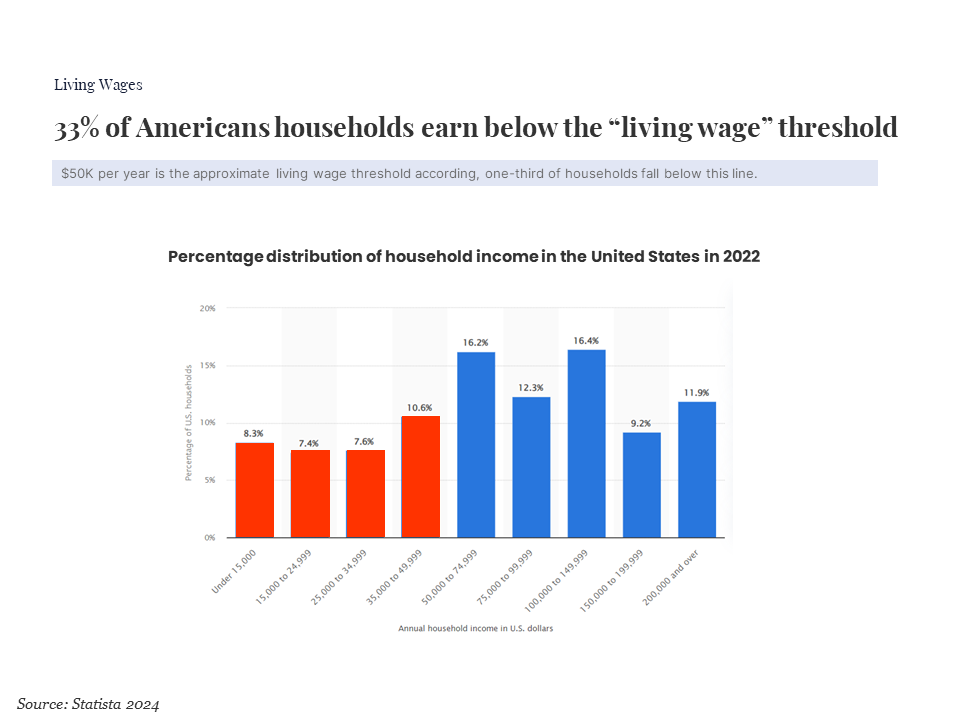
While the concept of a living wage has become an issue of increasing importance to both employers and employees in recent years, the number of workers actually earning a living wage has been steadily decreasing at the same time - though that decrease has not been experienced across industries and/or geographies in equal measure.
March 29, 2024

While the concept of a living wage has become an issue of increasing importance to both employers and employees in recent years, the number of workers actually earning a living wage has been steadily decreasing at the same time - though that decrease has not been experienced across industries and/or geographies in equal measure.

It may once have been easy to confuse minimum wage standards with living wage standards. In fact, the federal minimum wage was initially devised in part to ensure a living wage, those standards long ago diverged with cost of living significantly outpacing minimum wage increases on balance since the 1950s.

That said, the chasm between minimum wage and living wage seems to have become all the more stark in recent years, especially during the pandemic recovery when workers paid well above minimum wage found themselves unable to keep up as cost of living climbed faster than rising wages despite (and because of?) the historically labor-friendly labor market. 

Inflation has largely been under control for the better part of a year now, with the last 9 months holding steady below 4% annualized, but cost of living remains high and the minimum wage remains exactly where it has been for the last 15 years - 7 dollars and 25 cents an hour.

That $7.25 an hour in 2009 would be worth $10.58 today accounting for inflation, etc. Meanwhile, as of 2022, the average living wage in the US according to MIT was just over $25 dollars an hour at the time, or $27.53 in today’s dollars. 

With more workers than ever failing to secure a living wage, the repercussions of this situation are likely to be felt far beyond those who are personally affected, though not all industries are contributing equally to the issue nor are all cities/states/regions responding passively to the growing problem.

Industries With the Highest Living Wages

According to data from Revelio Labs, more than one third of workers (36%) employed by the top one thousand companies in the US are paid less than a living wage, defined here as a wage sufficient for two full-time workers to support themselves as well as two dependents. Even worse, nearly 1 out of 5 of those employees (19.2%) does not make enough money to meet basic needs. 

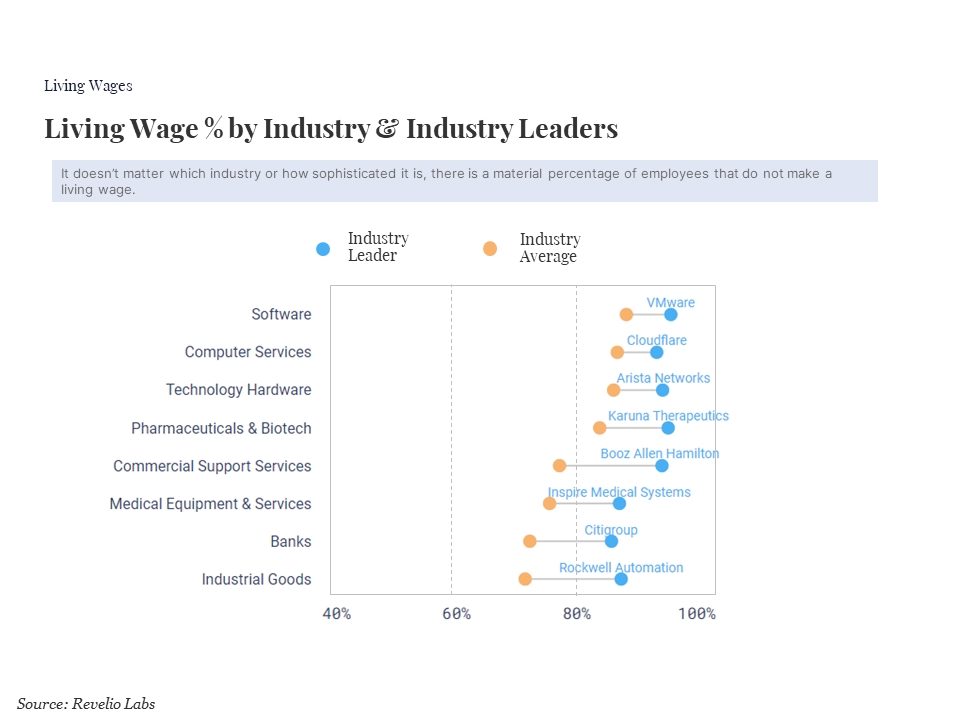
As the following graphic illustrates, among the 10 largest industries in terms of total number of employees (which collectively account for 10% of the US workforce), the industries involving technology development dominate the upper end of the scale, with the software, computer services, technology hardware, and pharmaceuticals/biotech industries all paying more than 80% of their employees at or above the living wage threshold.

On the other extreme, both the restaurant and leisure as well as the retail industries pay living wages to fewer than 40% of their employees, while the commercial support services, medical equipment, banking, and industrial goods industries all pay living wages to about 70% to 80% of their employees. 

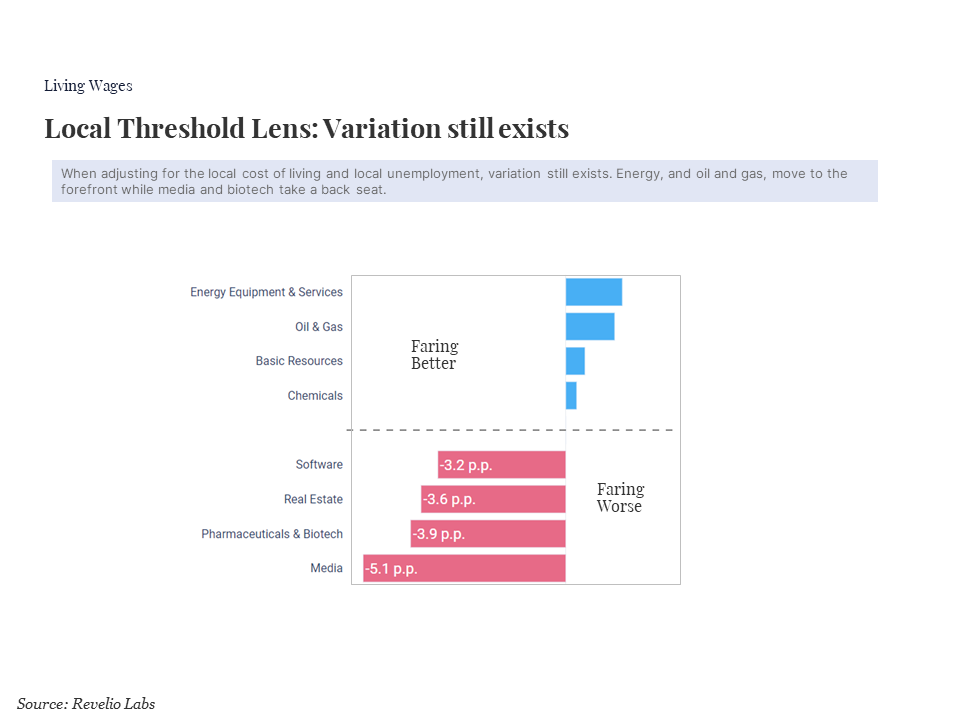
Even when taking into account geographic variance in cost of living, the big picture doesn’t change much, although the following graphic seems to indicate a somewhat less favorable view of the tech industry’s propensity toward paying living wages when factoring for local cost of living, with the total percentage of employees that are paid a living wage in the software and pharmaceuticals/biotech industries dropping by between 3% and 4%, respectively.

Mostly, however, the information best illustrated by this graphic may simply be that industries like tech and media tend to gravitate toward areas with a relatively higher cost of living while the more industrial industries tend to be located in areas with a relatively lower cost of living compared to the national average.

Minimum Wage Across States

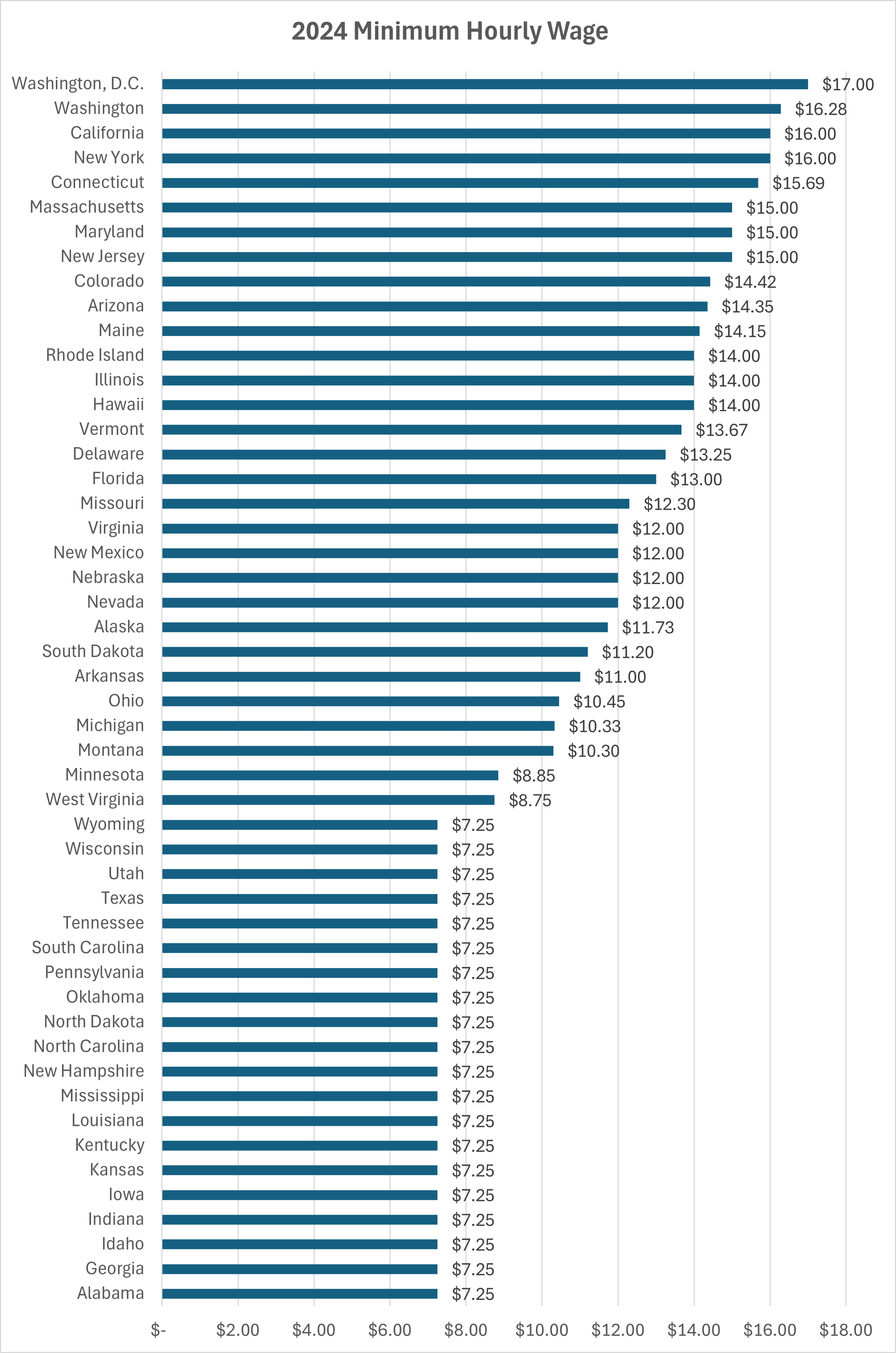
According to the National Conference of State Legislatures, Washington DC currently has the highest minimum wage among ‘states’ at $17 per hour, followed by Washington state at $16.26, then California and New York at $16 each. 

Beyond the 5 states that have no internally legislated minimum wage and are therefore subject only to the federal minimum wage standard (Alabama, Louisiana, Mississippi, South Carolina, Tennessee), there are 15 states that have set their minimum wage to the current federal level of $7.25 per hour - Georgia, Idaho, Indiana, Iowa, Kansas, Kentucky, New Hampshire, North Carolina, North Dakota, Oklahoma, Pennsylvania, Texas, Utah, Wisconsin, and Wyoming. 

Average minimum wage across the remaining states is about $13 per hour.

Minimum Wage Increases Coming Soon

There are 9 states that currently have enacted increases to their current minimum wage thresholds that have not been enacted yet:

  • Delaware: Increase of $1.75 from $13.25 to $15 effective January 1, 2025
  • Florida: A series of three minimum wage increases of $1 each are set to occur on September 30th of each of the next three years, raising the statewide minimum wage from $12 up to $15 by October 1, 2026.
  • Hawaii: 2 minimum wage increases are currently planned, raising the current minimum wage of $14 per hour up to $16 per hour effective on January 1, 2026 followed by another $2 increase up to $18 per hour two years later, effective on January 1, 2028.
  • Illinois: $1 increase from $14 per hour up to $15 per hour effective on January 1, 2025.
  • Michigan: Annual rate hikes are planned for January 1 of each of the next 6 years, increasing the statewide minimum wage from $10.33 per hour up to $12.05 by 2031.
  • Nebraska: 2 minimum wage increases of $1.50 each are currently planned to take effect on January 1 of 2025 and 2026, respectively, increasing the current minimum wage from $12 to $15.
  • Nevada: On July 1 of 2024, Nevada’s minimum wage will climb from $11.25 to $12.
  • Rhode Island: The minimum wage is set to increase by $1 per hour on January 1, 2025, bringing the pay rate up from $14 per hour to $15.
  • Virginia: 2 minimum wage increases of $1.50 each are currently planned to take effect on January 1 of 2025 and 2026, respectively, increasing the current minimum wage from $12 to $15.

What Comes Next?

It’s been almost 12 years since fast food workers launched the Fight for 15 movement to push for better pay (specifically $15 per hour) as well as better/safer working conditions. Currently, the US average living wage is about $27 per hour - nearly double the lofty (and obviously unachieved) goal that $15 per hour represented little more than a decade ago.

In the 85 years since the federal minimum wage was first introduced, it has been raised at least 23 times - most recently in 2009 - with an increase on average more than once every 4 years, but never in the past had more than 10 years passed in between increases, which makes the current 12 year pause all the more noteworthy. Perhaps even more concerning is that the previous record gap between federal minimum wage threshold increases was between 1997 and 2007, which indicates a troubling trend.

Some states are evidently trying to take up the mantle in lieu of waiting for further federal action, but even among the states with the highest planned minimum wages, those thresholds fall significantly short of the living wage standard.

It is also worth noting that all of the states that currently have minimum wage increases set on the books also already have a statewide minimum wage threshold that is meaningfully higher than the current federal standard. 

With 40% of states effectively mirroring the federal minimum wage standard, this problem will likely only worsen in the near term and become exacerbated on a regional basis, until some kind of federal solution is enacted.

Still, whenever Congress eventually gets around to increasing the federal minimum wage again, based on current conditions there is virtually zero chance that the increase will close much of let alone all of the gap between the minimum wage and living wage in a given area. 

Of course, failure to raise minimum wage standards to meet base standard of living expectations does no preclude other factors and/or market forces from reversing the trend toward larger proportions of the workforce earning unlivable wages, but whatever those factors may be they have yet to emerge, and the long-term implications of these conditions remain unclear.

HR Compliance
J&J HR Leader Sued Personally for Violating Fiduciary Liability
A recent lawsuit against Johnson & Johnson brings to light uncharted legal territory concerning employer fiduciary duties related to employee health plans. Alleging overpayment for prescription drugs, this class action suit not only challenges Johnson & Johnson but also targets individual members of its Planning & Benefits Committee. This landmark case raises important questions about the scope of fiduciary duty under ERISA, extending beyond retirement benefits to encompass employee health plans.
February 12, 2024

One recent lawsuit is testing uncharted legal waters when it comes to determining exactly what fiduciary duty employers owe employees with regard to the provision of employee health plans.

On February 5th, a class action lawsuit was filed against Johnson & Johnson in US District Court alleging the company breached its fiduciary duty to employees by egregiously overpaying for prescription drugs.

The plaintiffs, or employees and former employees, support their claim by citing the seemingly exorbitant sticker prices that the company plan appears to be paying for certain medications - prices that supposedly far exceed the cost that uninsured customers pay for the same medication.

Interestingly, in addition to naming Johnson & Johnson as a defendant in the case, the plaintiffs also filed suit specifically against the Johnson & Johnson Planning & Benefits Committee as well as each of the individual fiduciaries that make up that committee, which may be the first time that such fiduciaries have been personally named as defendants in a case like this for employee benefits.

ERISA Fiduciary Liability 

The Employee Retirement Income Security Act of 1974 (ERISA) governs primarily two components for an employer - their retirement and employee benefits. 

Retirement - As a corollary, about 10-15 years ago, with new ERISA requirements for retirement plans, a number of lawsuits were filed against employers for violation of fiduciary duty. These lawsuits have primarily focused on allegations that plan fiduciaries failed to uphold their duties, leading to significant repercussions for plan participants and beneficiaries. The core issues at the heart of these legal battles include:

  1. Excessive Fees - One of the most common grounds for ERISA lawsuits is the accusation that plan fiduciaries allowed excessive fees to be charged for plan administration and investment management. Plaintiffs argue that fiduciaries did not adequately review or negotiate lower fees, which could erode retirement savings over time. Courts have scrutinized whether fiduciaries have conducted regular and thorough fee benchmarking against comparable plans to ensure that fees are reasonable for the services provided.

  1. Poor Investment Options - Another significant area of litigation involves claims that fiduciaries offered poor investment options that underperformed relative benchmarks or were inappropriately risky for the plan’s investment objectives. These lawsuits often allege that fiduciaries failed to properly monitor investment options and replace underperformers, leading to lower returns for plan participants.

  1. Mismanagement of Plan Assets- Lawsuits also have targeted fiduciaries for mismanagement of plan assets, accusing them of failing to follow the plan's investment policies, engaging in prohibited transactions, or not acting in the best interests of plan participants. These cases often hinge on the fiduciary duty of prudence and loyalty, requiring fiduciaries to act with care, skill, prudence, and diligence under the circumstances.

The outcomes of these lawsuits have varied, with some resulting in substantial settlements or judgments against fiduciaries, while others have been dismissed. The legal landscape surrounding ERISA fiduciary liability has evolved, with courts increasingly setting higher standards for fiduciary conduct. These cases have led to greater awareness and changes in how retirement plans are managed, including more transparent fee structures, improved investment option monitoring, and the adoption of best practices in plan governance.

Fast-forward to benefits - It remains to be seen how receptive the judicial system will be to the plaintiffs’ claims given that the excessive list prices plaintiffs are highlighting in the suit may be more a reflection of bundling practices common among pharmacy benefit managers (PBMs) than an indication of price gouging or negligent administration.

Perhaps regardless of the ultimate outcome, however, any validation of the underlying premise that the fiduciary duty owed to employees by employers and health plan fiduciaries may extend to these matters will likely bring with it a surge in employees suing their employers for excessive medical care costs and fees.

These suits could come in a variety of forms as it relates to employee benefits, which span not only medical but also cover dental through disability and voluntary. Key items that attorneys may be considering include:

  • Failing to manage employer benefit spend as a fiduciary, specifically overpaying for medical, dental, vision or other as in the J&J case
  • Improper payments to a broker, consultant or third-party vendor
  • Denial of benefit claims
  • Improper amendment or termination of a plan
  • Failure to provide proper updates or adjustments
  • Failure to act in a timely manner

Strategy vs. Duty

Company leadership is hired to run a company effectively. They have a duty to shareholders to run the business to the best of their ability. Senior officers, directors and officers have insurance to protect themselves. When a company performs below expectations, are they liable to shareholders? Only if there are egregious and potentially illegal errors.

The same line is drawn here. You cannot sue someone for implementing a strategy that was ineffective, but you can sue someone if they were negligent.

How to Reduce Your Company’s Risk

In order to minimize the risk exposure that the expansion of fiduciary duty in line with the plaintiff’s perspective presents, here are 3 steps employers can take to ensure that they are properly exercising their fiduciary duty with regard to employee health plan administration.

Organize and Authorize a Health Plan Committee: In the complaint against Johnson & Johnson, the fact that they did not have a health plan committee in place to oversee health benefit plan issues may end up working against the company, especially in light of their implicit acknowledgment of the potential value of a such a committee as evidenced by the existence of their pension plan committee, which serves a similar function with regard to employee retirement benefits. 

Request Disclosures From EBCs and PBMs: According to the Johnson & Johnson complaint, federal law requires contract service providers like employee benefits consultants and pharmacy benefits managers to disclose in writing any compensation of more than $1,000 that they receive for their services, whether that compensation is acquired directly or indirectly. Further, failure to obtain such written disclosure prior to entering into, renewing, or extending a contract with a contract service provider makes that contract a de facto ERISA violation, so fiduciaries responsible for these matters should insist that such disclosures are documented before those contracts and renewals are signed.

Take Personal Responsibility: With each member of the benefits committee being named individually as a defendant in the Johnson & Johnson class action suit, proper oversight of health plans as well as the associated costs and administration is no longer any single fiduciary’s job - it is every fiduciary's job - which further underscores the value of health plan committees that are organized in part to provide accountability for these kinds of health-plan related issues.

***

Although the outcome of the lawsuit has not yet been determined at this point, the ripples across the benefits industry are already being felt, and with rising medical costs trending in the opposite direction of many people’s ability to afford them, employers and benefits managers are almost certainly going to be targeted as possible recipients of the blame with increasing regularity going forward.

You can read more about this case here.

Employee Benefits
Does your Glassdoor Rating matter?
In the digital age, where transparency and corporate reputation are increasingly scrutinized, the significance of an employer's Glassdoor rating has become a topic of much debate. Glassdoor, a platform where current and former employees anonymously review companies, has transformed into a crucial tool for job seekers and a barometer for companies' workplace cultures.
January 26, 2024

In the digital age, where transparency and corporate reputation are increasingly scrutinized, the significance of an employer's Glassdoor rating has become a topic of much debate. Glassdoor, a platform where current and former employees anonymously review companies, has transformed into a crucial tool for job seekers and a barometer for companies' workplace cultures. But does this rating genuinely matter, especially in the context of hiring new people and retaining current employees? Moreover, how does it compare with other metrics like the 'Best Places to Work' awards in the United States, which, intriguingly, have shown a strong correlation with organizational success?

Firstly, Glassdoor ratings play a pivotal role in shaping a company's image in the eyes of potential hires. In an era where candidates often research a company as rigorously as their potential employers scrutinize them, a low Glassdoor rating can be a red flag. It can deter top talent from applying, as these ratings are perceived as reflections of employee satisfaction, management style, and company culture. Conversely, a high rating can enhance an employer's brand, making it more attractive in a competitive job market. This aspect is particularly crucial in industries where talent is scarce and highly sought after.

However, it's essential to approach these ratings with a nuanced understanding. They can be subject to bias, as disgruntled employees might be more inclined to leave reviews than satisfied ones. Therefore, while these ratings offer valuable insights, they should be considered alongside other factors like company achievements, industry reputation, and direct feedback from current employees.

Regarding employee retention, Glassdoor ratings can serve as a useful barometer for internal health. A sudden drop in ratings can be an early warning sign of underlying issues, such as poor management practices or declining job satisfaction. Proactive companies monitor these ratings not just for external branding but also to gauge internal sentiment and address potential problems before they escalate.

Interestingly, when it comes to predicting a company's success, the 'Best Places to Work' awards in the United States offer a surprisingly accurate metric. These awards, determined through comprehensive employee surveys and an audit of company policies and practices, provide a more holistic view of an organization. They consider factors like employee engagement, job satisfaction, benefits, and work-life balance, which are crucial for long-term organizational success.

Companies that consistently rank high in these awards often demonstrate strong financial performance, lower employee turnover, and higher levels of innovation. This correlation suggests that a positive work environment is not just beneficial for employee morale but is also a critical driver of business success. For potential employees, these awards offer a reliable insight into a company's culture and values, often more so than standalone reviews on platforms like Glassdoor.

In conclusion, while an employer's Glassdoor rating is an important metric in the modern job market, influencing both hiring and retention, it should be viewed in context and supplemented with other information. The 'Best Places to Work' awards, on the other hand, provide a more comprehensive overview of a company's workplace environment and are a surprisingly effective predictor of organizational success. As the corporate world evolves, these tools and metrics will continue to shape the landscape of employment, emphasizing the growing importance of transparency and employee satisfaction in the quest for business excellence.

Workforce Management
Dress Codes Are Evolving - Both In and Outside the Office
The growth of off-site work arrangements has had a substantial effect on workplace attire expectations, building upon trends that were already occurring and massively accelerating them.
January 25, 2024

My mom was an airline stewardess in the glory days of PanAm. People would dress up to go on the plane. That is a distant memory if you have flown in the past two decades. The rise of hybrid work has been well-documented both here and elsewhere, but often less publicized is the massive effect that the proliferation of off-site work arrangements has had on work attire expectations, taking an already occurring evolutionary trend and massively accelerating it.

Where a worker is conducting their work can make a substantial difference in how they dress, of course, and it is no surprise that nearly 4 out of 5 employees (79%) who work hybrid schedules dress differently depending on their work location - whether that be at home, on-site, or in a third place.

Perhaps more interesting, however, is how on-site and in-office dress codes are becoming increasingly more casual at the same time. For example, the most recent polling data from Gallup indicates that only about 3% of US workers wear a suit to work - down 4% from the 7% of respondents who did so in 2019. 

Another survey indicates that the proportion of offices with formal dress codes in the US has fallen from 1.2% to just 0.2% over the last 4 years.

What was once a widely observed professional standard across an array of industries has now become an outlier, and the trend lines for business casual wear in the workplace, while not nearly as drastic, may ultimately lead to a similar fate. 

This recent piece from BizWomen takes a broad look at some of those trends that are emerging with regard to workplace attire:

Work Attire By The Numbers

  • Current Work Attire Breakdown: As of the most recent data from Gallup, about 41% of US workers currently dress in business casual attire, while about 31% wear casual clothing, and 23% wear uniforms on the job. 
  • Employee Perspective: Nearly 3 out of 4 employees believe flexibility in dress code expectations is vital, which includes just about the entire respondent pool if you exclude employees who wear uniforms at work. Further, in a separate poll almost 1 in 4 workers claimed that they would be willing to accept a cut in salary or wages in exchange for the loosening of attire-related restrictions and a more informal dress code generally.
  • Talent Attraction: There was a 20% swing in the number of job postings that mentioned business-casual work attire between 2019 and 2022. In January of 2019, about 40% of job postings referenced business-casual attire, but only 3 years later in January of 2022, just under 20% of job listings did so. Over that same time period, the percentage of job postings that referenced casual attire climbed from about 60% to nearly 80%. 
  • Dress Code Evolution By Gender: 85% of men respondents reported noticing a casual evolution in their professional in-office work attire while 77% of women said the same.
  • Back-to-Office Perk: Nearly a quarter of respondents (24%) claimed that their resistance to spending more time in the office would be reduced significantly if they could wear the clothing of their choosing within reason.

You can read more about this topic and find additional insight on the subject from industry professionals here.

DEI
How DEI Initiatives Are Adapting To Pushback
The uncertainty surrounding the legal foundations and limitations set on diversity, equity, and inclusion efforts has had a chilling effect in recent years, but 2024 may be primed for DEI advocates to retake some of the ground that had been lost while gaining new footing on some less contentious territory.
January 12, 2024

Benefits PRO recently released a piece that highlights an interesting perspective on the likely influence and prevalence of Diversity, Equity, and Inclusion initiatives in the year ahead.

The article notes that there has been a significant reduction in the scope and number of DEI programs across US companies over the past 2 years - in part in response to the additional calls for oversight and negative attention coming from some policymakers and legislators, as we have covered in previous blog entries.

Even beyond the direct action that has been taken in opposition to some DEI initiatives, the resulting uncertainty surrounding the legal foundation and limitations set on diversity-encouraging efforts has had a chilling effect that has likely discouraged additional DEI exploration and investment more than just staying in line with the letter of the law.

The author’s premise, however, is that these dynamics have resulted in a gap in the market, which creates an opportunity for forward-looking companies to bolster their DEI efforts and potentially not only reap all the benefits that diverse thinking, experience, and representation can bring to cooperative problem-solving, but reimagined and reinvigorated DEI programs can better position your organization to attract and retain a more diverse and currently underserved talent pool.

How Will DEI Programs Evolve In 2024?

Three of the top ways that DEI initiatives are expected to adapt and change over the coming year are through an increased focus on inclusion and equity, better integration into the overall business in a way that can be apparent from both internal and external perspectives, and increased adoption of AI to open up enable more opportunities for people with disabilities.

  • Focusing on Inclusion and Equity: Given that some of the more contentious backlash against some DEI efforts was largely specific to the diversity component, additional emphasis and building out the more inclusion and equity oriented aspects of these programs makes a lot of sense. Some companies are taking a look at their existing policies and looking for ways to expand them to cover additional, complementary services or employee groups who may not have been considered when the policy was originally envisioned and enacted - for example, broadening fertility benefits to include adoption support and/or to apply to same-sex couples. 
  • Ingraining DEI Companywide: To optimize the return on investment that can be gained through well-executed DEI programs including the talent-pool-broadening effect, these DEI efforts must be built into the company culture and operations so that people both inside and outside the company can see that these efforts are a priority, which is a necessary first element in order to maximize their impact. 
  • AI Further Enabling People With Disabilities: Artificial intelligence seems well positioned to impact just about every aspect of life and business in the relatively near future, but one less discussed opportunity that AI will afford is to both increase inclusion and broaden the talent pool by making a much wider range of tasks and roles accessible to disabled people.

You can read more about DEI initiatives and which ones your company should be prioritizing here

Workforce Management
The Most Pressing HR Issues of 2024
One recent study took an in-depth look at some of the biggest issues in workforce management and provided some recommendations about how best to meet those challenges.
January 9, 2024

Non-profit research organization The Integrated Benefit Institute recently conducted an in-depth study in order to better understand some of today’s most pressing issues in workforce management.

The research involved more than 300 human resources professionals and collected survey data in addition to less quantitative information and insights, largely focusing on the following topics:

  • Prioritization of Benefits
  • Data & Key Performance Indicators
  • Pandemic Takeaways
  • Strategic Investment Targets
  • Conflict Between Business Interests and Employee Interests
  • Challenges Implementing Effective Employee Well-Being Initiatives

Employers’  Top Organizational Goals

One of the most interesting insights that the research data revealed is that more than half (51%) of respondents claimed that improving employee job satisfaction was their organization’s top goal heading into the new year, which underscores the continuing resilience of the labor market and a power balance that remains relatively favorable to labor. 

Mitigating expenses and boosting revenue was the top priority for the vast majority of the remainder of study participants, accounting for 41% of survey responses. 

Employers’ Top Benefit Priorities

According to the survey results, participants ranked the following employee benefits as top priorities for their organizations:

  • Mental Health & Well-being
  • Financial Security
  • Physical Health & Wellness
  • Job Flexibility and Life Balance
  • Caregiving Support

There were of course generational discrepancies in benefit prioritization, for example employees age 46 and older were most interested in preventative health screenings and retirement related financial concerns, whereas employees under 30 placed the highest priority on work-life balance and fitness/wellness initiatives. 

Organizational Data Habits

The study also revealed that while the adoption of better data collection and management practices is becoming fairly widespread across industry in general, there are still significant opportunities to improve internal processes and gain competitive advantages through better/broader data capture and analysis.

Perhaps unsurprisingly given the employee-job-satisfaction focus that many organizational leaders are emphasizing in the new year, the highest rate of adoption among data categories in the survey responses was the collection of employee job satisfaction data, which nearly 3 out of 4 (72%) survey respondents reported collecting.

Only a little more than half of responding organizations gather data on employee retention or productivity (57% and 52%, respectively), which may reflect the continuing prevalence of outdated presumptions about diminishing returns in the quality of these kinds of measures that have not kept up with recent advancements in data analytics.

Interestingly, when it comes to health care, 64% of survey participants conduct a formal review of their health programs every year, but only 44% of respondents gather the necessary health data from their employee population to optimize the effectiveness and utilization of those health programs. 

Strategic Benefit Design Recommendations For Employers 

Based on their analysis, the authors make the following recommendations as to how employers can best adapt to the changing market conditions outlined above:

  • Evaluate current policies in light of the company mission and the evolving tactics being employed by the company in the furtherance of that mission;
  • Consider creating work arrangements and work flexibility policies that take into account the needs of each role/team on a smaller, more granular scale as opposed to a one-size-fits-all approach;
  • Develop employees internally to fill skill gaps and build a stable talent pool; 
  • Prioritize quality benefit outcomes over employee benefit engagement rates; and
  • Provide additional, specialized training for managers and company leaders;

You can read more about this study and the resulting analysis here.

Employee Benefits
Benefit Spotlight: Bereavement Leave
The average number of days of PTO offered by US companies for bereavement leave is 5 days, although trends indicate that number is likely to grow.
January 4, 2024

This article from Bloomberg highlights an often overlooked employee benefit that most employees hope to never have to use but will ultimately prove to be invaluable in the unfortunate albeit nearly inevitable event that it becomes applicable - bereavement leave. 

In a resiliently tight labor market, enhanced grief and loss-related offerings are not only a means of differentiation in the competition to attract top talent, they also provide an opportunity to display meaningful support, flexibility, and generosity in a time when those efforts are likely to be appreciated, remembered, and reciprocated by way of loyalty in return.

Interestingly, the piece included two examples of companies that expanded their bereavement leave policies in response to executives who each had to navigate their company’s earlier bereavement policy in the wake of personal tragedy, found those policies to be lacking to say the least, and were able to embody the case for expanded bereavement leave in a way that clearly resonated. 

One of those examples was an executive with Johnson & Johnson who unexpectedly lost his teenage son and discovered that the 5 days of PTO the company offered at the time was insufficient to complete the funeral arrangements. 

Ultimately, after being faced with a first-hand case study that 5 days was simply not enough time for people to adapt to changes in life and family circumstances of this magnitude, Johnson & Johnson increased their number of bereavement leave days from 5 to 30.

As for outcomes, the executive who lost his son and catalyzed these changes in the first place claims that he’ll “never” leave the company in light of how responsive leadership proved to be when he raised these issues, and the chief human resources officer who ushered the new bereavement policy into effect says that he received more positive feedback for this particular bereavement policy change than for any other HR policy shift he’d seen in his 16 years with the company. 

Bereavement Leave By The Numbers

Much of the conversation surrounding bereavement leave and potential enhancements to bereavement policies involves 2 questions: How many days of paid time off should be allotted following the death of a loved one, and who qualifies as a loved one? 

  • According to Mercer, the average number of days of bereavement PTO offered by US companies is 5 days.
  • Currently, only 5% of US companies offer more than 6 days of bereavement leave, although trends indicate that number is likely to grow with about 20% of a group of HR professionals known as the Disability Management Employer Coalition having stated their intent to expand their bereavement policies over the next year.
  • One professor with the University of Alberta, Canada who researches grief recommends bereavement policies that allow for 14 days of PTO.
  • More than two-thirds of companies that offer bereavement leave have expanded bereavement leave to include extended family members like grandparents and grandchildren.

Some noteworthy companies that have expanded their bereavement leave policies up to 20 days of PTO include Adobe, American Express, Bank of America, Goldman Sachs, and JPMorgan Chase.

You can read more about bereavement policies and the surrounding issues and enhancements here

Workforce Management
Is ‘Coffee Badging’ The Next Evolution of ‘Quiet Quitting’?
‘Quiet quitting’ is to work productivity what ‘Coffee badging’ is to work presence.
December 21, 2023

‘Quiet quitting’ is to work productivity what ‘Coffee badging’ is to work presence.

While doing essentially the bare minimum at work is by no means a new phenomenon, the post-pandemic years gave quiet quitting a name that appears to have stuck.

The actual practice of quiet quitting seems to have more than just a toehold across the workforce, as well, with at least 50% of workers admitting to being quiet quitters themselves.

In light of the the impact that the pandemic has had and continues to have, it is understandable why so many people reevaluated their relationship with their employer and their resulting obligations in the midst of such a profound disruption to their and most everyone's lives - both on a macro scale with regard to the economy and society in general, but also on a human scale as people as individuals and households navigated the changes to their routines. 

Coffee badging, while a somewhat more recent phenomenon than quiet quitting, seems to also grow in part from a similar disruption and reevaluation cycle, except the disruption catalyzing coffee badging isn’t the result of being required to stay at home and work from there, but instead by being forced back to the office. 

The current routine being disrupted is the now the entrenched remote/hybrid work schedule that is being challenged via the back-to-office pushes that many organizations have conducted with mixed results over the last year, and coffee badging is the pushback to those updated work requirements.

What is ‘Coffee Badging’?

Coffee badging in the literal sense refers to an employee that uses their identification card to enter work premises just to have coffee before leaving again without staying for a full day of work, but the phrase applies more broadly to any situation where an employee makes an appearance on-site for less time than they are supposed to, primarily for the sake of appearances.

The goal with coffee badging seems to be at worst giving the impression that one is complying with in-office work commitment expectations without actually fulfilling those expectations, and at best taking advantage of uncertainties and gray areas that have arisen as companies continue to experiment and adapt to a seemingly ever-shifting new normal when it comes to work scheduling.

Whereas quiet quitting typically involves employees doing that which is explicitly required of them and no more, however, coffee badging is often more explicitly insubordinate in practice given that many ‘coffee badgers’ are likely knowingly falling short when it comes to the amount of time they are spending on-site.

Who is ‘Coffee Badging’?

At least one recent survey indicates that coffee badging has become even more widespread than quiet quitting, with 58% of hybrid workers claiming they have participated in coffee badging while another 8% reported that they had not yet done so but would like to give coffee badging a try at some point.

And the practice isn’t limited to those workers occupying the lower rungs of the ladder, for that matter, with an even larger percentage of managers (64%) claiming that they have personally coffee badged already while another 6% of managers intend to do so at some point in the future.

How Companies Can Better Manage ‘Coffee Badging’

While noting that coffee badging is but one of many obstacles and hurdles that employers must overcome when competing for talent in a competitive labor market, one managing director for HR specialists Insperity recommends addressing coffee badging via:

  • Maximize Schedule Flexibility so that employees can continue tailoring their work schedule to better meet the requirements of their lives away from work while also providing some additional structure to better facilitate collaboration and team interaction when needed;
  • Offer perks that encourage non-work related interaction both on and off-site, such as parties, delivered meals, restaurant tabs, etc. for employees to socialize and to incentivize employee attendance and open communication; and
  • Determine The Cause behind the coffee-badging, which can often be a symptom of burnout among overworked employees who may just be attempting to claw back time and some control over their working conditions however they can. 

You can read more about coffee badging and how best to handle it here.

Important Holidays
US Employers Guide to Armed Forces Remembrance Day (Nigeria)
January 15 is a day to honor the sacrifices of Nigerian veterans and those currently serving in the armed forces. Events include memorial services and parades.
December 14, 2023

Recognizing and honoring important national holidays is key to fostering a supportive and culturally sensitive workplace. Armed Forces Remembrance Day in Nigeria, observed on January 15th, is a solemn occasion dedicated to honoring the sacrifices of the country's military personnel. This guide provides US employers with insights on the significance of Armed Forces Remembrance Day, ways to observe it in the workplace, and considerations for legal and compliance matters.

Specific Dates

Armed Forces Remembrance Day is observed annually on January 15th.

Level of Importance

Armed Forces Remembrance Day holds a high level of importance in Nigeria. It is a day of reflection and tribute to the Nigerian military personnel who have made sacrifices for the nation.

Background on the Holiday

The day was set aside to honor members of the Nigerian Armed Forces who lost their lives in the line of duty, particularly during World Wars I and II, the Nigerian Civil War, and various peacekeeping missions. It also serves as a reminder of the ongoing efforts to maintain peace and security in the country.

Specific Customs and Items

  • Red Poppies: While not a Nigerian tradition, wearing red poppies, a symbol of remembrance, can be a meaningful gesture to show support for military personnel.
  • Moments of Silence: Observe moments of silence during any gatherings or meetings to honor fallen soldiers.
  • Charitable Contributions: Encourage employees to contribute to charitable organizations that support veterans and their families.

Celebrating Armed Forces Remembrance Day as a US Employer

  • Memorial Displays: Create a memorial display with images and information about Nigeria's military history to raise awareness among employees.
  • Guest Speakers: If possible, invite veterans or representatives from military organizations to share their experiences.
  • Charity Initiatives: Organize charity initiatives or drives to support veterans and their families.

Template Email to Send to Your Team

Subject: Honoring Armed Forces Remembrance Day - A Day of Reflection

Dear [Team/Company] Members,

As Nigeria observes Armed Forces Remembrance Day on January 15th, we join our hearts in solemn reflection to honor the sacrifices made by the brave members of the Nigerian Armed Forces.

To commemorate this day, we encourage everyone to observe a moment of silence during our [meeting/event] as a gesture of respect for the fallen heroes. Additionally, we are initiating [insert planned activities] to contribute to charities supporting veterans and their families.

Let us come together as a team to recognize and appreciate the dedication and sacrifices of our military personnel.

Best regards, [Your Company]

Legal and Compliance

Ensure that any workplace activities comply with legal requirements and adhere to company policies.

  • Sensitive Approach: Approach the day with sensitivity, recognizing that it may evoke strong emotions in individuals who have a personal connection to the military.
  • Educational Resources: Provide resources or reading materials to employees interested in learning more about the history and significance of Armed Forces Remembrance Day.

By acknowledging Armed Forces Remembrance Day, US employers contribute to fostering a workplace culture that values and respects the sacrifices made by military personnel. This inclusive approach creates a supportive environment for employees of diverse backgrounds and experiences.

Important Holidays
US Employers Guide to Golden Week (Japan)
A collection of public holidays that occur in late April and early May, including Showa Day (April 29), Constitution Memorial Day (May 3), Greenery Day (May 4), and Children's Day (May 5). Many Japanese people take advantage of the consecutive days off for travel and relaxation.
December 14, 2023

As global workplaces become increasingly diverse, it's essential for US-based employers to recognize and respect the cultural holidays of their employees. One such significant holiday in Japan is Golden Week, a period marked by a series of public holidays that allows for extended time off. In this guide, we'll delve into the specifics of Golden Week, its cultural importance, traditions, and how US employers can navigate this holiday to foster a harmonious workplace.

Specific Dates

Golden Week typically spans from late April to early May, with several public holidays closely packed together. The specific dates may vary slightly each year but often include Showa Day (April 29), Constitution Memorial Day (May 3), Greenery Day (May 4), and Children's Day (May 5).

Level of Importance

Golden Week holds immense importance in Japan. It is a time when many Japanese citizens take advantage of consecutive public holidays to travel, spend time with family, or engage in recreational activities. Understanding the significance of Golden Week is crucial for employers seeking to accommodate and respect their employees' cultural traditions.

Background on the Holiday

Golden Week originated as a way to celebrate a cluster of national holidays and create an extended period of rest and relaxation. The name "Golden Week" reflects the pleasant weather during this time, making it an ideal period for outdoor activities and travel.

Specific Customs and Items

  • Travel: Japanese people often use Golden Week to travel domestically or abroad. Employers should be aware that employees may request time off or plan vacations during this period.
  • Family Time: Golden Week is an occasion for families to come together. It's common for people to visit their hometowns or engage in activities with family members.
  • Decorations: While there are no specific decorations associated with Golden Week, businesses and public spaces may display banners or signage to celebrate the holidays.
  • Celebrating Golden Week in the Workplace:
  • Flexible Scheduling: Given the importance of Golden Week, consider offering flexible scheduling options to accommodate employees' travel plans or family commitments.
  • Virtual Celebrations: If your team includes remote workers or individuals unable to take time off, consider organizing virtual celebrations or team-building activities during Golden Week.
  • Communication and Awareness: Proactively communicate about Golden Week well in advance. Provide information about the holidays, their significance, and any impact on work schedules.

Template Email to Send to Your Team

Subject: Embracing Golden Week - A Time for Rest and Reflection

Dear [Team/Company] Members,

As we approach Golden Week, we want to take a moment to acknowledge and respect the cultural significance of this holiday for our team members from Japan. Golden Week is a time when many individuals celebrate various public holidays, and it holds great importance in Japanese culture.

We encourage everyone to be mindful of our colleagues who may be observing Golden Week, and we support flexible scheduling to accommodate their plans. If you have specific traditions or customs you'd like to share with the team, we welcome the opportunity to learn and celebrate together.

Wishing you all a wonderful Golden Week filled with rest, relaxation, and joy!

[Your Company]

Legal and Compliance

Be aware of any legal considerations regarding time off or flexible scheduling during Golden Week.

  • Inclusive Policies: Ensure that company policies reflect inclusivity, acknowledging and respecting diverse cultural practices.
  • Workload Planning: Plan projects and workloads to account for potential reduced staffing during Golden Week.

In conclusion, recognizing and respecting Golden Week contributes to a workplace culture that values diversity and promotes understanding among team members. By embracing the cultural traditions of Golden Week, US employers can create a more inclusive and supportive work environment.

Important Holidays
US Employers Guide to Japan's New Year's Day (Shogatsu)
The most significant holiday in Japan, New Year's celebrations last for several days. Families clean their homes, visit shrines and temples, and enjoy special foods, such as osechi-ryori and mochi.
December 14, 2023

As businesses continue to embrace diversity and inclusion, it becomes essential for employers to understand and respect various cultural holidays celebrated by their employees. In Japan, New Year's Day, known as Shogatsu, holds immense cultural significance and is a time of reflection, family, and tradition. In this guide, we'll explore the specifics of Shogatsu, its importance, customs, and how US employers can celebrate and communicate this holiday to their teams.

Specific Dates

Shogatsu is celebrated on January 1st, marking the beginning of the Japanese New Year. Unlike some other Asian countries that follow the lunar calendar, Japan adheres to the Gregorian calendar for New Year's celebrations.

Level of Importance

Shogatsu is one of the most significant and widely celebrated holidays in Japan. It is a time when families come together, businesses close, and individuals engage in traditional customs to welcome the New Year. Understanding its importance is crucial for employers seeking to foster a culturally aware and inclusive workplace.

Background on the Holiday

Shogatsu has deep roots in Japanese culture and is associated with various Shinto, Buddhist, and secular traditions. The holiday is not only a time to bid farewell to the old year but also to welcome the new with a sense of renewal, reflection, and gratitude.

Specific Customs and Items

  • Omisoka (New Year's Eve): Families gather for a special dinner on New Year's Eve, known as Omisoka. Traditional foods like toshikoshi soba (buckwheat noodles) are eaten for longevity.
  • Hatsumode (First Shrine Visit): Many people visit Shinto shrines or Buddhist temples during the first few days of the year to pray for good fortune. Employers should be aware that some employees may take time off for these visits.
  • Kadomatsu and Shimenawa: Decorations like kadomatsu (bamboo and pine arrangements) and shimenawa (sacred straw ropes) are common during Shogatsu, symbolizing purity and warding off evil spirits.
  • Nengajo (New Year's Greetings): Sending New Year's greeting cards, Nengajo, is a widespread custom. Companies often exchange these cards with business partners and clients.
  • Otoshidama (New Year's Money): Parents and relatives give otoshidama, small envelopes containing money, to children for good luck in the coming year.

Celebrating Shogatsu in the Workplace

  • Flexible Scheduling: Consider offering flexible scheduling options around the New Year to accommodate employees who may want to observe traditional customs.
  • Cultural Awareness Training: Provide cultural awareness training to educate employees about the significance of Shogatsu, its customs, and the importance of respect for diverse traditions.
  • Office Decorations: Embrace a festive atmosphere by incorporating Japanese New Year decorations in the office, fostering a sense of inclusivity and celebration.

Template Email to Send to Your Team

Subject: Embracing Shogatsu - A Time of Renewal and Celebration

Dear [Team/Company] Members,

As we approach the New Year, we would like to take a moment to recognize and celebrate the cultural diversity within our team. In Japan, the New Year, or Shogatsu, is a time of great importance, marked by traditional customs and family gatherings.

We encourage everyone to learn more about Shogatsu and its significance. This is a time for reflection, gratitude, and the embrace of new beginnings. If you have any specific customs or traditions you'd like to share with the team, we welcome the opportunity to learn from one another.

Wishing you a joyous and prosperous New Year!

[Your Company]

Legal and Compliance

Be aware of any legal considerations regarding time off or flexible scheduling during the New Year period.

  • Inclusive Policies: Ensure that company policies reflect inclusivity, acknowledging and respecting diverse cultural practices.
  • Virtual Celebrations: If you have remote team members, consider hosting virtual celebrations or activities to foster a sense of connection during the holiday season.

In conclusion, embracing Shogatsu within the workplace not only promotes cultural awareness but also strengthens the bond among team members. By acknowledging and respecting diverse traditions, employers can create an inclusive and harmonious work environment.

Important Holidays
US Employers Guide to International Workers' Day (Vietnam)
Vietnam's International Workers' Day, also known as "Ngày Quốc tế Lao động" in Vietnamese, is a public holiday celebrated on May 1st each year. This holiday has several meanings and significance.
December 14, 2023

As organizations strive for global collaboration and inclusivity, understanding and acknowledging international holidays is essential. For US-based employers, recognizing and respecting significant holidays in countries where team members have cultural ties is crucial for fostering an inclusive workplace. International Workers' Day in Vietnam, celebrated on May 1st, is one such occasion that holds significance in the Vietnamese cultural calendar. This guide aims to provide insights into International Workers' Day, enabling US employers to embrace and celebrate this important holiday with their Vietnamese employees.

Specific Dates to Keep in Mind

International Workers' Day is observed on May 1st every year.

Level of Importance

The level of importance for International Workers' Day in Vietnam is high, as it is a public holiday that honors the contributions of workers to the nation.

Background on the Holiday

International Workers' Day, also known as Labor Day, is a global celebration of the achievements and contributions of workers.

In Vietnam, it is a day to honor the dedication and hard work of individuals across various industries.

Traditional Practices and Specific Items

  • Public Celebrations: International Workers' Day is marked by public events, parades, and celebrations, acknowledging the contributions of workers to society.
  • Labor Union Participation: Many employees participate in events organized by labor unions to advocate for workers' rights.

Specific Foods

  • Communal Meals: In some workplaces, communal meals or gatherings may be organized to celebrate the holiday and strengthen team bonds.

How to Celebrate as a US Employer

  • Acknowledgment: Recognize International Workers' Day in your internal communications, acknowledging the importance of the contributions of workers globally.
  • Flexible Work Policies: Consider offering flexibility on this day, allowing employees to participate in local celebrations or observe the holiday in their own way.

Communicating the Festival to Your Teams

Subject: Celebrating International Workers' Day - Recognizing Your Contributions

Dear [Team],

As we approach International Workers' Day on May 1st, we want to take a moment to express our gratitude for your hard work and dedication to our shared goals.

This day holds great significance globally, and we want to recognize and celebrate the contributions each one of you makes to our team and the broader community.

If you have any specific traditions or ways you celebrate International Workers' Day, we would love to hear about them. Let's take this opportunity to acknowledge and appreciate the collective efforts that make our workplace thrive.

Wishing you a wonderful International Workers' Day!

Best regards, [Your Company]

Legal and Compliance

  • Policies on Time Off: Ensure that your policies regarding time off are communicated clearly, especially if employees wish to observe International Workers' Day in a traditional manner.
  • Awareness Training: Provide awareness training to employees to promote cultural sensitivity and understanding of the significance of International Workers' Day.

By recognizing and celebrating International Workers' Day in Vietnam, US employers contribute to a workplace culture that values and appreciates the diverse backgrounds and traditions of their global workforce.

Important Holidays
US Employers Guide to Reunification Day (Vietnam)
Vietnam's Reunification Day, also known as "Ngày Thống nhất" in Vietnamese, is a significant national holiday commemorating the reunification of North and South Vietnam. The day holds historical importance and marks the end of the Vietnam War, resulting in the reunification of the country.
December 14, 2023

Cultural diversity in the workplace is a hallmark of a thriving organization. As a US-based employer, understanding and acknowledging significant cultural celebrations is pivotal for fostering a harmonious and inclusive environment. Reunification Day, a crucial holiday in Vietnam, presents an excellent opportunity for HR, benefit, and compliance leaders to promote cultural awareness and appreciation within their teams. This guide aims to provide insights into Reunification Day, enabling employers to navigate and embrace this cultural observance.

Specific Dates to Keep in Mind

Reunification Day, also known as Victory Day or Liberation Day, is celebrated on April 30th every year.

Level of Importance

Reunification Day holds immense importance in Vietnam as it commemorates the end of the Vietnam War and the reunification of North and South Vietnam.

Background on the Holiday

Reunification Day marks the fall of Saigon (now Ho Chi Minh City) in 1975, signifying the reunification of the country under communist rule.

The day is a symbol of Vietnamese resilience, unity, and the pursuit of independence.

Traditional Practices and Specific Items

  • Public Celebrations: Reunification Day is marked by various public celebrations, including parades, concerts, and firework displays.
  • National Flags and Symbols: The Vietnamese flag and other patriotic symbols are prominently displayed.

Specific Foods

  • Traditional Vietnamese Cuisine: Consider incorporating traditional Vietnamese dishes into workplace celebrations to honor the country's culinary heritage.

How to Celebrate as a US Employer

  • Cultural Workshops: Host workshops or presentations to educate employees about the historical significance of Reunification Day.
  • Communal Celebrations: Organize workplace events or activities that highlight Vietnamese culture, history, and traditions.

Communicating the Festival to Your Teams

Subject: Commemorating Reunification Day - A Cultural Reflection

Dear [Team],

As we approach Reunification Day on April 30th, we extend our warmest regards to our team members of Vietnamese heritage. This significant day marks the end of the Vietnam War and the reunification of North and South Vietnam.

We encourage everyone to take a moment to reflect on the historical significance of this day and appreciate the resilience and unity demonstrated by the Vietnamese people.

If you have any personal observances related to Reunification Day that you would like to share with the team, we welcome your insights.

Wishing you a thoughtful Reunification Day.

Best regards, [Your Company]

Legal and Compliance

  • Cultural Sensitivity Training: Implement cultural sensitivity training to ensure that all employees understand and respect the significance of Reunification Day.
  • Flexible Work Policies: Consider offering flexibility to employees who may wish to observe Reunification Day with traditional practices.

By recognizing and respecting Reunification Day, US employers contribute to creating an inclusive workplace that values and celebrates the diverse cultural backgrounds of its employees.

Important Holidays
US Employers Guide to Hung Kings' Temple Festival
Honoring the legendary founders of the Vietnamese nation, this festival takes place on the 10th day of the third lunar month. It involves ceremonies, processions, and performances to pay respects to the Hung Kings.
December 14, 2023

Cultural diversity in the workplace is an asset that contributes to a rich and inclusive environment. The Hung Kings' Temple Festival, a significant celebration in Vietnam, is an excellent opportunity for US-based employers, especially HR, benefit, and compliance leaders, to foster cultural awareness and appreciation. This guide aims to provide insights into the festival, enabling employers to understand and respect this cultural observance within their teams.

Specific Dates to Keep in Mind

The Hung Kings' Temple Festival occurs on the 10th day of the third lunar month, usually falling in April.

Level of Importance

The festival holds high importance in Vietnam as it honors the country's legendary founders, the Hung Kings, and commemorates their contributions to the nation.

Background on the Holiday

The Hung Kings' Temple Festival is a national holiday dedicated to the worship of the Hung Kings, the first emperors of Vietnam.

The festival symbolizes patriotism, gratitude, and the preservation of national identity.

Traditional Practices and Specific Items

  • Pilgrimages: Many Vietnamese make pilgrimages to the Hung Temple to pay respects to the Hung Kings.
  • Ban on Entertainment: In some regions, there is a tradition of avoiding entertainment and merry-making on this day.

Specific Foods

  • Chung Cake: A square sticky rice cake, similar to the one made during Tet, is often prepared for the festival.

How to Celebrate as a US Employer

  • Acknowledgment: Recognize the festival in internal communications, emphasizing its cultural significance.
  • Flexible Work Policies: Consider offering flexibility to employees who may wish to observe the festival with traditional practices.

Communicating the Festival to Your Teams

Subject: Observing the Hung Kings' Temple Festival - A Cultural Insight

Dear [Team],

As we approach the Hung Kings' Temple Festival on [specific date], we extend our best wishes to our team members who observe this significant cultural celebration. The festival holds great importance in Vietnam, honoring the country's founders, the Hung Kings.

We encourage everyone to embrace and respect the cultural diversity within our workplace. If you have any specific observances related to this festival that you would like us to be aware of, please feel free to share.

Wishing you a meaningful Hung Kings' Temple Festival.

Best regards, [Your Company]

Legal and Compliance

  • Respecting Religious Observances: Ensure that workplace policies accommodate employees observing religious or cultural practices.
  • Inclusivity Training: Foster a workplace culture that values and understands cultural and religious diversity through inclusivity training.

By recognizing and respecting the Hung Kings' Temple Festival, US employers contribute to creating an inclusive workplace that appreciates and celebrates the diverse backgrounds of its employees.

Important Holidays
US Employers Guide to Qingming Festival (Tomb Sweeping Day)
A time for families to visit the graves of ancestors, clean the tombstones, and make offerings. It usually takes place in early April.
December 14, 2023

As a US-based employer, recognizing and understanding the significance of Qingming Festival, also known as Tomb Sweeping Day, is essential for fostering cultural awareness and inclusion within your workforce. This guide provides valuable insights into the specific dates, cultural importance, background, traditional practices, ways to celebrate as a US employer, and important legal and compliance considerations.

Specific Dates to Keep in Mind

Qingming Festival is a fixed date on April 4th or 5th each year, depending on the Chinese lunar calendar.

Level of Importance

Qingming Festival holds significant importance in China, as it is a time for families to honor their ancestors by visiting their gravesites, cleaning tombstones, and making offerings.

Background on the Holiday

Qingming has a history of over 2,500 years and is deeply rooted in Confucianism.

The holiday signifies respect for ancestors, family unity, and a connection to nature.

Traditional Practices and Specific Items

Families often visit cemeteries to tend to the graves of their ancestors, clean tombstones, and offer food, flowers, and other items.

There is a cultural tradition of flying kites during Qingming, symbolizing good luck and a connection between the earth and the sky.

Specific Foods

Qingtuan, a special green dumpling made of glutinous rice and barley grass, is a traditional food associated with Qingming Festival.

How to Celebrate as a US Employer

  • Flexible Leave Policies: Consider implementing flexible leave policies to accommodate employees who observe Qingming and may need time off for family-related activities.
  • Cultural Sensitivity Training: Provide cultural sensitivity training to help all employees understand the significance of Qingming Festival.

Communicating Qingming Festival to Your Teams

Subject: Observing Qingming Festival - Cultural Awareness

Dear [Team],

As Qingming Festival approaches, we would like to take a moment to acknowledge the cultural significance of this observance for our team members who celebrate.

Qingming is a time for families to honor their ancestors, and we want to extend our understanding and support to those who may be taking part in traditional practices during this period. We encourage all team members to be aware and respectful of the cultural diversity within our workplace.

Wishing everyone a meaningful Qingming Festival.

Best regards, [Your Company]

Legal and Compliance

  • Time-Off Policies: Ensure that your company's time-off policies accommodate employees observing Qingming Festival.
  • Inclusive Work Environment: Foster an inclusive workplace culture that respects and values cultural diversity.

By acknowledging Qingming Festival, US employers contribute to a workplace culture that appreciates and accommodates diverse cultural practices, fostering a more inclusive and supportive environment for all employees.