Health Insurance Trends
The PBM Challenge in Today's Market
With Mployer's Insights+ platform, employers can now evaluate their 401(k) offering with the same rigor as salary benchmarking, leading to a powerful edge in recruiting and retention.
June 16, 2025

The PBM Challenge in Today's Market

(An easy to understand guide)

Prescription drug costs have surged dramatically in recent years, placing increasing strain on employer-sponsored health plans. Between 2000 and 2020, retail prescription drug spending in the U.S. nearly doubled (a 91% increase) and continues to climb—outpacing most other healthcare cost categories. The rise stems from two primary factors: expensive new specialty therapies (like weight-loss and biologic treatments) and the opaque role of Pharmacy Benefit Managers (PBMs) in setting prices. What makes matters worse is that Americans pay dramatically more than people in other high-income nations—U.S. drug prices average 2.78 times higher than in 33 comparable countries, and brand-name drugs can cost more than four times as much. This steep cost trajectory and global overpayment emphasize why understanding and managing PBMs has become essential for employers aiming to control healthcare spend and protect employees.

How PBMs Actually Work

When an employer designs its health plan, it either chooses a PBM directly or selects a carrier that already has a PBM embedded in its plan. From there, the PBM takes control of the prescription drug benefit. They build the formulary—the list of drugs that are covered—and negotiate with manufacturers to decide which drugs make the list. By narrowing coverage to certain products, PBMs gain leverage to demand better deals. They also restrict which pharmacies are in-network, again concentrating volume to maximize bargaining power.

This means PBMs effectively set the market, costs, and tiers employees experience: whether a drug falls into Tier 1 with a $10 copay or Tier 4 with a 25% coinsurance is dictated by the PBM’s design. On the back end, PBMs collect rebates from drug makers. A rebate is essentially a kickback payment from the manufacturer to the PBM, offered in exchange for favorable placement of a drug on the formulary or higher expected utilization. For example, if two similar drugs treat the same condition, the manufacturer willing to pay a higher rebate is more likely to have their drug chosen. Some portion of these rebates is passed back to the employer to lower plan costs, but a significant share is often kept by the PBM—one of the biggest transparency concerns in the system

How Drug Tiers and Payment Structures Work

Most employer health plans organize prescription coverage into tiers, which determine both access and cost-sharing for employees.

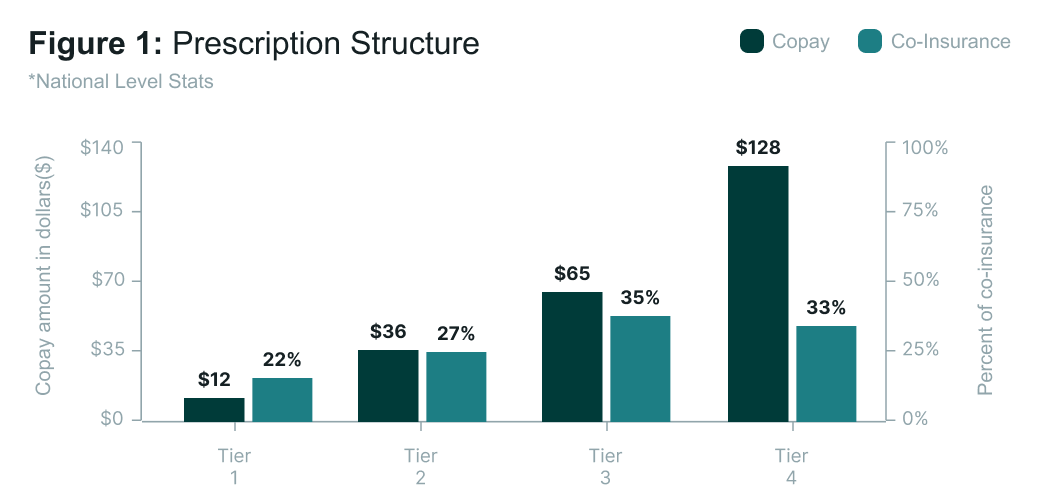
  • Tier 1 (Generics): Lowest-cost drugs, usually just a $10–$20 copay. They are widely accessible and often encouraged as first-line therapy.
  • Tier 2 (Preferred Brands): Brand-name drugs that PBMs have negotiated discounts on. Employees typically pay $30–$50 copays or around 20% coinsurance.
  • Tier 3 (Non-Preferred Brands): Higher-cost brand drugs not favored on the formulary. Employees may owe 40%+ coinsurance, leading to hundreds in out-of-pocket costs.
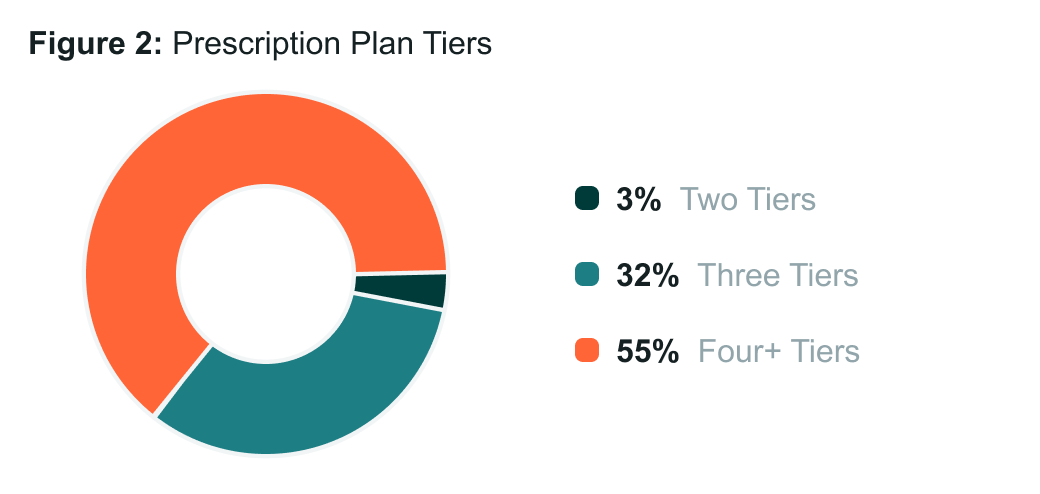
  • Tier 4 (Specialty Drugs): High-cost therapies for serious conditions like cancer or hemophilia. These usually require coinsurance (20–30%), which can mean thousands of dollars per month. Although they make up less than 2% of prescriptions, specialty drugs drive nearly half of total drug spending.

Copays vs. Coinsurance

  • A copay is a fixed, predictable dollar amount per prescription.
  • Coinsurance is a percentage of the total drug cost until the deductible or out-of-pocket maximum is reached. While it helps share costs, it creates unpredictability—especially for specialty drugs, where 25% coinsurance could mean $250 on a $1,000 medication or much more on therapies costing thousands each month.

For employers, understanding how tiers and cost-sharing are structured is critical, since they directly affect both plan expenses and employee affordability.


High-Cost Drugs and Their Outsized Impact

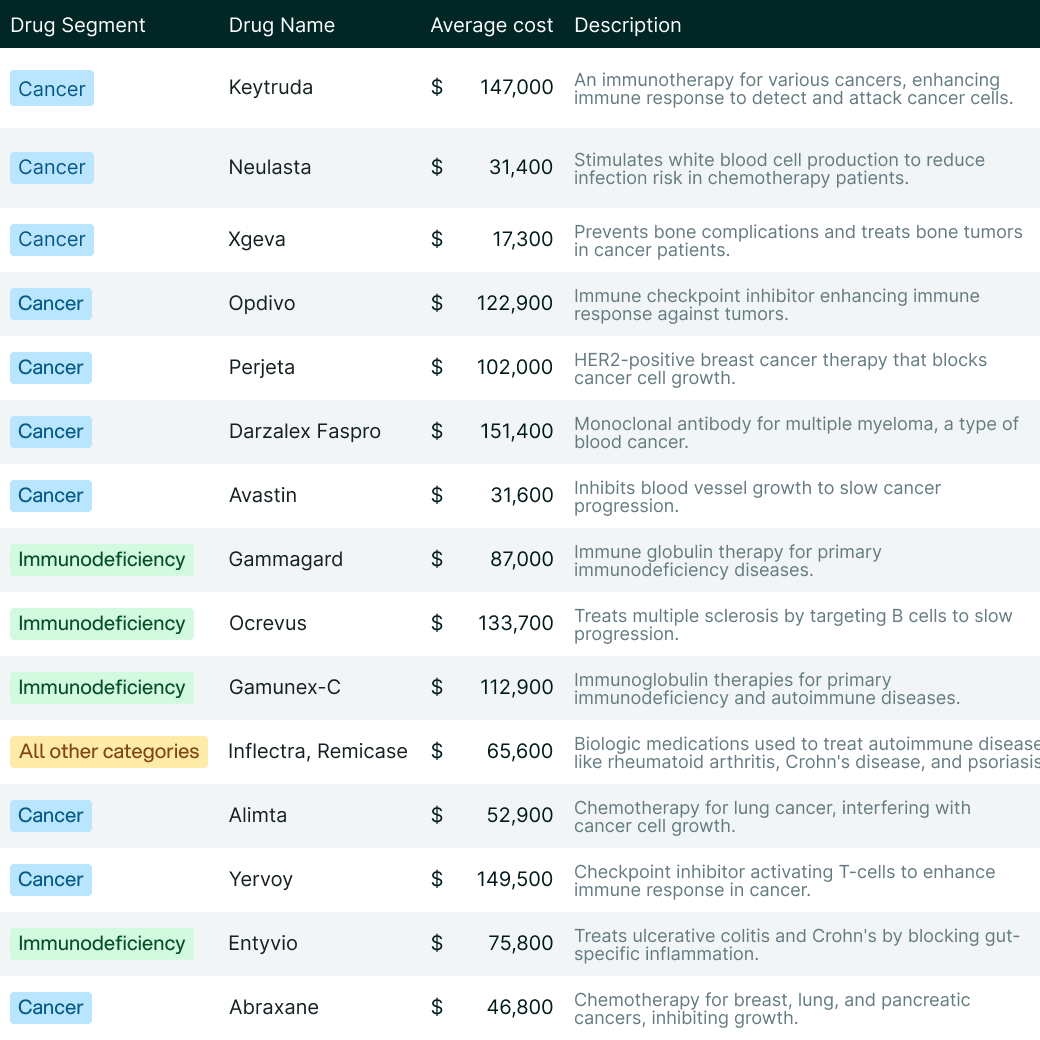
While high-cost drugs represent only a small fraction of total prescriptions, their impact on employer health plans is staggering. Specialty medications—such as those for cancer, hemophilia, and autoimmune disorders—account for less than 2% of prescriptions but drive close to 50% of all drug spending. Their costs have grown at double-digit rates year over year, fueled by new biologics, gene therapies, and infusion-based treatments that can run into hundreds of thousands of dollars annually. According to Sun Life’s High-Cost Claims Report, in many catastrophic claim categories like hemophilia or leukemia, prescription drugs make up more than 90% of the total cost of care. For employers, this means a single claimant on a specialty drug can dramatically shift overall plan spend, making pharmacy benefits one of the most volatile and financially significant areas to manage.

How Carriers Handle High-Cost Drugs

Carriers cover most FDA-approved specialty drugs but tightly manage access and cost. They use formularies to decide which drugs are included (and on what tier), require prior authorization or step therapy before approving treatment, and often restrict dispensing to their own specialty pharmacy networks. Coverage is generally limited to drugs deemed medically necessary, while experimental or non-formulary drugs are excluded unless appealed. For employees, this can mean higher coinsurance, delays in approval, and fewer choices on where prescriptions can be filled.

Who Controls the PBM Market—and Who’s Challenging It

Today, most carriers are tied to the “Big Three” PBMs, which together control more than 75% of the market:
  • Aetna/CVS → CVS Caremark
  • Cigna → Express Scripts
  • UnitedHealthcare → OptumRx
  • Anthem/Blue Cross (varies by region) → Caremark or Express Scripts

This consolidation means that for many employers, pharmacy benefits are automatically bundled with one of these large PBMs, leaving little room for visibility or flexibility.  

The remaining 25% is made up of disruptors offering more transparent models. Players like SmithRx (pass-through pricing with detailed reporting), MedOne (independent PBM with customizable formularies and full rebate pass-through), and Mark Cuban’s Cost Plus Drugs (a direct-to-consumer model selling drugs at cost plus a small margin) are challenging the status quo. For employers, knowing which PBM their carrier relies on—and whether a carve-out to one of these disruptors is possible—can be a critical step in controlling pharmacy costs.

Legislation and Reform Efforts

In recent years, lawmakers have increasingly targeted the opaque practices of PBMs, introducing multiple federal bills like the Pharmacy Benefit Manager Transparency Act (S. 127, 2023) and the PBM Transparency Act of 2025 (S. 526). These aim to ban spread pricing, require full rebate pass-through, and mandate detailed reporting—but none have passed into law yet. Similarly, a 2025 House bill dubbed the PBM Reform Act proposes greater transparency around Medicare Part D contracts and delinking PBM compensation from drug prices, but it remains pending in committee.

At the state level, all 50 states have enacted some degree of PBM regulation. Few states have gone further: for example, Iowa is considering a law imposing minimum pharmacy dispensing fees, and Arkansas passed legislation curbing PBMs’ ownership of pharmacies—though that law has been temporarily blocked by a federal judge

In short: there's plenty of activity at both federal and state levels—but no sweeping reforms have become law yet, leaving employers to manage PBM challenges proactively on their own.

Be Educated: Key Questions to Ask Your Broker

  1. Who is our PBM, and is it bundled with our carrier?
  1. Do we receive 100% of rebates, or are they retained?
  1. Can we carve out our PBM given our size and funding model?
  1. Which high-cost drugs are driving our spend?
  1. Do we get claim-level reporting from our PBM? (often not)
  1. What specialty drug management strategies are in place?
  1. How does our plan compare to industry peers?

Closing Thoughts

Prescription drug costs are no longer a side issue—they’re a central driver of employer healthcare spend. The combination of high-cost specialty therapies and the opaque role PBMs play in setting formularies, controlling access, and managing rebates makes this one of the most complex and consequential areas of benefit management. For employers, the path forward starts with awareness: knowing which PBM you’re tied to, how rebates flow, which drugs are shaping your spend, and what levers you have to push for transparency or carve out alternatives.

While legislation at the federal and state levels may eventually bring more clarity and accountability to the PBM market, employers cannot afford to wait. By asking sharper questions, exploring disruptive PBM models, and partnering with brokers who understand this space, employers can take meaningful steps today to control costs and support employees more effectively.

Bottom line: Prescription drug costs are only going up. Employers that engage now—by digging into the details and holding PBMs and carriers accountable—will be best positioned to protect both their budgets and their people.

Employee Benefits
The Employers' Guide To Ozempic and GLP-1 Drugs
There's growing demand by employees for increasingly expensive prescription weight-loss solutions as employers weigh the costs and benefits of providing coverage for these drugs when used for weight-loss purposes.
July 22, 2024

Key Takeaways:

  • Ozempic and other GLP-1 drugs have a number of different uses with more still being tested and discovered, but their (sometimes off-label) effectiveness as a weight loss drug has led to a spike in demand in the last couple years that continues to climb
  • These drugs can cost as much as $15 thousand per year per user and represent a growing proportion of total employer health care costs that may have accounted for almost 9% in 2023 - a 2% increase from 2022
  • Some employers are abandoning GLP-1 coverage in the face of those growing expenses, but others are expanding coverage in pursuit of the reduced long-term health care expenditures and a competitive advantage in terms of talent attraction and retention, with about 1 in 3 employers currently covering these drugs for weight loss purposes
  • Some ways employers are attempting to offer these drug treatments for weight loss purpose while also limiting their exposure to excessive expenses include lifetime use caps, minimum body mass thresholds, and limiting drug offerings

ARTICLE | The Employers' Guide To Ozempic and GLP-1 Drugs

The meteoric rise of Ozempic has been widely documented. 

More than just the traditional drug marketing via billboards, commercials, and pamphlets at primary care offices, some of the most heavily publicized evidence of Ozempic’s effectiveness has been found on magazine covers, streaming platforms, and in social media feeds, all providing the kind of organic promotion that even huge sums of money can’t (always) buy.

While to some it may seem like a miracle drug - with potential health benefits including blood sugar regulation, cardiovascular issue risk reduction, and of course weight loss - there is, it seems, at least one catch - Ozempic is very expensive.

The sudden surge in demand as a result of Ozempic’s success has left manufacturers scrambling to keep up, which has contributed to soaring prices and in turn sent employers and insurance providers struggling to adapt to the rapid rise in popularity of a drug that can cost more than $1,000 per person per month. 

Not all employers are addressing that tension between the growing employee demand and the accompanying growing expense in the same way, however, and in this piece we’ll take a look at some of those potential approaches as well as some of the potential costs and benefits associated with each.

Background

Ozempic is a type of drug known as a GLP-1, which is a relatively new class of drugs that first gained approval from the FDA in 2005. 

There are currently at least 10 different GLP-1 drugs, but treating diabetes, cardiovascular conditions, and/or weight loss seem to be fairly consistent among them, although new uses such as treating kidney disease are still being explored.

Ozempic was approved by the FDA as a diabetes medication in the final month of 2017 before hitting the market in earnest the following year, but it wasn’t too long before users and their doctors started taking note of the weight loss side-effect.

Nearly 20 thousand Ozempic prescriptions were written in 2018, which grew to just over 60 thousand active prescriptions in 2019, 100 thousand in 2020, and 160 thousand in 2021. 

But in 2022, Ozempic seems to have crossed the tipping point, with prescriptions doubling to more than 300 thousand over the year before then growing by another 25% - up to about 375 thousand - within the first couple of months of 2023, which is the most recent data available.

Collectively, prescriptions for Ozempic and its GLP-1 weight loss drug competitors have grown by more than 300% over the last 3 years with total US sales growing from less than $5 billion at the end of 2020 to more than $15 billion at the end of 2023. 

According to a Gallup poll released at the end of May 2024, more than 15.5 million people in the US had used one of these drugs for weight loss - representing 6% of the US population and counting. 

GLP-1 Drug Sales In US (Ozempic, Rybelsus, Wegovy)

The Problem

According to the Pew Research Center, about 3 in 4 Americans are either overweight or obese based on current medical classifications, and that number has been growing pretty consistently for a quite awhile.

As a result, the target market of potential Ozempic, et al. weight loss users is considerably larger than the (still substantial) 30 plus million Americans with type 2 diabetes, and although the resulting Ozempic shortages are certainly more problematic for the latter group, any sufficiently substantial surge in demand will make the price goes up for everyone.

While the company that produces Ozempic has plans in the works to build a more than 4 billion dollar factory in order to improve production capacity, any release of demand pressure as a result of the increased accessibility of the drug is still likely several years away at least.

Further, that patent on Ozempic will prevent the production and sale of cheaper generic alternatives until at least 2031 in the US, so no short-term cost-saving hope on that front either.

Given these market conditions, Ozempic-comparable weight loss drugs are likely to continue costing upwards of 15 thousand dollars per patient per year for the foreseeable future. 

For employers, those costs, which essentially were non-existent just a handful of years ago before doctors started prescribing GLP-1 drugs for weight loss, accounted for 8.9% of total employer health care spending in 2023 according to a survey from the International Foundation of Employee Benefits - up from 6.9% of total employer health care expenses the year before. 

Proportion Of Americans Who Are Overweight Or Obese Over Time

How Are Employers Responding

At those prices in the face of near-exponential demand growth, it is not hard to understand why multiple health systems have chosen to drop or reduce weight-loss-based GLP-1 coverage from their employer-sponsored plans, including Hennepin Health Care, University of Texas Health System, and the Mayo Clinic. 

At the same time, however, other employers and health systems are looking past the sticker shock and weighing the totality of health benefits that can accompany weight loss in the cost-benefit analysis, including potential reversal of diabetes, cardiovascular improvements, reduced incidence of certain cancers, and improved arthritic conditions. 

After looking at those net benefits, a growing number of companies including Elevance Health, Kaiser Permanente, and CVS Health are expanding coverage and concluding that it is worth paying the high ticket price of GLP-1 medication for improved patient outcomes and the expectation of reduced expenses in the long run.

In terms of proportional breakdown, those employers who see the value in GLP-1-assisted weight loss are still in the minority, but they have the momentum on their side, with the percentage of employers covering Ozempic or a comparable drug for weight loss purposes rising to 34% in 2023, up from 28% in 2022. 

Further, larger businesses are even more likely to adopt GLP-1 weight loss coverage according to the head of Cigna’s health services business, who also noted that 50% of the employers utilizing their pharmacy benefits management system already cover GLP-1 weight loss uses, and that figure is inching up.

Finding The Right Balance

For those employers who are not yet ready to buy-in completely on the long-term benefits or for whom full coverage of Ozempic and comparable drugs for weight loss purposes is economically infeasible in the short-term, there are still several measures that can be taken in order to minimize the risk of runaway costs while still providing employees with a meaningful option.

  • Lifetime Cap: Some companies are limiting their exposure to excessive GLP-1 weight loss expenses by setting a lifetime cap on the amount of funds available to covered employees. The Mayo clinic, for example, instituted a lifetime cap of $20 thousand per person in order to provide meaningful access to these drugs for weight loss purposes while also putting a ceiling in place on a rapidly growing expense line item. 
  • Minimum Body Mass Threshold: Other companies have set a minimum body mass index that must be met in order to qualify for GLP-1 weight loss drugs, limiting cost exposure by limiting the size of the population with access to these treatments. Fairview Health Services, for example, only offers GLP-1 weight loss coverage to employees with a body mass index of 40 or higher.
  • Limit GLP-1 Options Covered: Some companies also restrict the number of GLP-1 weight loss drug options to only those that are the most cost effective at any given time, which may also reduce demand.

Mployer Advisor’s Take

The appetite for these drugs among employees is likely to continue growing, especially as new treatments and functions emerge (i.e. treating kidney disease), which will likely keep the costs relatively inflated in the short term even as new production capacity comes online.

In the long run, however, short term price inflation may be a small price to pay relative to the long-term benefits that can potentially come from a reduced risk of obesity-related illnesses that go well beyond cost savings, and that’s true for both employers and employees.

But more than just putting upward pressure on the price, that demand reflects health care that is both expensive and increasingly sought after by a large portion of the talent pool, so there’s also an opportunity here to differentiate your organization from the competition in terms of employee attraction and retention.

Although some employers are moving away from Ozempic and other GLP-1 coverage to curb those growing expenses, there are more employers moving in the opposite direction and opening up coverage, and absent an unforeseen change in circumstances, that trend is unlikely to reverse course anytime soon.

Compliance & Policy
Top 25 States With Most Employee-Friendly Paid Leave Laws (Part 2)
Even among states with some paid leave requirements, the nature and degree of those requirements can vary significantly, with some states adopting relatively minimal paid leave requirements and others with paid leave laws that are significantly more involved and comprehensive.
July 11, 2024

Key Takeaways

  • Even among states with paid leave requirements, the nature and degree of those requirements can vary significantly, with some states adopting relatively minimal paid leave requirements and others with paid leave laws that are significantly more involved and comprehensive
  • Employers with operations in different locations or those seeking to expand beyond their city/county/state borders will likely have to take an assortment of paid leave rules into account in crafting and executing their own internal paid leave policies
  • While applicable laws certainly shape paid leave policy and expectation from one place to another, employers that operate in areas with relatively unobtrusive paid leave rules often adopt policies that go well beyond the minimum required of them by the government in order to comply with industry/geographic norms and/or gain a competitive advantage with regard to talent attraction and retention

ARTICLE | Top 25 States With Most Employee-Friendly Paid Leave Laws (Part 2)

In part 1 of this 2 part series, we took a look at the 25 states with the most employer-friendly laws and regulations in terms of the circumstances in which the state may require some or all employers to provide some or all employees with paid leave. 

In this piece, we’ll review the paid leave rules in the remaining 25 states that have more employee-friendly laws and regulations, which includes a much wider spectrum of regulatory involvement, ranging from a relatively minor paid leave requirements that don’t go much beyond what is required in the states covered in Part 1, all the way up to substantial, robust paid leave mandates and worker protections.

Arizona

Arizona paid leave law requires private employers with $500,000 or more in annual revenues to provide their employees with one hour of paid sick leave for every 30 hours worked. 

For employers that have more than 15 or more employees, those employees can accrue up to 40 hours of sick leave per year, while the employees of employers with fewer than 15 employees can accrue a maximum of 24 hours of paid sick leave per year. 

Employers can require employees to wait up to 90 days after the start of their employment before they can use any paid sick leave that has accrued, and employers are not required to pay out any accrued PSL upon termination, employees are allowed to roll over paid sick leave from one year to the next.

Arizona employers are also required to provide up to 3 hours of paid leave to enable employees to vote in any municipal, county, state, or federal primary or general election if those employees do not already have 3 consecutive hours available to them when the polls are open and they are not required to be at work. 

California

California enacted one of the more robust paid sick leave policies among states, requiring pretty much all employers - with few exceptions, such as railroad companies and airlines - to provide at least 40 hours of paid sick leave each year to their employees, even part-time and temporary workers, who have worked at least 30 days out of the first year of their employment. While employees begin accruing pid sick leave as soon as they begin working, accruing at 1 hour of paid sick leave for every hour worked, employees are not legally allowed to use the accrued leave until they have been on the job for at least 90 days.

California state law doesn’t require employers to offer either paid or unpaid vacations, but if an employer chooses to offer PTO, then any unused hours (not including unused paid sick leave) must eventually be paid out with the employee’s last paycheck. 

Further, while California employers are required to allow employees to roll over unused PTO days, as well as up to 80 hours of paid sick leave, they do have significant leeway in determining how many consecutive PTO days an employee can use, preventing employees from using PTO on certain dates, and implementing notice requirements that must be met before leave will be granted. 

California law entitles employees to 8 weeks of paid family leave at between 60% to 70% of employee’s income, up to $1,620 each week in 2024, although importantly this leave is not necessarily job-protected, though other state and federal laws may protect an employees job in this situation nonetheless. State Disability Insurance can also be used as support for up to 1 year with weekly payouts of between 60% -90% of income, capped at $1,325 per week. 

California employees who don’t otherwise have time to vote also get up to 2 paid hours for voting leave if they provide their employers with at least 3 days’ notice of their intent to be away from their job for the purpose of voting.

Colorado

Colorado state law requires all employers to provide paid sick leave, which accrues at a rate of one hour of paid sick leave for every hour worked. That accrued sick leave can be capped at 48 hours per year, but Colorado law requires employers to allow employees to roll over unused paid sick leave from one year to another. 

Colorado employees who earn at least $2,500 per year and have been on the job for at least 180 days are entitled to up to 12 weeks of family leave with partial pay, which can include up to an additional 4 weeks of paid parental leave in the event of pregnancy and/or childbirth complications. 

And while Colorado state law does not require employers to offer paid vacation time, Colorado does require employers to pay out any unused PTO in the event that the employee leaves the company.  

Colorado law also requires employers to pay employees $50 per day for the first 3 days of jury duty service, after which the state will take over jury service compensation. 

Finally, for any employee whose shift starts less than 3 hours after the polls open or ends less than three hours before the polls close, employers must offer up to 2 hours of PTO so that employees can exercise their right to vote, and while employers can choose when an employee votes during the middle of a shift, if the employee requests to vote at the beginning or end of a shift, the employer is obligated to honor that request.

Connecticut

Connecticut law requires employers who had averaged at least 50 employees at some point in the prior year, to provide paid sick leave to employees who work at least 10 hours a week, which accrues at a rate of 1 hour of paid sick leave for every 40 hours worked for up to 40 hour per year, which can be rolled over to the next year if unused. Paid sick leave hours begin accruing immediately, but can not be used until an employee has worked 680 hours on the job. These rules cover most employees, but exceptions include employees who are exempt from overtime and minimum wage rules in accordance with the Fair Labor Standards Act. 

Paid family and medical leave is available to most Connecticut employees (including many sole proprietors and self-employed people) for up to 12 weeks per year (with a potential additional 2 weeks in the event of medical complication) so long as the employee has earned at least $2,325 in one of the previous four quarters, is currently employed, and has been employed for the preceding 12 weeks. Qualifying employees can receive up to 95% of their typical income with a cap set at 60 times the state’s minimum wage, currently $15.69 per hour. 

Further, for the first 5 days of an employee’s jury duty service, Connecticut law requires employers to pay employees $50 per day before the state then takes over those payments. 

While Connecticut voters had been entitled since 2021 to 2 hours of paid time off to vote in special elections and standard elections for state and federal representatives should they request that time off at least 2 days in advance, those rules are set to expire at the end of June 2024, after which time the voting paid time off requirement will no longer be valid absent the intervention of Connecticut lawmakers. 

Delaware

Delaware currently has no laws in effect with regard to paid time off requirements, but beginning January 1, 2026, employees who have worked at least 1,250 hours for an employer over the past year are eligible for up to 12 weeks of paid family and medical leave at a rate equivalent to the lesser of $900 per week or 80% of the employee’s weekly pay. 

Georgia

Georgia state law requires employers with 25 or more employees to allow those employees who work at least 30 hours per week to accrue up to 5 paid sick leave days per calendar year that can be used to care for close family members in need. 

Hawaii

Hawaii state law allows for partial paid leave via Temporary Disability Insurance, which requires that an employee has worked in Hawaii for 14 or more weeks and has worked at least 20 hours and earned at least $400 in each of those weeks, although the weeks need not be in a row and can be spread among multiple employers. Employees can receive up to 67% of their average weekly wages, with a cap that’s currently set around $700 per week. 

While pregnancy and childbirth applications of the temporary disability insurance program usually last between 4 and 6 weeks, the disability insurance generally is available for up to 6 months. 

Hawaiian employees that don’t already have 2 consecutive hours when they are off work and polls are open are also entitled to up to 2 hours of paid voting leave, though employers can require proof that the employee voted. 

Illinois

Illinois state law entitles employees with 1 hour of flex leave for every 40 hours worked (capped at 40 hours per year) that can be used for any purpose. Employees must, however, wait 90 days after their leave time has begun accruing before they can exercise it, and employers are allowed to require 7 days notice before accrued leave can be used and can set a minimum leave usage increment of at least 2 hours. 

Whether or not employees are allowed to roll over unused leave depends on whether employers have front-loaded leave (i.e. provided a pro rated 40 hours on the first day of the year to all employees, in which case employee leave does roll over from one year to the next) or whether employees accrue their hours of leave one at a time - 1 hour of leave for every 40 hours worked as described in the preceding paragraph - in which case leave does roll over. 

Further, while Illinois does not provide for paid sick leave statewide, Cook County and the city of Chicago both have laws in place guaranteeing paid sick leave for employees who have been with their employer for at least 6 months, worked at least 2 hours within the city/county over the last 2 weeks, and have worked at least 80 hours within the last 120 days. Paid sick leave for qualifying employees accrues at 1 hour for every 40 hours worked, capped at 40 hours annually. 

Employees in Illinois are also entitled to up to  2 hours of paid leave in order to vote if their schedule does not already provide for 2 consecutive hours off work during which the polls are open. 

While Illinois does not require most unused leave to be paid out upon termination, if leave has been specifically granted as PTO or vacation, then employers must compensate employees for it when an employee leaves the company.

Louisiana

Louisiana employers are not required to provide paid vacation time, but those employers that choose to offer such PTO are required to pay out any unused time at the conclusion of employment if the employee is eligible for a vacation at that time of their departure according to company policy.

Louisiana employers also must provide employees with one day’s wages on the employee’s first day of jury duty.

Maine

Maine law requires that most employers provide employees with 1 hour of paid leave for every 40 hours worked, capped at 40 hours per year - although there are exceptions including employers with fewer than 10 employees and employees that are seasonal or commission-based. 

If employers front-load employee paid leave banks to 40 hours at the start of each year (or at the start of an individual new employee’s employment) then that leave is not required to roll over, but if the leave is accrued, then roll over is mandated by law. Employers must also pay out any unused leave at the conclusion of an employee’s employment. 

Maryland

Maryland state law requires employers to provide 1 hour of paid sick leave for every 30 hours worked, capped at 40 hours per year, to employees who have worked for the employer at least 12 hours per week for 15 weeks, although the law excludes employees under the age of 18, independent contract workers, seasonal agricultural workers, and those operating under collective bargaining agreements. Further, unused leave can roll over but the bank is capped at 64 hours accumulated total. Employees who work at least 8 hours each week in Montgomery County have their annual sick leave accrual cap set at 56 hours.

For employers with 15 or more employees that do provide paid leave, the Maryland Flexible Leave act provides for paid time off in the event of an illness or death of an immediate family member, as well. 

Maryland employers are also required to provide at least 2 hours of paid voting leave if an employee’s schedule does not already provide for 2 consecutive non-working hours when polls are open. 

Massachusetts

Massachusetts state law does not require employers to provide paid vacation leave, but employers who have adopted such a policy are required to pay out any unused time when the employee leaves the company. 

Massachusetts employees earn 1 hour of paid sick time for every 30 hours worked - capped at 40 hours per year and unusable until the employee has been on the job for at least 90 days - which can be utilized to take care of themselves and/or close family members dealing with physical or mental illness. Employers are allowed to require 7 days notice for appointments that are scheduled in advance, and can also opt to allow employee paid sick leave to accrue on a statutorily-set lump-sum schedule if they don’t want to track the hours worked of individual employees. Employers in Massachusetts also have the option of front-loading paid sick leave for their employees, in which case roll over isn’t required, but roll over is mandated when the leave is accrued.

Massachusetts employees are also entitled to up to 12 weeks of paid family leave and 20 weeks of paid medical leave which can combine to amount to as many as 26 weeks of paid leave in a year. 

Further, Massachusetts employers are required to pay out up to 3 days of jury duty leave.

Michigan

Michigan state employers and private employers with 50 or more employees must provide paid sick leave to employees who work at least 25 hours a week for at least 26 weeks a year, which accrues at a rate of 1 hour of leave for every 35 hours worked, capped at 40 hours per year and can roll over from one year to the next if unused. Employees, however, are not allowed to use accrued leave until their 90th day on the job. Employees exempted from these paid sick leave requirements include workers operating under collective bargaining agreements or those exempt from minimum wage and overtime regulations. 

Minnesota

Minnesota employees who worked at least 80 hours over the last year in Minnesota can accrue 1 hour of paid sick leave for every 30 hours worked, capped at 48 hours per year - but that paid leave doesn’t become available to employees until they’ve been on the job for 90 days. Unused hours also roll over from one year to the next, capped at 80 hours. 

4 cities in Minnesota - Minneapolis, St. Paul, Duluth, and Bloomington - each have additional paid sick laws that go further than the statewide paid sick leave requirements. 

Minnesota employers are also required to allow employees paid leave so they can vote, though no minimum or maximum lengths of time for that leave are specified. 

Nebraska

Nebraska employers are not required to provide any paid vacation leave, but if they do offer such PTO, employers are required to pay out for any PTO that remains unused when an employee leaves the company. Nebraska state law also specifically forbids Nebraska employers from enacting use-it-or-lose-it policies with regard to earned leave, so Nebraska employees are entitled to be paid out for any remaining unused leave at the conclusion of their employment.

Nebraska law also requires employers to provide paid leave for jury duty, and 2 consecutive hours of paid leave to vote in municipal, country, state, and federal primaries and general elections if the employees schedule does not already allow for 2 consecutive off-duty hours during polling hours, though employers retain the right to determine during which hours eligible employees are allowed paid leave in order to vote. 

Nevada

Nevada employers with 50 or more employees must provide flex leave time that can be used for any purpose, which employees acquire at a rate of 0.01923 hours of paid leave per hour worked, which is about 1 hour of paid leave for every 52 hours worked. The law doesn’t apply to temporary, seasonal, and on-call workers, and employers can exempt themselves from the law by providing a flat 40 hours of paid time off each year to each eligible employee. Employers who have been in operation for less than 2 years are also exempt.

Further, Nevada state law doesn’t cap the amount of PTO that employees can accrue, but it does allow employers to limit the amount that employees can use to as little as 40 hours in a benefit year. Employees must also work for 90 days before they are able to use any of the accrued PTO.

Employers are required to provide paid leave for employees to vote, as well: 1 hour of paid leave if the polling place is less than 2 miles away, 3 hours of paid leave if the polling place is more than 10 miles away, and 2 hours of paid leave otherwise. 

New Jersey

New Jersey law mandates that employees earn 1 hour of paid sick leave for every 30 hours worked capped at 40 hours per year, and employees must be on the job for 120 days before utilizing any accrued paid leave. Further, employees are entitled to roll over from one year to the next up to 40 hours of unused paid sick leave, but employers can require up to 7 days notice for appointments and can require reasonable documentation for absences that last 3 or more days in a row. 

New Jersey state law also enables employees to take up to 12 weeks per year of flexible paid family leave, which is funded by the New Jersey Family Leave Insurance Program via payroll deductions. 

New Mexico

New Mexico state law entitles employees to 1 hour of paid sick leave for every 30 hours worked, capped at 64 hours per year, which employees can roll over from one year to the next. 

New Mexico does not require PTO accrual, but if an employer adopts a policy of providing PTO and allowing earned/unused hours to accrue, then unused time off must be paid out when the employee leaves the company. 

Employers in New Mexico must also allow employees 2 hours to vote if polls are not open for 2 hours prior to the start of a shift of 3 hours after the end of a shift. 

New York

New York employers that have between 0 and 4 employees and more than $1 million in revenue and New York employers that have between 5 and 99 employees regardless of revenue must provide employees with 40 hours of paid sick leave per year, accrued at 1 hour of leave for every 30 hours worked. New York employers with 100 or more employees must provide 56 hours of paid sick leave each year.

New York employees are also entitled to 12 weeks of paid family leave per year after they have completed at least 26 weeks in a row of at least 20 hours of work per week. Those leave payments are typically covered through insurance and provide up to 67% of an employee’s average weekly salary, capped at 67% of the statewide average weekly salary, which currently puts the cap at about $1,068 per week.

New York employees are also entitled to collect up to 26 weeks of short-term disability (or 4 to 6 weeks for disability as a result of pregnancy and/or childbirth), but these disability payments are only available during times when an employee is actually, physically unable to perform the job. 

New York state law also requires that employers with more than 10 employees must pay $40 dollars a day for each of the first 3 days of an employee’s jury duty service.

New York employees that don’t have 4 consecutive hours during which to vote are also entitled up to 2 hours of paid voting leave, but employees must notify their employers between 2 and 10 days before their planned voting absence, and employers can choose what time the voting leave is exercised.

Oregon

Oregon employers are not required to provide paid vacation leave, but if they choose to offer it and their employment policies and contracts don’t specifically absolve employers of the responsibility to pay out unused PTO at the conclusion of employment, then employers are required to make those payouts when an employee parts ways with the employer.

Oregon employers with 10 or more employees are required to provide paid sick leave at a rate of 1 hour earned for every 30 hours worked, which is capped at 40 hours per year that can be rolled over to the next year when unused (unless the leave is front-loaded), but any accrued leave can not be used until the employee has worked at least 90 days. 

Oregon employees are also entitled to up to 12 weeks per year of paid family/medical/safe leave via a social insurance program.

Rhode Island

Rhode Island state law requires employers to pay out any unused PTO upon termination if the employee has been on the job for at least 1 year. 

Rhode Island employers that have 18 or more employees are required to provide paid sick leave at a rate of 1 hour for every 35 hours worked (capped at 40 hours per year and capable of roll over from one year to the next), which accrue immediately upon commencement of work but can not be used for the first 90 days of employment. 

Rhode Island employees are also entitled to up to 30 weeks of temporary disability insurance and up to 6 weeks of temporary caregiver insurance, each offering up to about $1000 per week.

Tennessee

Tennessee employers with 5 or more employees are required to provide paid leave for jury duty service, though employees must show their employer their jury summons on the day they receive their jury summons or the day after receiving summons in order to be eligible, and employers can deduct any payment received from the court from the wages owed to the employee. 

Tennessee employers are also required to provide up to 3 consecutive hours of paid vote leave to any employee that does not already have 3 consecutive hours off work when the polls are open. In order to qualify, employees must request paid voting leave by 12pm on the day prior to Election Day.

Tennessee state employees and some metropolitan employees also are eligible for up to 6 weeks of paid family leave. 

Utah

Utah employers are not required to provide PTO, but if they do they must explicitly make clear their policy of not paying out unused PTO upon termination, otherwise unused PTO must be paid out when an employee is terminated. 

Utah employees that don’t already have at least 3 hours off during polling hours are entitled to 2 hours of paid voting leave, provided that they give their employer at least 1 day of advanced notice, and employers may still choose when the leave is exercised.

Vermont

Vermont employees earn 1 hour of paid sick leave for every 52 hours worked, capped at 40 hours per year which can be rolled over from 1 year to the next if unused, but employees may have to wait up to 1 year before utilizing accrued leave. In order to be eligible, however, employees must be at least 18 years old, must have worked at least 20 weeks in the last year, and must have averaged 18 hours per week over the year, as well.

Washington

Washington employers are required to provide employees with paid sick leave that accrues at a rate of 1 hour earned for every 40 hours worked, with up to 40 hours capable of being rolled over from one year to the next. Employees may have to wait 90 days before utilizing the accrued leave, at the employer's discretion. 

The city of Seattle expands upon the statewide paid sick leave rules by allowing the employees of employers that employ between 50 and 259 employees to roll over 56 hours of accrued paid sick leave per year, while employees of employers with 250 or more employees can roll over up to 72 hours per year of unused leave.

Washington state law also provides for a paid family leave insurance program that enables employees to take up to 12 weeks of paid leave for many family and medical events including childbirth under normal circumstances, and up to 18 weeks given certain qualifying events. 

Mployer Advisor’s Take

While the range of regulatory involvement with regard to paid leave varies considerably between states, the bars set by state rulemakers can tend to be on the low-side relative to the actual paid leave benefits offered by companies within those states.

Even in states with no paid leave requirements whatsoever, industry and regional/intra-state norms often set standards that many if not most applicable employers follow, and those norms can sometimes go beyond the heftier mandates laid out by some of the states with more comprehensive regulation, as well.

As a result, in order to maintain a more complete picture of both best practices and talent expectations, it is important to keep up with a changing regulatory environment, both on the state and federal level, as well as benchmarking against comparable employers in the same industry and/or region.

Compliance & Policy
Top 25 States With Most Employer-Friendly Paid Leave Laws (Part 1)
Laws and regulations that mandate paid leave for employees in certain circumstances can vary widely from state to state, from circumstance to circumstance, and even within a given state.
July 11, 2024

Key Takeaways

  • Laws and regulations that mandate paid leave for employees in certain circumstances can vary widely from state to state, from circumstance to circumstance, and even within a given state
  • Employers with operations in different locations or those seeking to expand beyond their city/county/state borders will likely have to take an assortment of paid leave rules into account in crafting and executing their own internal paid leave policies
  • While applicable laws certainly shape paid leave policy and expectation from one place to another, employers that operate in areas with relatively unobtrusive paid leave rules often adopt policies that go well beyond the minimum required of them by the government in order to comply with industry/geographic norms and/or gain a competitive advantage with regard to talent attraction and retention

ARTICLE | Top 25 States With Most Employer-Friendly Paid Leave Laws

Last month, we covered the rising popularity and prevalence of consolidated and unlimited leave policies relative to non-consolidated leave policies, which have now nearly become a minority policy among US employers.

These policy choices and changes do not occur in a vacuum, however, and can be significantly impacted by both industry and geographic norms as well as governmental rules and regulations, which can sometimes vary widely from one state, county, and municipality to another.

While data on the geographic distribution of leave policy structure can be found in our benchmarking reports, available on mployeradvisor.com, this piece will be the first in a pair of articles that will highlight major differences in the rules governing paid leave from state to state in the US, compiled from information primarily from Vacation Tracker and Paycom.

This piece will cover the 25 states that provide the most leeway for employers to determine their own policies with regard to providing employees with paid leave.

Alabama

Alabama state paid leave law requires only that employers provide their employees with paid leave for jury duty if the employee provides notice of jury duty summons within one business day of receiving the summons. Further, that PTO for jury duty service must not reduce the amount of PTO an employee may have otherwise accrued, although employers are permitted to deduct the amount paid to the employee by the court from any amount the employer owes the employee.

Alaska

Alaska state paid leave law requires employers to provide employees with paid voting leave in order to cast ballots in municipal, county, state, and federal primary and general elections if that employee’s shift starts earlier than 2 hours after the polls open or ends later than 1 hour before the polls close. While the employee is to be given sufficient time to enable them to vote, the employer gets to determine the hour(s) when the employee leaves work to cast their vote.

Arkansas

While Arkansas provides no mandatory paid leave for private employees in the state beyond what the policies and contract requirements set by the employers themselves, state law does allow public employees paid sick leave for illness, injury, and the death or illness of a close family member. Those public employees can accrue up to 30 days (depending on employee tenure) of paid sick leave every year.

Arkansas state law also requires state employers to provide paid leave for jury duty, but no similar requirement exists for private employers, although private employers are prohibited from requiring an employee to use vacation or other leave in order to fulfill their jury duty requirements.

Florida

Florida state law imposes no obligations on employers with regard to paid leave for employees.

Idaho

Idaho state law entitles state employees to up to 8 weeks of paid leave following the birth or adoption of a child, but no similar requirement for private employers exists unless the private employer has adopted or contracted to provide such a policy.

Indiana

Indiana state law makes no requirements for employers to provide employees with paid leave.

Iowa

Iowa provides for some paid vacation leave for state employees, but there is no similar requirement for the employees of private employers.

Further, employees who do not have 3 consecutive hours off work during which time polls are open are entitled to up to 3 hours of paid leave in order to cast their votes, though employers have the right to determine which 3 hours are made available to their employees.

Kansas

Kansas has no formal state laws requiring paid leave, although internal leave policies adopted by companies may be legally enforceable against employers if they rise to the level of a “promise.”

Kansas employers must, however, provide employees with up to 2 consecutive hours to vote (including employee non-working hours when the polls are open) and the timing of which the employer has the right to determine.

Kentucky

In Kentucky, employers are not required to offer paid leave for vacation, but if they do offer such paid leave, it is considered essentially equivalent to wages and must be dealt with accordingly - in this case meaning any unused leave of this sort must be paid out when an employee leaves the company.

Further, while Kentucky doesn’t require paid family leave to employees upon the birth of a child, if an employer does provide paid maternity/paternity leave, they must also make those provisions available to newly adoptive parents.

Mississippi

Mississippi state law imposes no obligations on employers with regard to paid leave for employees.

Missouri

Missouri employers are required to provide 3 hours of paid voting leave if employees schedules do not already allow for 3 consecutive non-working hours when the polls are open.

Montana

Montana state law imposes no obligations on employers with regard to paid leave for employees.

New Hampshire

New Hampshire state law imposes no obligations on employers with regard to paid leave for employees, although there is an optional paid family and medical leave insurance program that employers can opt into.

North Carolina

Although North Carolina state law doesn’t require employers to provide paid vacation time, if employers choose to do so and don’t specifically state as a matter of policy or contract that unused PTO will not be paid out when the employee leaves the company, then NC employers are required to make those payouts at the conclusion of employment.

North Dakota

While North Dakota state law doesn’t mandate PTO, employers who choose to offer it are required to pay out unused PTO upon the conclusion of employment, although there are a few exceptions. Employers are not required to pay out unused PTO if the employee does not provide at least 5 days notice prior to their departure or if an employee has been on the job for less than 1 year. Also, employers can provide written notice at the start of their employment that any unused PTO will not be paid out, in which case the employer is not required to pay out unused time.

Ohio

Although Ohio employers are not required to provide paid vacation time, if they do offer paid vacation and employment policy and contracts don’t specifically make it clear that unused PTO will not be paid out when an employee leaves the company, then employers are required to pay out for unused PTO when the employ departs the organization for whatever reason.

Oklahoma

Oklahoma employees are entitled to 2 hours of paid voting leave (and more than 2 hours if their commute to polling place and work would reasonably require it), but employees are required to provide at least 1 day notice to their employer regarding their absence.

Pennsylvania

Pennsylvania employers are not required to provide paid sick leave in general, but employers in Philadelphia, Pittsburgh, and Allegheny County are required to provide employees with paid sick leave.

In Philadelphia, employers with 10 or more employees must provide paid sick leave to employees, which accrues at a rate of 1 hour earned for every 40 hours worked up to 40 hours, which aren’t usable until the employee has been on the job for 90 days.

In Pittsburgh, employees earn 1 hour of paid sick leave for every 35 hours worked, capped at 24 hours per year for employers with fewer than 10 employees and capped at 40 hours total for employers with 10 or more employees.

Allegheny County employers with 26 or more employees must provide them with 1 hour of paid sick leave for every 35 hours worked, capped at 40 hours.

South Carolina

South Carolina state law places no paid leave requirements on employers.

South Dakota

South Dakota employers are required to provide any employee that doesn’t already have 2 consecutive hours off duty when the polls are open with 2 hours of paid vote leave, although the employer can set the time during which the leave is exercised.

Texas

Texas employees who notify their employer in advance and who don’t already have 2 consecutive hours off work during polling hours are entitled to a reasonable amount of paid voting leave.

Virginia

Virginia state law limits paid sick leave requirements to home health care workers who work an average of 20 hours per week or 90 hours per month. Qualifying employees accrue paid sick leave at a rate of 1 hour earned for every 30 hours worked, capped at 40 hours per year and capable of being rolled over from year to year unless the sick leave was frontloaded.

West Virginia

West Virginia employees who don’t already have 3 consecutive hours available when they’re off duty and polls are open are entitled to 3 hours of paid voting leave so long as they provide at least 3 days notice prior to the day of the election.

Wisconsin

Wisconsin state law imposes no obligations on employers with regard to paid leave for employees.

Wyoming

Wyoming employers are required to provide employees (who don’t already have 3 consecutive hours when they are not scheduled at work and polls are open) with 1 hour of paid voting leave, though the employer is allowed to pick when the employee exercises the leave and only has to pay out on the hour of wages owed if the employee actually votes.

Mployer Advisor’s Take

Stay tuned for Part 2 where we'll take a look at the 25 states with more employee-friendly paid leave laws and what they are requiring from employers.

Economy
The Employment Situation for July 2024
The latest economic release from the Bureau of Labor Statistics reports that the U.S. added 206 thousand new jobs last month, while the unemployment rate climbed to 4.1%, hitting a 31 month high albeit still reflecting a quite strong job market.
July 8, 2024

Editor's Note: This report is based on survey data from June 2024 that was published in July 2024. This is the most recent data available. (Source: Bureau of Labor Statistics)

The unemployment rate hit 4.1% as of the latest report from the Bureau of Labor Statistics, which is the highest the unemployment rate has been since November 2021, albeit still well within the range of a healthy job market.

US employers added 206 thousand jobs, which slightly exceeded the 200 thousand that were expected. That said, the latest report also included downward revisions of the job additions reported in April and May amounting to 111 thousand jobs, which is a reduction of almost 25% of new jobs from what was initially reported.

The number of unemployed people climbed a bit to about 6.8 million after hovering around 6.5 million for several months, and the number of long-term unemployed made a significant jump up by about 166 thousand up to 1.5 million last month, as well. 

Of the approximate 200 thousand new jobs added, the largest portion were government jobs, which grew by 70 thousand payroll entries -  a significant improvement over the approximate 50 thousand government jobs added on average over the last year.

The healthcare industry was also responsible for a significant chunk of the new jobs, netting almost 50 thousand new jobs, which is strong albeit down from the 64 thousand monthly average, followed by the social assistance and construction industries, which each grew by about 25 thousand jobs last month.

Industries that recorded a net reduction in jobs last month include the retail and professional services industries, which dropped about 9 thousand and 17 thousand jobs respectively, while there was no meaningful change in the employment numbers in the energy, manufacturing, warehousing, transportation, information, financial activities, and leisure and hospitality industries. 

The average workweek didn’t budge from 34.3 hours per week for the third month in a row, while average hourly pay rose by 10 cents to $35.00 per hour, which is a 0.3% jump over the month and represents a slight slowing in rate increase from the month before. Hourly wages are up 3.9% total over the last year.

Mployer Advisor’s Take

On one hand, there are economic professionals who describe the latest jobs report as the ideal balance, with a job market that’s neither too hot nor too cold, but instead is right in the sweet spot in the middle that the Fed is targeting.

On the other hand, however, there are plenty of experts of equal stature who are starting to call more attention to the potential problems on the horizon.

Beyond the dramatic downsizing of the last couple of months of job gains, another potentially troubling sign is the sharp reduction in temporary worker employment recorded last month, which can often foretell employer expectations that their growth will slow, stop, and or reverse. 

Another problematic indicator worth keeping an eye on is the noteworthy increase in the percentage of unemployed people who are now long-term unemployed, which has grown nearly 3 and a half percent in the last year and now accounts for 22% of the total unemployed population in the US.

The Fed will meet again at the end of this month and determine whether or not to keep interest rates where they are or whether to start bringing them down, and this report (including recent revisions) certainly makes a rate cut or two this year more likely and markets seem to believe we remain on track for  a quarter point decrease in September. 

As previously noted, however, any rates that may come to be are far from guaranteed at this point, even if markets are largely pricing in a pair of quarter point drops before 2025. 

From this onlookers perspective at least, the latest report makes an interest rate reduction sometime this fall now more likely than not, but another report like this one and a rate reduction this year will graduate to plain old ‘likely.’ 

Check out the Mployer Advisor blog here.

Leave Benefits
The Employers’ Guide To Consolidated, Non-Consolidated & Unlimited Leave Policies
Here's what you need to know about leave policies and how to make them work for your organization.
June 21, 2024

ARTICLE | The Employers’ Guide To Consolidated, Non-Consolidated & Unlimited Leave Policies

Leave practices and policies can be wildly inconsistent between states, industries, and organizations - even internally - and yet they are regularly one of the top factors employees consider when evaluating and taking stock of their prospective and/or current compensation packages and job situations, generally.

Further, according to Forbes’ best employee benefits of 2024 reporting, leave is one of the most notably undervalued benefit package components in terms of the gap between the importance ascribed to favorable leave policies by employees vs. the importance ascribed to favorable leave policies by employers.

The combination of the wide-ranging leave policies employees may have encountered over the course of their careers and the large number of employers that are overlooking the significance of leave from the employee perspective provides an opportunity for employers to better align leave policy with larger organizational goals while gaining a competitive edge over other players in their respective industries at the same time.

Paid Leave In the USA

Despite that the idea for paid leave first started gaining steam globally around 1910 after President Taft proposed a law (that never came to pass) requiring 2 to 3 months of mandatory paid vacation for every American worker, the US has lagged behind its international, industrialized peers ever since in terms of ensuring its domestic workforce has access to paid time off from their labor.

In the years since, many state governments have stepped in to require private employers to provide some forms of paid leave in some situations, and many private employers have of course gone above and beyond state minimums as part of a compensation package designed to attract, retain, and optimize the output of talent, but the end result is a mess of policies and expectations that can vary considerably depending on a number of different variables.

The net effect of those varying policies is that a little less than 8 out of 10 workers on average in the US have access to some form of paid leave, with about 79% of US workers having access to paid sick leave, 77% of US workers having access to paid holidays, and 75% of US workers getting some form of paid vacation.

Non-Consolidated Leave vs. Consolidated Leave vs. Unlimited Leave

Even among similarly situated employers, there remains at least 3 distinct approaches for how best to navigate this shifting leave policy landscape - the standard non-consolidated leave approach, the growing consolidated leave approach, and the emerging unlimited leave approach.

There are, however, disadvantages and advantages to each of the potential leave approaches that comparably positioned organizations may weigh very differently and are best addressed on a case-by-case basis in light of the circumstances specific to a given employer.

Non-Consolidated Leave

Non-consolidated leave policies separate different potential types of leave into categories with a separate amount/tranche of leave time offered for each category. For example, in non-consolidated leave plans an employee is offered a set amount of paid sick days during a given term/year, as well as a set amount of paid vacation days, and a set amount of paid/personal time off (PTO) to be used for personal business, etc.

According to the most recent available data from the Bureau of Labor Statistics, about 56% of US employees are subject to non-consolidated leave policies, which, while still a majority, is down considerably in just the last few years and is hanging onto that majority status by a thread.

This kind of leave segmentation is in many ways more the natural evolutionary byproduct of paid leave plan administrators adding new types of leave piecemeal over time than it is a cohesive policy conceived in pursuit of some specific aims, but there are nonetheless advantages that non-consolidated leave policies can potentially wield over the newer, less-structured alternatives.

The main advantages that non-consolidated leave policies provide employers is a greater degree of hands-on control that may enable them to better tailor leave policies in line with the needs of both the organization and the employees.

For example, sick days can be deemed to rollover from one term to another in order to encourage employees to come to work when capable while knowing that those days aren’t lost if they find themselves experiencing a more significant, contagious, and/or long-term illness or injury down the road.On the other hand, vacation days may be deemed not to rollover, thereby encouraging employees to take the breaks that have been afforded them in order to relax, recharge, and return to work ready to produce at a high level, which is in all parties’ mutual interest.

Further, sick days, personal days, and vacation days can potentially be set to accrue at different rates based on different inputs in line with business needs, as well.The disadvantages to non-consolidated leave policies, however, are largely centered around enforcement difficulties and the additional administrative expenses incurred to manage them. While employers may have an interest in having their employees use sick days only when they are sick, the process for confirming and documenting proper leave utilization can be cumbersome, invasive, and/or lead to ill will between workers and management that is outsized relative to the perceived advantages that are attained.

Consolidated Leave

In consolidated leave policies, time made available for employee leave - whether for vacation, illness, personal business, or otherwise - all comes out of the same collective pool (sometimes referred to as a PTO bank) with no need for segmentation into leave categories.

As of the most recent data available, about 44% of US workers who have some kind of PTO work under consolidated leave plans, although that number climbs to over 50% when measuring only workers who receive paid vacation days (as of 2023), in contrast to the fewer than 25% of workers with paid vacation who had consolidated leave plans back in 2010.

Clearly, consolidated leave plan adoption has been on the rise, and while they do not share some of the employer-tailoring potential that non-consolidated plans can offer, consolidated plans do have the benefit of allowing employees to tailor their leave utilization in line with their own motivations and interests, which is a selling point in its own right and a meaningful one from the vantage point of many employees.

Consolidated plans also immediately remove the sick-day skepticism that can poison working relationships between workers, managers, and coworkers alike, in addition to cutting down on costs associated with collecting, tracking, and storing certain leave utilization documentation.

Unlimited Leave

The latest trend in leave policy takes consolidated leave flexibility one step further by not only consolidating the different types of leave into one PTO bank, but also removing the cap on the number of days in that bank so that the number of PTO days available to a given employee is technically unlimited.

According to a recent report from the International Foundation for Employee Benefit Plans, about 9% of private employers surveyed had adopted an unlimited PTO policy, which comports with the 8% of companies offering and 10% of employees being offered unlimited PTO as reported by Zippia.

Further, 87% of those employers offering unlimited-PTO have begun doing so within the last 4 years, and Indeed reports that the number of job listings referencing unlimited PTO grew by 40% between 2019 and 2023, so the growth trajectory for unlimited leave is even steeper than that of consolidated leave has been.

While an unlimited PTO model may sound like a dream to many workers and a nightmare to some employers, the reality so far has in many ways been the opposite.Workers who may envision themselves going on regular extended sabbaticals more often than not actually find themselves taking fewer days off work under the unlimited PTO model than they did with a set number of PTO days. Such employees often cite a heavy workload, social stigma, coworker/manager coordination, and not wanting to offload responsibilities to others as some of the main reasons for underutilizing the opportunity to take leave. In fact, workers with unlimited PTO take only an average of about 13 PTO days per year.

Employers, on the other hand, who may be reluctant to adopt the unlimited leave model for fear of mass employee absenteeism not only end up with employees working more than before, they also can eliminate carrying the liabilities associated with accrued vacation days on their accounting books and can avoid paying out on unused PTO to terminated employees (as is required in 19 states: CA, CO, IL, IN, LA, ME, MD, MA, MT, NE, NH, NM, NY, NC, ND, OH, RI, WV, WI) simply because there are no longer any PTO days that have accrued.

Those kinds of advantages may become increasingly hard for employers to ignore, even as employees adjust to the new system and begin to utilize it more to their own advantage, as well.

PTO Laws By State

While a majority of states (27) have some form of PTO law on the books, the scope ranges from relatively small (as in Louisiana's requirement that each employee be given one day of PTO for jury duty or Virginia’s requirement that home health workers who work at least 20 hours per week receive one hour of paid sick leave for every 30 hours they spend on the job) to much more broad in application (like Nevada’s law requiring employers with more than 50 employees to provide 0.01923 hours of PTO (capped at 40 hours per year) for every hour worked, which employees can use for any purpose.

The following states have enacted at least one law with regard to PTO for private employers/employees, the vast majority of which focus on sick and family leave:

  • Alabama, Arizona, Arkansas, California, Colorado, Connecticut, Delaware, Georgia, Illinois, Louisiana, Maine, Maryland, Massachusetts, Michigan, Minnesota, Nebraska, Nevada, New Hampshire, New Jersey, New Mexico, New York, Oregon, Rhode Island, Tennessee, Vermont, Virginia, and Washington

The following states have no current laws mandating any form of PTO:

  • Alaska, Florida, Hawaii, Idaho, Indiana, Iowa, Kansas, Kentucky, Mississippi, Missouri, Montana, North Carolina, North Dakota, Ohio, Oklahoma, Pennsylvania, South Carolina, South Dakota, Texas, Utah, Washington D.C. West Virginia, Wisconsin, Wyoming

Mployer Advisor’s Take

While there are a few potential advantages to non-consolidated PTO, many of those advantages in terms of shaping employee PTO usage are often more theoretical than practical, whereas the additional burdens of verifying and administering non-consolidated PTO are very concrete.

Though non-consolidated PTO remains the majority position for the time being at least, all the momentum seems to be behind consolidation.

Whether that momentum will ultimately carry the unlimited leave model and its even greater levels of flexibility to become standard business practice and the majority approach among employers remains to be seen, but unlimited PTO certainly seems to have the necessary tailwinds behind it to make that outcome a real possibility.

Despite the practical downsides for employees with unlimited PTO - which employees will adapt to over time and which employers can mitigate through proactive efforts to help encourage culture shift and encourage optimized leave utilization - the idealized promise of unlimited PTO remains a strong draw for talent from a recruitment and retention perspective.

Further, employers would be ill advised not to consider the potential benefits that can be immediately realized from a liability perspective when the policy is implemented, especially if they operate in a state that considers accrued PTO to be equivalent to wages and/or mandates the payout of accrued PTO to employees that have been fired.

The right PTO arrangement may very well be a little different for any given employer based on what they do, where they are, and what they hope to accomplish via the policy, but consolidation and unlimited PTO offerings are clearly not only attracting the interest of a growing number of employers, but many of those employers who take a closer look are liking what they see and making a change.

Leave Benefits
The Employers’ Guide To Juneteenth
Juneteenth is coming up this Wednesday on June 19th, 2024 - Here’s what you need to know.
June 17, 2024

Key Takeaways

  • Juneteenth occurs every year on June 19th and commemorates the end of slavery in the US
  • Though Juneteenth has been celebrated for nearly 160 years, it has only been a federal holiday since 2021
  • Juneteenth is the fastest growing holiday in terms of the percentage of employers adopting Juneteenth as a companywide holiday and offering employees PTO (39% as of 2023)
  • Although banks, post offices, financial markets, and most government buildings will be closed on Juneteenth, as with any other federal holiday there are no federal requirements imposed on private employers with regard to Juneteenth observance, though state and local rules may vary

ARTICLE | The Employers’ Guide To Juneteenth

Juneteenth is coming up on June 19th, 2024 - Here’s what you need to know.

Juneteenth - a celebration and commemoration of the end of slavery in the US - is the latest holiday to join the esteemed ranks of the 10 other federal holidays that can be found on the US calendar.

As with all other federal holidays, private employers are not federally mandated to provide paid time off or any other accommodations for employees with regard to Juneteenth under the Fair Labor Standards Act or otherwise, but the scope of the holiday’s impact will extend well beyond government employees getting the day off work.

Juneteenth - Practical Considerations

In terms of practical impacts, most government buildings will of course be closed including, post offices, public schools, and courts. Banks and financial markets will be closed, as well.

Further, 38 states so far have declared Juneteenth as a state holiday, so many state workers will be off-duty too, and more than a few cities and local governments have also passed Juneteenth-related ordinances to varying effect that may be worth looking into in your geographic area.

This year, June 19th will be a Wednesday - but for those who do/will offer PTO for Juneteenth and want to stay in line with the federal holiday schedule protocol in the event that June 19th falls on a weekend - if it’s a Saturday the holiday should be observed on the preceding Friday and if it’s a Sunday the holiday should be observed on the following Monday.

Juneteenth - Private Employer PTO Adoption

Perhaps most impactful will be the growing number of private businesses that are choosing to make Juneteenth a companywide holiday.

According to a study from Mercer, about 39% of private employers in the US had adopted Juneteenth as a paid holiday as of last year (2023 - the most recent data available), which is up by 6% over the 33% adoption rate reported in 2022.

In 2021 - the year that Juneteenth was declared a federal holiday - only 9% of private employers had adopted Juneteenth as a paid holiday, so while the rate of adoption has slowed over time, the upward trajectory almost certainly continues as more organizations get on board and time off for the Juneteenth holiday approaches the tipping point from normalized to expected.

In some industries, to be clear, that threshold from Juneteenth PTO normalization to expectation has already been crossed, such as in the financial services industry for example. In 2023, nearly 2 out of 3 employers in the financial services industry (63%) were already offering employees paid time off for the Juneteenth holiday.

Juneteenth PTO Adoption Vs. Other Holiday PTO Adoption

How does Juneteenth PTO adoption among private employers stack up compared with PTO adoption for the other holidays, federal and otherwise? It is about middle of the pack, which is especially impressive given how recently it attained federal holiday status.

Prior to gaining federal holiday status in 2021, the PTO adoption rate for Juneteenth was less than half of the PTO adoption rate for President’s Day and Good Friday, both of which have been adopted as company holidays by about 19% of private employers. Juneteenth was even below Veteran’s Day and New Year’s day at 11% and 14%, respectively, according to Indeed.

After becoming an official federal holiday, however, and being adopted by an additional 30% of private employers in the 3 years following that status declaration, the number of private employers offering Juneteenth as a company holiday now likely exceeds the number of private employers who do so for the Day After Thanksgiving (~39% PTO adoption), Christmas Eve (26% PTO adoption), or Martin Luther King, Jr. Day (24% PTO adoption).

While Juneteenth still has a long way to go to reach private employer PTO adoption rates comparable to the heavy hitter holidays like Christmas Day, Thanksgiving Day, Independence Day, Labor Day, New Year’s Day, and Memorial Day - all of which have approximately 90% or more adoption across private employers - those kinds of adoption figures are not outside the realm of possibility if the labor market remains tight and leave/benefits become an increasingly competitive battlefield in the fight for top talent.

Juneteenth History

Despite being a recent addition to the federal holiday list, there is a long history and tradition surrounding the Juneteenth celebration stretching back nearly 160 years, and a closer look at that history will serve to encourage further the adoption of the holiday for reasons beyond talent attraction and retention.

While slaves in secessionist states were technically freed upon Lincoln’s issuance of the Emancipation Proclamation on January 1, 1863, it wasn’t until 2 and a half years later - and more than 2 months after the war had technically concluded - that the Union army finally secured the physical release of the last remaining slaves from a Confederate stronghold in Galveston Texas (on June 19, 1865) that the promise of the Emancipation Proclamation was finally fulfilled.

It is also worth noting that the last remaining slaves in the US were not actually freed until the 13th Amendment was ratified on December 6, 1865 since the Emancipation Proclamation only addressed the slaves in secessionist states and had not covered slaves in Kentucky and Delaware, neither of which had joined the Confederacy despite allowing legalized slavery within their borders.

By the end of 1865, all slaves had been freed in the US, and the following year on June 19th, 1866, the first ever Juneteenth holiday was celebrated to mark the significance of the occasion and memorialize the gravity of what had taken place the year (and the years) before.

Mployer Advisor’s Take

With the growth we’ve seen over the last few years in the number of employers recognizing Juneteenth and offering employees paid time off, it is probable that the holiday has already reached critical mass at which point observation of the holiday and company-wide holiday status for Juneteenth is more likely to continue growing than to recede.

We are, however, still in the sweet spot when Juneteenth PTO is becoming commonplace but has not yet become a majority position among private employers (in most industries), so the window of opportunity to gain a competitive advantage as an early adopter is still open for most organizations and enterprises.

Whether or not commemorating an important date in American history coupled with forward-thinking talent attraction and retention tactics is enough motivation to consider expanding PTO-covered holidays to include Juneteenth, it would be wise to recognize these dynamics at play in terms of how they are likely to induce additional adoption in the years ahead.

The downside for late adopters, of course, is that instead of getting ahead of the competition while signifying the importance of the occasion and making a positive connection, they end up coming around anyway just to keep up with the competition even as the benefits for doing so yield increasingly diminished returns.

Don’t miss out on the opportunity to call attention to the occasion and celebrate Juneteenth this year!