Health Insurance Trends
The PBM Challenge in Today's Market
With Mployer's Insights+ platform, employers can now evaluate their 401(k) offering with the same rigor as salary benchmarking, leading to a powerful edge in recruiting and retention.
June 16, 2025

The PBM Challenge in Today's Market

(An easy to understand guide)

Prescription drug costs have surged dramatically in recent years, placing increasing strain on employer-sponsored health plans. Between 2000 and 2020, retail prescription drug spending in the U.S. nearly doubled (a 91% increase) and continues to climb—outpacing most other healthcare cost categories. The rise stems from two primary factors: expensive new specialty therapies (like weight-loss and biologic treatments) and the opaque role of Pharmacy Benefit Managers (PBMs) in setting prices. What makes matters worse is that Americans pay dramatically more than people in other high-income nations—U.S. drug prices average 2.78 times higher than in 33 comparable countries, and brand-name drugs can cost more than four times as much. This steep cost trajectory and global overpayment emphasize why understanding and managing PBMs has become essential for employers aiming to control healthcare spend and protect employees.

How PBMs Actually Work

When an employer designs its health plan, it either chooses a PBM directly or selects a carrier that already has a PBM embedded in its plan. From there, the PBM takes control of the prescription drug benefit. They build the formulary—the list of drugs that are covered—and negotiate with manufacturers to decide which drugs make the list. By narrowing coverage to certain products, PBMs gain leverage to demand better deals. They also restrict which pharmacies are in-network, again concentrating volume to maximize bargaining power.

This means PBMs effectively set the market, costs, and tiers employees experience: whether a drug falls into Tier 1 with a $10 copay or Tier 4 with a 25% coinsurance is dictated by the PBM’s design. On the back end, PBMs collect rebates from drug makers. A rebate is essentially a kickback payment from the manufacturer to the PBM, offered in exchange for favorable placement of a drug on the formulary or higher expected utilization. For example, if two similar drugs treat the same condition, the manufacturer willing to pay a higher rebate is more likely to have their drug chosen. Some portion of these rebates is passed back to the employer to lower plan costs, but a significant share is often kept by the PBM—one of the biggest transparency concerns in the system

How Drug Tiers and Payment Structures Work

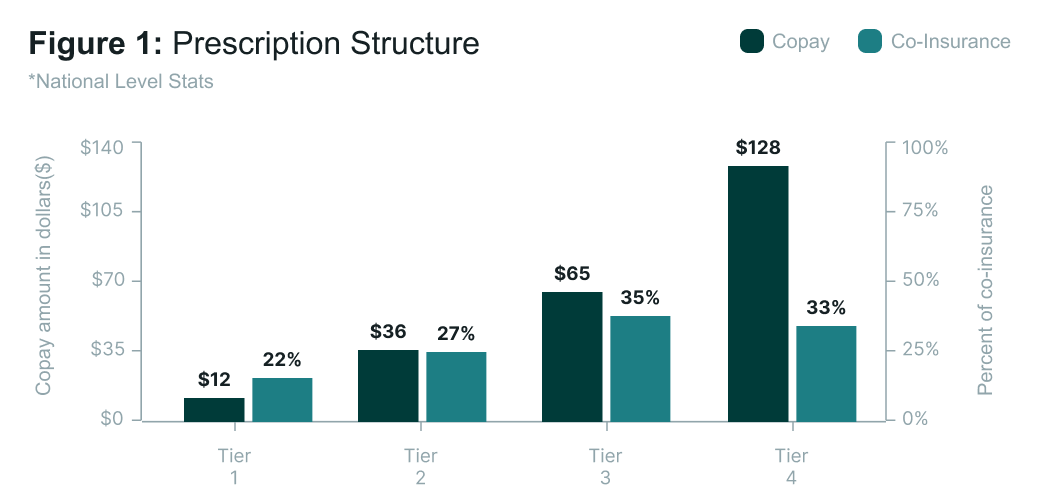
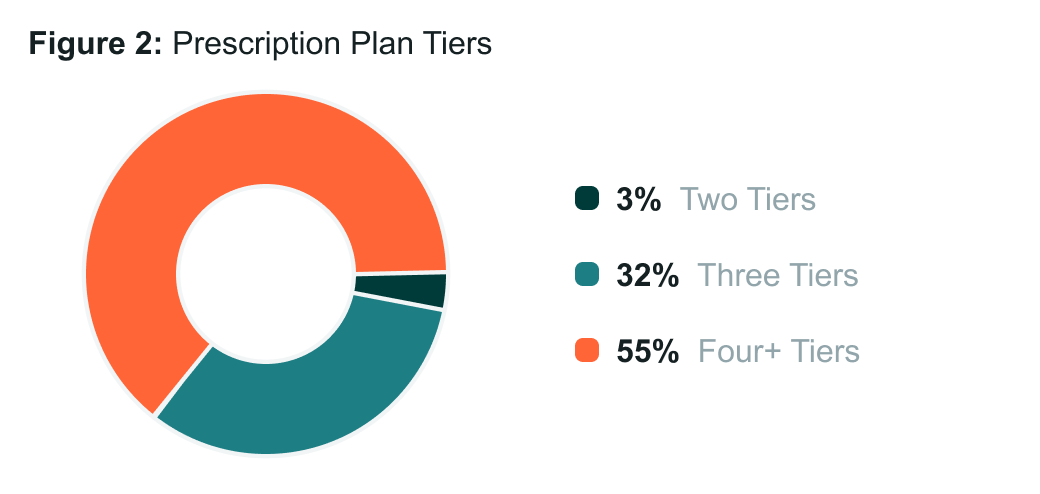
Most employer health plans organize prescription coverage into tiers, which determine both access and cost-sharing for employees.

  • Tier 1 (Generics): Lowest-cost drugs, usually just a $10–$20 copay. They are widely accessible and often encouraged as first-line therapy.
  • Tier 2 (Preferred Brands): Brand-name drugs that PBMs have negotiated discounts on. Employees typically pay $30–$50 copays or around 20% coinsurance.
  • Tier 3 (Non-Preferred Brands): Higher-cost brand drugs not favored on the formulary. Employees may owe 40%+ coinsurance, leading to hundreds in out-of-pocket costs.
  • Tier 4 (Specialty Drugs): High-cost therapies for serious conditions like cancer or hemophilia. These usually require coinsurance (20–30%), which can mean thousands of dollars per month. Although they make up less than 2% of prescriptions, specialty drugs drive nearly half of total drug spending.

Copays vs. Coinsurance

  • A copay is a fixed, predictable dollar amount per prescription.
  • Coinsurance is a percentage of the total drug cost until the deductible or out-of-pocket maximum is reached. While it helps share costs, it creates unpredictability—especially for specialty drugs, where 25% coinsurance could mean $250 on a $1,000 medication or much more on therapies costing thousands each month.

For employers, understanding how tiers and cost-sharing are structured is critical, since they directly affect both plan expenses and employee affordability.
High-Cost Drugs and Their Outsized Impact

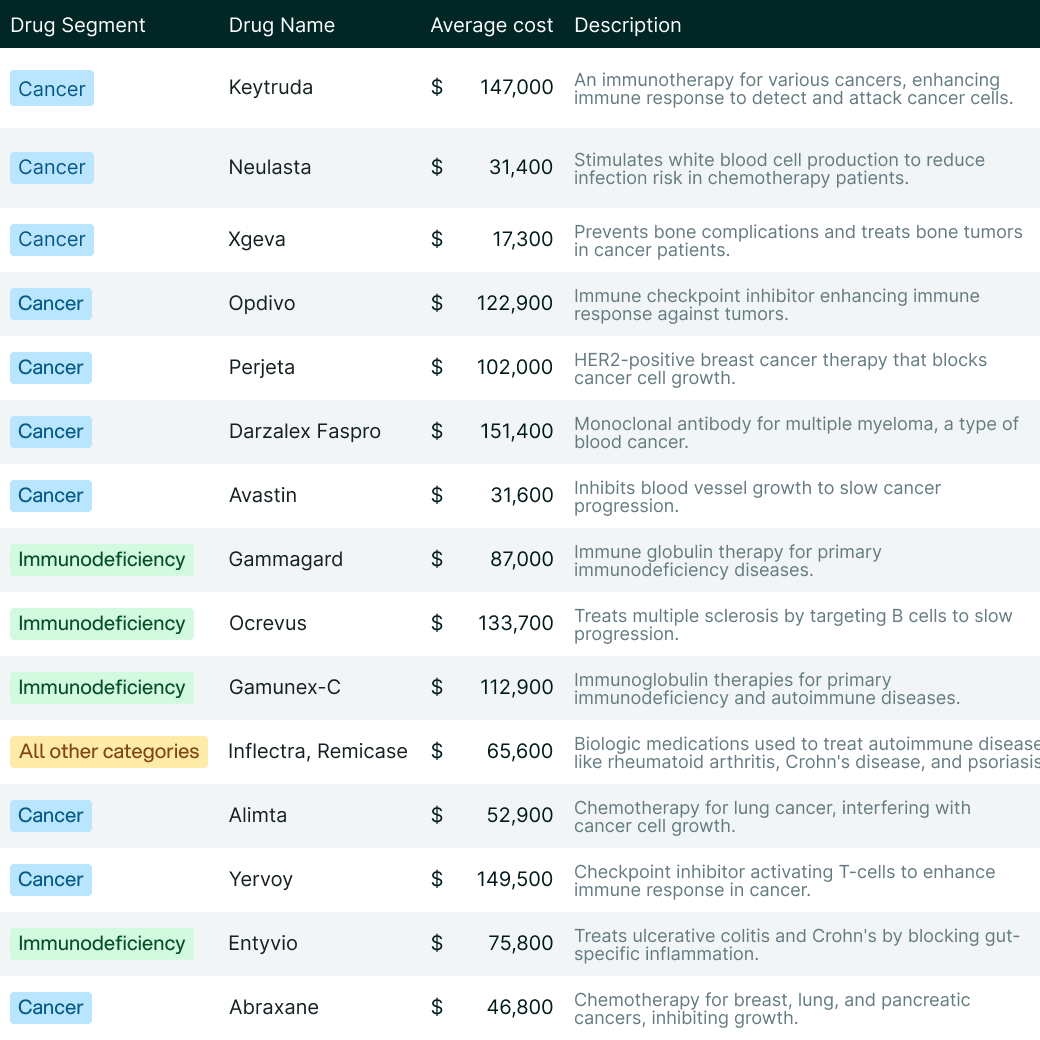
While high-cost drugs represent only a small fraction of total prescriptions, their impact on employer health plans is staggering. Specialty medications—such as those for cancer, hemophilia, and autoimmune disorders—account for less than 2% of prescriptions but drive close to 50% of all drug spending. Their costs have grown at double-digit rates year over year, fueled by new biologics, gene therapies, and infusion-based treatments that can run into hundreds of thousands of dollars annually. According to Sun Life’s High-Cost Claims Report, in many catastrophic claim categories like hemophilia or leukemia, prescription drugs make up more than 90% of the total cost of care. For employers, this means a single claimant on a specialty drug can dramatically shift overall plan spend, making pharmacy benefits one of the most volatile and financially significant areas to manage.
How Carriers Handle High-Cost Drugs

Carriers cover most FDA-approved specialty drugs but tightly manage access and cost. They use formularies to decide which drugs are included (and on what tier), require prior authorization or step therapy before approving treatment, and often restrict dispensing to their own specialty pharmacy networks. Coverage is generally limited to drugs deemed medically necessary, while experimental or non-formulary drugs are excluded unless appealed. For employees, this can mean higher coinsurance, delays in approval, and fewer choices on where prescriptions can be filled.

Who Controls the PBM Market—and Who’s Challenging It

Today, most carriers are tied to the “Big Three” PBMs, which together control more than 75% of the market:
  • Aetna/CVS → CVS Caremark
  • Cigna → Express Scripts
  • UnitedHealthcare → OptumRx
  • Anthem/Blue Cross (varies by region) → Caremark or Express Scripts

This consolidation means that for many employers, pharmacy benefits are automatically bundled with one of these large PBMs, leaving little room for visibility or flexibility.  

The remaining 25% is made up of disruptors offering more transparent models. Players like SmithRx (pass-through pricing with detailed reporting), MedOne (independent PBM with customizable formularies and full rebate pass-through), and Mark Cuban’s Cost Plus Drugs (a direct-to-consumer model selling drugs at cost plus a small margin) are challenging the status quo. For employers, knowing which PBM their carrier relies on—and whether a carve-out to one of these disruptors is possible—can be a critical step in controlling pharmacy costs.

Legislation and Reform Efforts

In recent years, lawmakers have increasingly targeted the opaque practices of PBMs, introducing multiple federal bills like the Pharmacy Benefit Manager Transparency Act (S. 127, 2023) and the PBM Transparency Act of 2025 (S. 526). These aim to ban spread pricing, require full rebate pass-through, and mandate detailed reporting—but none have passed into law yet. Similarly, a 2025 House bill dubbed the PBM Reform Act proposes greater transparency around Medicare Part D contracts and delinking PBM compensation from drug prices, but it remains pending in committee.

At the state level, all 50 states have enacted some degree of PBM regulation. Few states have gone further: for example, Iowa is considering a law imposing minimum pharmacy dispensing fees, and Arkansas passed legislation curbing PBMs’ ownership of pharmacies—though that law has been temporarily blocked by a federal judge

In short: there's plenty of activity at both federal and state levels—but no sweeping reforms have become law yet, leaving employers to manage PBM challenges proactively on their own.

Be Educated: Key Questions to Ask Your Broker

  1. Who is our PBM, and is it bundled with our carrier?
  1. Do we receive 100% of rebates, or are they retained?
  1. Can we carve out our PBM given our size and funding model?
  1. Which high-cost drugs are driving our spend?
  1. Do we get claim-level reporting from our PBM? (often not)
  1. What specialty drug management strategies are in place?
  1. How does our plan compare to industry peers?

Closing Thoughts

Prescription drug costs are no longer a side issue—they’re a central driver of employer healthcare spend. The combination of high-cost specialty therapies and the opaque role PBMs play in setting formularies, controlling access, and managing rebates makes this one of the most complex and consequential areas of benefit management. For employers, the path forward starts with awareness: knowing which PBM you’re tied to, how rebates flow, which drugs are shaping your spend, and what levers you have to push for transparency or carve out alternatives.

While legislation at the federal and state levels may eventually bring more clarity and accountability to the PBM market, employers cannot afford to wait. By asking sharper questions, exploring disruptive PBM models, and partnering with brokers who understand this space, employers can take meaningful steps today to control costs and support employees more effectively.

Bottom line: Prescription drug costs are only going up. Employers that engage now—by digging into the details and holding PBMs and carriers accountable—will be best positioned to protect both their budgets and their people.

Compliance & Policy
The Employers’ Guide to Voting Leave Regulation and Early Voting
There are just 26 business days left not only to make sure your organization is up-to-date with state and local election rules governing employee voting leave requirements, but also to communicate and coordinate your Election Day plans with employees in order to ensure the minimal disruption to your workflow.
September 29, 2024

Key Takeaways

  • Election Day is 36 days away.
  • Make sure your organization is in compliance with relevant voting leave regulations.
  • Coordinating vote absences and encouraging early voting can help minimize election-related disruption to your productivity.

ARTICLE | The Employers’ Guide to Voting Leave Regulation and Early Voting

Election Day is Tuesday, November 5th, which is just 5 weeks away as of this posting.

That leaves just 26 business days not only to make sure your organization is up-to-date with state and local election rules governing employee voting leave requirements, but also to communicate and coordinate your Election Day plans with employees in order to ensure the minimal disruption to your workflow.

Below, we have compiled a list of relevant voting regulations by state as well as information about early voting that you can share with employees and potentially reduce the number of absences concentrated on Election Day, as well.

The process of early voting has already begun in many places and will soon begin in many more, so let’s get to it.

Alabama: Employees in Alabama that begin work less than 2 hours after polls open or end work less than 1 hour before polls close are entitled to 1 hour of voting leave if they give reasonable notice. There is no early voting in Alabama. 

Alaska: For employees that don’t already have at least 2 consecutive hours off duty when the polls are open on Election Day, employers are required to provide paid voting leave and allow as much time off as is reasonably necessary for employees to vote. The early voting window can differ in different districts but 15 days prior to Election Day is the norm.

Arizona: Employers in Arizona must provide employees with up to 3 hours of paid leave if they do not already have 3 hours in a row when they are not scheduled to work when polls are open on Election Day. Employees must apply for voting leave in advance of Election Day, and employers can specify the hours on Election Day when employee’s utilize their voting leave. The early voting period in Arizona varies by location but begins about 15 days before Election Day in most districts.

Arkansas: In Arkansas, employers are required to adjust employees’ work schedules on Election Day in order to enable employees to vote. Early voting will begin 15 days prior to Election Day.

California: Employees who give their employer at least 2 working days notice of their intent to take time off work in order to vote are allowed up to 2 hours of paid voting leave at either the beginning or end of a shift. Employers must provide enough leave so that when it is combined with voting hours before/after the shift, employees will have sufficient time to vote. Although there is some variation from one county to the next, in general early voting in California begins 29 days before Election Day.

Colorado: Employees that request voting leave and who do not already have 3 consecutive non-working hours during which the polls are open are entitled to paid voting leave. Employees can request that leave be at either the beginning or end of their shift, but employers can determine when leave is granted. Early voting begins in-person 15 days before Election Day in general, though there may be some variance between counties.

Connecticut: There are currently no voting leave rules in place in Connecticut as the last law regulating that issue expired in June 2024 and has not yet been replaced. Early voting begins 15 days prior to Election Day.

Delaware: Employers in Delaware are not required to provide employees with voting leave. Early voting begins 10 days before Election Day. 

Florida: Florida law does not require employers to provide employees with voting leave. Early voting schedules can differ from one county to another, but early voting in Florida typically begins at least 10 days in advance of Election Day.

Georgia: Employees in Georgia are entitled by law to up to 2 hours of voting leave that can be used on Election Day or before via in-person early voting. That leave can be unpaid except for employees who can’t have their pay decreased due to absence from the job. Early voting begins the fourth Monday before Election Day, which is October 14th this cycle.

Hawaii: Elections in Hawaii are conducted by mail, and all registered voters should receive mail-in ballots automatically about 18 days in advance of Election Day. Voters can also turn in ballots or vote in person at service centers beginning 10 days prior to election day.

Idaho: There are no laws or regulations in Idaho that require employers to provide voting leave to employees. Some Idaho counties allow no early voting at all, but for the counties that do allow early voting, it begins the third Monday in advance of the election, which is October 21st this cycle.

Illinois: Employers are required to provide employees with up to 2 hours of paid voting leave if an employee doesn’t already have 2 consecutive hours of non-working time when the polls are open. Employers can use their discretion as to when the voting leave is exercised, and employees must apply for voting leave in advance of Election Day. Early voting in Illinois begins 40 days before Election Day.

Indiana: Indiana has no rules with regard to voting leave for employees. Early voting in Indiana begins 28 days before the election.

Iowa: Employees who request voting leave in writing in advance of Election Day are entitled to 3 consecutive hours of paid voting leave, assuming that there is not already a period of 3 consecutive non-working hours when the polls are open. Employers, however, can set the time during which employees are allowed to exercise their voting leave. In-person absentee voting in Iowa starts 20 days prior to Election Day.

Kansas: Kansas law ensures that employees have at least 2 consecutive hours that they are not required to work while the polls are open. If the polls are open before or after an employee’s shift but for less than 2 consecutive hours, employers are required to provide complementary paid voting leave sufficient to amount to 2 consecutive hours when combined with the pre or post-shift polling hours. Other than lunch hours, employers can also set when the voting leave is utilized. Early voting varies by country and begins up to 20 days prior to Election Day.

Kentucky: Employers in Kentucky must give employees up to 4 hours of leave that can be used either to cast a ballot on Election Day or to apply for an absentee ballot. To qualify, however, employees must request voting leave at least one day before they intend to utilize it, but employers can set the hours during which that voting leave is available on a given day and can penalize employees who utilize voting leave but fail to actually vote in certain cases. Early voting in Kentucky starts 5 days before the election.

Louisiana: There are no laws in Louisiana that require employers to provide voting leave to employees. Early voting in Louisiana starts 18 days before Election Day this cycle.

Maine: Employers in Maine are not required to provide employees with voting leave. In-person absentee voting in Maine begins 30 days prior to Election Day.

Maryland: In Maryland, employers are required to allow employees up to 2 hours of paid voting leave if an employee does not have at least 2 consecutive hours before or after their shift when polls are open. Employers, however, are allowed to require employees to submit a form that the state will provide as proof that the employee either voted or tried to vote. Early voting in Maryland opens two Thursdays prior to Election Day, which is October 24th this cycle.

Massachusetts: In Massachusetts, the only industries in which employers are required to provide employees with voting leave are the mercantile, manufacturing, and mechanical industries. Employers in those industries must provide employees with 2 hours of voting leave, while there are no voting leave requirements made of employers in other industries. Early voting starts 17 days in advance of Election Day.

Michigan: Michigan has no rules requiring employers to provide employees with voting leave. Early voting begins the second Saturday prior to Election Day, which falls on October 27th this cycle.

Minnesota: Employers in Minnesota must provide employees with paid leave for as long as necessary to enable employees to vote and return to work. In-person absentee voting begins 46 days before Election Day. 

Mississippi: No laws or regulations in Mississippi require employers to provide employees with voting leave, but Mississippi law does state that employers can’t take any adverse action against employees because they voted (or chose not to vote). Eligible absentee voters can begin casting their ballots 45 days before Election Day.

Missouri: Unless employees have  at least 3 consecutive non-working hours when the polls are open, employers in Missouri are required to provide employees with at least 3 hours in a row of paid voting leave. Employers, however, can require that employees who wish to exercise their voting leave apply to do so in advance of Election Day, and employers can choose when that voting leave is utilized. Beginning the second Tuesday before Election Day, which is October 22nd this cycle, Missouri offers in-person absentee voting in locations designated by local county election officials. 

Montana: Employers in Montana have no duty to provide employees with voting leave. In-person absentee voting in Montana begins 30 days prior to the election.

Nebraska: For employees that don’t already have at least 2 consecutive hours off when the polls are open on Election Day, employers must provide up to 2 hours of paid voting leave at a time of the employer’s choosing if the employee requests voting leave either on or before Election Day. If an employee exercises voting leave without requesting it, however, it may be possible for that voting leave to be unpaid. Early voting begins 30 days before the election in Nebraska.

Nevada: Nevada employers must provide paid voting leave to employees for whom it would be impractical to vote before or after work - 1 hour of paid voting leave for employees who must travel 2 or fewer miles to vote, 3 hours of paid voting leave for employees who must travel more than 10 miles to vote, and 2 hours of paid voting leave for all other employees. Employers can determine the window during which that voting leave is exercised, and they can require that employees apply for voting leave in advance of election day as well. Early voting starts 17 days before Election Day. 

New Hampshire: Employers in New Hampshire are not required to provide voting leave to employees. New Hampshire offers neither early voting nor in-person, no-excuse absentee voting. 

New Jersey: There are no New Jersey laws requiring employers to provide employees with voting leave. Early voting begins 10 days before Election Day.

New Mexico: If polls are not open for at least 2 hours in a row before an employee’s shift or for at least 3 hours in a row after an employee’s shift, then that employee is entitled to 2 hours of paid voting leave, although employers can set when that leave is utilized. Early voting opens 28 days before Election Day. 

New York: Employees in New York who do not have 4 consecutive hours before or after their shift when the polls are open are entitled to 2 hours of paid voting leave. Employers, however, can specify if the voting leave is utilized at the beginning or end of the scheduled work period, or at another time agreed upon by both the employer and employee. Early voting begins 10 days before Election Day. 

North Carolina: While North Carolina employers are not required to offer voting leave, employers that discharge employees for taking leave to vote may nonetheless be in violation of rules prohibiting wrongful discharge. Early voting in North Carolina begins no sooner than 3 Thursdays prior to Election Day.

North Dakota: Employers in North Dakota are not required to provide employees with voting leave. Early voting schedules can differ by county but early voting tends to begin at least 15 days prior to Election Day. 

Ohio: Employers in Ohio must give employees a reasonable length of time off work on Election Day so that they may vote. Early voting in Ohio begins on the first business day that occurs 29 days before Election Day or less. 

Oklahoma: Employees who don’t have at least 3 consecutive non-working hours when the polls are open before or after their shift are entitled to two hours of voting leave and potentially additional time beyond those 2 hours if distance to the voting site requires it. Employees must request voting leave at least one day before Election Day, but employers can set the day and hours during which employees can exercise their voting leave. Early voting this cycle begins the Wednesday before Election Day, which is October 30th.

Oregon: Employers in Oregon are not required to provide voting leave to employees, and Oregon does not have early voting in a traditional sense since Oregon elections are conducted largely through mail-in ballots. 

Pennsylvania: There are no requirements that Pennsylvania employers provide employees with voting leave. There is no statewide early voting, either, but some Pennsylvania counties allow voters to fill out absentee and mail-in ballots in person beginning 50 days before the election.

Rhode Island: There are no rules in Rhode Island that require employers to provide employees with voting leave. Early voting begins 20 days prior to Election Day.

South Carolina: Employers in South Carolina are not permitted to terminate employees due to exercising their voting rights, but there are no other rules with regard to voting leave. Early voting begins 15 days before Election Day.

South Dakota: Under South Dakota law, employees that don’t already have 2 consecutive non-working hours when the polls are open either before or after their shift are entitled to 2 hours of paid voting leave. Employers, however, can choose the hours during which voting leave is utilized. In-person absentee voting begins 46 days prior to Election Day.

Tennessee: Employers are required to provide up to 3 hours of paid voting leave if employees don’t have 3 consecutive hours when polls are open either before or after their shifts. Employer’s may demand that employees request voting leave by noon on the day before Election Day and may also set the hours during which an employee utilizes their voting leave. Early voting in Tennessee begins 20 days before Election Day.

Texas: Employers in Texas must provide employees with at least 2 consecutive hours in which to vote if they don’t already have 2 consecutive hours off duty on Election Day when the polls are open. Early voting begins 17 days before the election if it’s a business day and if not, the next business day.

Utah: If an employee’s work shift on Election Day doesn’t allow for at least 3 consecutive off-duty hours when the polls are open and that employee requests voting leave before Election Day, employers are required to provide up to 2 hours of paid leave. Early voting in Utah begins 2 weeks prior to Election Day.

Vermont: There are no rules on the books requiring employers in Vermont to provide voting leave, although state law does require employers to give employees unpaid leave to attend annual Town Hall Meetings if employees provide 7 days notice in advance. Vermont opens early voting from 45 days prior to the election until the day before Election Day.

Virginia: The only laws on the books in Virginia requiring employers to provide employees with election-related leave apply only to employees who are working as election officials. In-person absentee voting in Virginia begins 45 days before Election Day. 

Washington: Washington has no state laws or regulations that require employers to provide employees with voting leave. Early voting in Washington begins 18 days before the election.

West Virginia: Employees in West Virginia are entitled to up to 3 hours of voting leave unless those employees already have 3 consecutive non-working hours when polls are open. Employers, however, can demand that employees submit applications for voting leave at least 3 days in advance of Election Day. Early voting begins 13 days before Election Day.

Wisconsin: Employers in Wisconsin must provide their employees with up to 3 hours of unpaid voting leave during the hours of the employer’s choosing to any employee that provides at least 1 day of notice. Early voting in Wisconsin begins no sooner than 2 weeks before Election Day.

Wyoming: For employees who do not have at least 3 hours in a row outside of their work shift when the polls are open, employers must provide at least 1 hour of paid leave, although employers are allowed to determine when that voting leave is utilized within the shift. In-person absentee voting starts 28 days before the election.

Mployer’s Take

If the election process is not already underway in your area, it will be very soon.

Employers seeking to minimize election-related confusion and impacts should be proactive in coordinating absences, communicating plans, and ensuring that disruptions in workflow and productivity are kept to an absolute minimum.

For the next 5 weeks, uncertainty about the outcome of the elections is an unfortunate inevitability, but there is no need for or benefit from uncertainty about how your organization will manage employees as they exercise their voting rights.

Economy
The Market Employment Summary for September 2024
Each month, Mployer Advisor breaks down the Bureau of Labor Statistics’ most recent State Employment and Unemployment Summary to highlight some employment trends across various markets. This is an overview of September’s report.
September 23, 2024

Editor's Note: This report is based on survey data from August 2024 that was published in September 2024. This is the most recent data available. (Source: Bureau of Labor Statistics)

The US unemployment rate average came down about one-tenth of a point last month, dropping from approximately 4.3% to 4.2%.

For context, the US unemployment rate hasn’t been above 4.3% since October of 2021, representing a tight labor market for an extended period of time seldom seen in US history outside of wartime.

Only 1 state saw its internal unemployment rate come down over the month, however, with Connecticut showing a 0.2% unemployment rate reduction, falling from 3.6% to 3.4%. 

On the other hand, 7 ‘states’ - Georgia, Massachusetts, Minnesota, North Dakota, South Carolina, Utah, and Washington DC - recorded increases in their state unemployment rates, ranging from plus 0.1% to plus 0.4%. The number of states with climbing unemployment rates is down from 13 the month prior.

The more than 140 thousand new jobs added last month across the US as a whole resulted in 4 states with a net increase in payroll figures, while only 1 state - South Dakota - saw a net decrease in jobs, and the remainder were essentially unchanged.

Below is the breakdown of the Bureau of Labor Statistics’ (BLS) market employment summary for September 2024.

States With the Highest Unemployment Rates

For the fourth straight month, Washington DC had the highest unemployment rate, jumping two-tenths of a point from 5.5% to 5.7%.

Nevada had the next highest unemployment rate, climbing from 5.4% to 5.5%.

California and Illinois were the only 2 other states that posted unemployment rates above 5%, at 5.3% each.

Washington State at 4.8% unemployment was the only other state above the US average, and the only other state above 4% for that matter. 

South Carolina saw the largest increase in unemployment last month, spiking 0.4% from 3.9% to 4.3% unemployment, while Washington DC, Georgia, and Massachusetts each saw 0.2% increases in their respective unemployment rates, and 0.1% unemployment rate increases were recorded by Minnesota, North Dakota, and Utah.

Half of all states plus Washington DC recorded an increase in unemployment over the last 12 months - the largest increases going to Rhode Island, South Carolina, and Ohio, with 1.7%, 1.4%, and 1.0% increases, respectively.

States With The Lowest Unemployment Rates

For the 8th month in a row, South Dakota has recorded the lowest unemployment rate, holding steady at 2%.

Vermont has the next lowest unemployment rate at 2.2%, followed by North Dakota at 2.3% and New Hampshire at 2.6%. Mississippi and Nebraska are next at 2.7%; followed by Alabama and Maine at 2.8%; and Hawaii, Iowa, Maryland, and Wisconsin at 2.9% unemployment. 

Only Connecticut saw its unemployment rate decrease over the month, dropping 0.2% from 3.6% unemployment to 3.4%.

Over the last 12 months, only 4 states have seen a net reduction in their unemployment rates, led by Arizona ( - 0.7%) and followed by Connecticut ( - 0.4%), Wisconsin ( - 0.4%), and Mississippi ( - 0.5%).

States With New Job Losses

Despite having the lowest unemployment rate, or perhaps because it has consistently had the lowest unemployment rate among states throughout 2024, South Dakota was the only state to record a net decrease in jobs over the month, dropping a little more than 3 thousand and seeing in-state payrolls reduce by 0.7%.

No state recorded a net reduction in jobs over the course of the year.

States With New Job Gains

Indiana, Minnesota, Texas, and Wisconsin all recorded net payroll increases last month.

Texas recorded the largest net gain both in terms of raw jobs figures and percentage gain, with the Texas labor force growing by 0.6% or almost 80 thousand jobs over the course of August.

Indiana tied Texas at 0.6% job growth and had the second largest number of raw jobs gains, netting almost 20 thousand.

Minnesota added a bit more than 14 thousand jobs for 0.5% growth and Wisconsin added a little less than 12 thousand jobs, accounting for 0.4% growth.

Over the course of the last year, Missouri and South Carolina have recorded the largest workforce growth rates at 3.3% each, followed by Montana at 3.1% and Alaska at 2.8%. 

The states with the smallest job growth rates over the year are Massachusetts and New Jersey at 1.1% each, followed by Wisconsin at 1.2% and Iowa at 1.3%.

In terms of raw job figures, Texas has added just over 300 thousand net jobs over the last 12 months, while California added just under 290 thousand, Florida added just over 200 thousand, New York added 140 thousand, and Pennsylvania added a bit more than 100 thousand jobs.

Mployer Advisor’s Take: 

The big economic story of the moment is the long-awaited interest rate cuts that finally arrived when the Federal Reserve reduced rates by half a percentage point last week, bringing baseline rates down to between 4.75% and 5%.

Further, the Fed is poised to lower interest rates by another half point over the remainder of 2024, and is on course to bring rates down by another percentage point over 2025, as well - assuming that inflation and employment trends hold.

While there are more than a few intervening events and trend shifts that might disrupt potential 2025 rate reductions, an additional half point cut in 2024 remains far more likely than not to occur at this point.

According to Fed projections, although inflation has yet to fall below the Fed’s stated target of 2%, we are expected to cross that threshold by 2026, and unemployment is forecast to climb slowly through 2025 before leveling out.

In sum, keep an eye out for more interest rate relief in the near-term, and maybe significant interest relief next year as well if expectations about our current economic trajectory hold. It has been a long time coming.

Looking for more exclusive content? Check out the Mployer Advisor blog.

Employee Benefits
The Boring Yet Obligatory Guide to Dental & Vision Insurance For Employers
Between 8 and 9 out of 10 organizations offer dental and vision insurance, but that figure can vary significantly based on factors like company size, industry, and region.
September 18, 2024

Key Takeaways

  • Between 8 and 9 out of 10 organizations offer dental and vision insurance, but that can vary based on factors like company size, industry, and region.
  • Dental and vision plans are typically designed as PPOs, HMOs, traditional Indemnity Insurance, Point of Service, or Direct Reimbursement plans, which are largely distinguished by how restrictive they are in terms of allowing/requiring services in or out of network, as well as by who pays the care provider and when.
  • The size of the US dental insurance market is nearing $100 billion annually while the vision insurance market in the US is about $60 billion.

ARTICLE | The Boring Yet Obligatory Guide to Dental & Vision Insurance For Employers

Dental and vision insurance have often been looked at as more of an afterthought than a necessity, but those views are quickly becoming outdated.

Not only are an increasing number of organizations offering supplemental dental and/or vision insurance options, but more and more organizations are choosing to contribute to the coverage costs, as well, which further encourages participation.

In addition to that organic growth, a slew of recent changes in vision and dental insurance-related law both at the state and federal level indicates that this space currently has the attention of policymakers, as well, with one new federal rule poised to expand demand levels for dental and vision services in the coming years, potentially leading to some upward pressure on the costs associated with these services in the future.

Let’s take a look at dental and vision coverage in terms of where we’ve been, where we are, and where we’re going.

Employer Coverage Trends for Dental and Vision Benefits

According to the most recent Mployer Insights data for 2024, the vast majority of employers offer dental insurance (93%) with a slightly smaller proportion offering vision insurance (82%) as well, but smaller organizations are less likely to offer these supplemental forms of health insurance than larger organizations.

In fact, only about 40% of employers with between 2 and 24 employees offer dental insurance, but that number climbs significantly to about 90% and up for employers with 100 or more employees. About 60% of employers with between 25 and 49 employees offer dental insurance, while about 75% of employers with between 50 and 99 employees offer dental insurance, so the employee count and dental insurance trend are pretty closely correlated, although there is some additional variance depending on industry and geographical region, as well.

Interestingly, the percentage of employees who choose to enroll in dental insurance plans if offered by their employer is much less correlated with employee count and more consistent across variously sized companies. The enrollment rate for companies with between 3 and 24 employees is about 71% and about 75% for companies with 500 or more employees.

Employer contributions toward employee dental coverage aren’t strongly correlated with employee count, either, with about 16% of employers covering 100% of the premium, about 16% of employers making no contributions toward employee dental plan costs, and the remainder (about 68%) making partial contributions.

As for vision insurance, about 62% of employers with between 3 and 24 employees offer it, which is significantly above the 40% of comparably-sized employers that offer dental insurance, but only about 83% of employers with 100 or more employees offer vision insurance, which is a bit under the approximate 90% of employers with 100 or more employees offering employee dental plans.

Participation rates among employees who are offered vision insurance hovers in the low 70% regardless of company size, which is comparable to dental insurance as well. Employer contributions toward employee vision plan costs are comparable - although slightly more generous - than dental plan contributions, with about 19% of employers making a 100% contribution to employee vision plans and about 64% providing a partial contribution.

It is also worth noting how these trends have evolved over time with half of the growth in small business dental insurance offering rates since the beginning of the millennium occurring in just the four years between 2019 and 2023.

The proportion of smaller organizations offering vision coverage has seen comparable growth, with the percentage of large employers who offer vision insurance doubling between 2006 and 2023, while the percentage of small employers offering vision insurance quadrupled over the same time period.

Smaller organizations clearly lagged behind larger organizations in terms of adding dental and vision benefits to their offerings, but they have nearly caught up at relatively low employee counts in terms of participation, although there is still room for differentiation on the contribution front, both with dental and vision coverage, which is especially relevant given how consistent demand seems to be for these offerings at employers of all sizes.

How Many Employers Offer Dental & Vision Plans?

Chart
Chart

Regulatory Requirements for Dental and Vision Benefits

There are no laws that require employers to provide employees with dental or vision insurance, although doing so has certainly become the norm amongst organizations, regardless of size.

Further, the ACA does not require parents to provide children with dental insurance, but it does label dental insurance for children as an essential health benefit, thereby requiring that such coverage be either included in a plan or offered as a separate plan in order for an insurance plan to meet the minimum qualifications necessary to appear on the exchanges.

A few months ago, however, the Centers for Medicaid and Medicare Services issued a new rule that will allow states to designate non-pediatric dental care for adults as an essential health benefit as well, which will broadly expand the dental coverage options for many of the residents of states that opt-in.

As a caveat, it is important to bear in mind that this expansion will only apply to those states that take proactive steps to label adult dental care as an essential health benefit as a matter of law, which is not a cause that will be taken up by all state legislatures in the near future, so not all states will see a meaningful shift in demand as a result.

There has also been significant activity in recent years addressing issues including transparency, patient choice, downcoding, network access, and loss ratios.

How Many Employees Enroll In Dental & Vision Plans?

Chart
Chart

Employer Contributions To Dental & Vision Plans

Chart

Dental Benefit Plan Design

While there are several different plan designs for dental benefits, by far the most common are Preferred Provider Organization (PPO) plans, accounting for more than 8 out of 10 employer-sponsored dental plans.

Typically, DPPO plans contain an annual cap on all expenses, which is the most money that an insurer will pay out for a claimant in total over a single year.It’s important to also point out that these annual caps often exclude orthodontic work, which may have a separate lifetime cap - meaning that orthodontic work doesn’t count against the annual cap but instead has its own separate maximum dollar figure that an insurer will pay out for orthodontic work over the life of the policy.

Additionally, DPPOs will typically require insurance to cover a predetermined percentage of any given service up to that annual limit after a small annual deductible is met.For example, a DPPO plan may have a $1,500 annual cap and a small annual deductible, which is often waived for class 1 preventative services. Coinsurance amounts are usually broken down by class of service, with plans typically covering preventative services like teeth cleanings at 100% (deductible waived), 80% coverage for basic restoration work (after deductible is met), 50% for major restoration work, and 50% for orthodontic work up to a lifetime max (e.g. $1,500).

Other relatively common types of dental plans include Dental Health Maintenance Organizations (DHMO), which prepay dentists for potential services and account for about 4% of dental plans; traditional indemnity plans, which are similar to DPPOs but without the same in-network emphasis and account for about 3% of dental plans; Point of Service plans, which further emphasize discounts for in-network services; and Direct Reimbursement plans, which reimburses policy holders for their expenses after the fact according to a predetermined reimbursement schedule.Some of the key elements that distinguish plans are:

  • Network emphasis: Whether policy holders can seek care with any dental provider of their choosing without consequence, or whether they are encouraged or required to seek out the services of in-network care providers

.

  • Payment plans: Who pays the dental care provider, and when - payment by insurer to provider before services are provided, payment by insurer to provider after services have been rendered, or payment by policy holder to provider after services have been provided followed by reimbursement from insurer to policy holder for all or part of that payment.

You can read more about the various types of dental plan designs and their differences in this piece from the American Dental Association.

Vision Benefit Plan Design

Four of the main types of vision plans closely mirror prominent plan types for dental insurance coverage: Preferred Provider Organization plans, Health Maintenance Organization plans, Point of Service plans, and Indemnity insurance plans.

Beyond plan structure, some of the main factors to consider that distinguish one plan from another are:

  • Annual benefits: How often are eye examinations covered each year (usually 1 every 12 months)? How often are frame and lens replacements covered?
  • Network: How large and accessible is the network of care providers?
  • Frame and lens allowances: How much does each plan allot per frame/lens purchase/replacement?
  • Enrollment costs: Are low monthly fees being supplemented by high, hidden initiation fees?

While deductibles are less common with vision insurance than dental and traditional medical coverage, copays and annual coverage caps are standard.

Dental & Vision Insurance Markets in the US

The US dental insurance market crossed the $80 billion threshold in 2021, and is expected to grow by 6% compounded each year between 2024 and 2029, while the US vision insurance market is expected to hit about $60 billion this year.

Top market share leaders in the US dental insurance market are:

  • Aetna
  • Aflac
  • Ameritas
  • Cigna
  • Delta Dental Plans Association
  • United Healthcare Service

The top market share leaders in the US vision insurance market are:

  • Vision Services Plan (VSP)
  • Vision Benefits Group
  • Delta Dental
  • SightCare Inc.
  • Essilor Luxottica

Mployer’s Take

On one hand, it is understandable why dental and vision care have historically been dealt with as separate offerings from traditional medical care.

For one, professionals in each field are typically trained at separate institutions on separate courses of study with little overlap, and much dental and vision related care takes place at separate sites apart from hospitals and traditional medical practices.

But these distinctions are becoming less and less relevant given a modern understanding of how closely tied dental health can be to overall bodily health, not to mention the correlation between proper progressive lens care and productivity.

As with many other aspects of life and business, regular maintenance and an ounce of prevention can be worth a pound of cure, and employers have an opportunity not only to provide employees with a valuable benefit offering, but they can also stand apart from competitors on the talent attraction and retention front by not only offering dental and vision insurance but also making contributions to that coverage to further encourage employees to opt in.

With as many as 3 in 10 US adults currently without dental insurance, and with up to 8 in 10 US adults currently without vision insurance, there is no better time than the present for employers to review their benefits offerings to determine how best to help employees meet their dental and vision insurance needs.

Economy
The Employment Situation for September 2024
The latest economic release from the Bureau of Labor Statistics reports that the U.S. added a respectable 142 thousand new jobs last month, while the unemployment rate fell slightly to 4.2%.
September 9, 2024

Editor's Note: This report is based on survey data from August 2024 that was published in September 2024. This is the most recent data available. (Source: Bureau of Labor Statistics)

For the first time in 5 months, the US unemployment rate has started coming down again, albeit ever so slightly from about 4.2% to 4.1%.

US employers also added 142 thousand jobs to their payrolls, which was a decent performance although about 20 thousand jobs fewer than expected. Downward revisions of the job numbers from the previous 2 months were a bit more substantial, however, accounting for about 80 thousand fewer jobs than previously reported.

The labor force participation rate held steady at about 62.7 million and has been pretty consistent all year long.

The number of people who have part-time jobs because full-time work was not available also essentially held steady at 4.8 million, but it is worth noting that this figure is up almost 15% from 4.2 million just 12 months ago. This change may in part represent a growing number of both employers and employees that have been navigating the softening economy and labor market and waiting for interest rates to come down before reevaluating their labor demand - a wait that will likely soon be over.

Among the 142 thousand jobs added to US employer payrolls last month, the construction industry claimed the largest share, with 34 thousand new jobs - almost an 80% increase over the approximate 19 thousand jobs added by the construction industry on average each of the last 12 months.

The healthcare industry wasn’t far behind with 31 thousand jobs added last month, but that figure represents a significant slow down in healthcare hiring and a major underperformance relative to the approximate 60 thousand jobs by which payrolls in the healthcare industry have increased on average each month over the last year.

The social services industry also added about 13 thousand jobs, down from an average monthly gain of 21 thousand.

While there was little to no change in job figures across the majority of the remainder of industries, the manufacturing industry actually saw a fairly significant reduction in jobs last month, losing 25 thousand positions in the durable goods production industries.

Average hourly pay rose by 4 cents last month, climbing to $35.21 per hour and representing a 0.4% increase over the month before. Average hourly pay has increased by 3.8% over the last year, outpacing inflation by nearly a percentage point over the same time frame.

The average workweek on the other hand increased by one-tenth of an hour up to 34.3 hours per week. In the manufacturing sector, however, the average workweek held steady at about 40 hours per week, but the average amount of overtime inched up one-tenth of a point as well to 3 hours per week.

Mployer’s Take

Last month, Federal Reserve Chair Jerome Powell said that Fed policy goals no longer include any further softening of the labor market, which paves the way for the first interest rate cuts since the Fed began raising rates 2 and a half years ago.

The Fed is expected to lower interest rates when they meet next week and this latest jobs report further solidifies that likelihood, but the main remaining question is how big of a cut they will implement. 

With inflation now down below 3% on an annualized basis, some Fed watchers are expecting a 50 basis point interest rate cut, but the majority seems to be rallying around a more modest 25 basis point cut given the remaining resilience in the job market and economy in addition to the continuing upward pressure on wages.

To be clear, however, a 50 basis point rate cut is still a very real possibility, and is only slightly less likely than a 25 basis point cut.

It’s only a little over a week before September 18th when the Fed is expected to announce whether or not they will be cutting interest rates, and if so by how much, so the speculation about whether and how much rates will be cut this time will very soon be replaced by speculation about whether and how much interest rates will be cut next time when the Fed meets again in the first week of November.

Nothing is certain, of course, but it does seem like some interest rate relief may at long last be at hand. 


While it took less than a year and a half for the Fed to increase interest rates from practically 0 to over 5 and a half percent (in increments of a quarter and half point at a time), however, it is likely going to take much, much longer to bring interest rates back down by even half of the increase we’ve seen since the pandemic.

We still appear to be on track for a relatively soft landing where inflation is tamped down without triggering a swift onset recession, but in order to maintain the delicate balance necessary to avoid some of the worse potential outcomes, this soft landing is going to occur over a very long period of time. 

Check out the Mployer blog here.

Health Insurance Trends
Preliminary Health Insurance Premium Rate Increases for 2025
Preliminary health insurance premium rate increases are starting to be filed by state and are expected to climb considerably on average next year.
August 22, 2024

Key Takeaways

  • Preliminary health insurance premium rate increases are starting to be filed by state and are expected to climb considerably on average next year.
  • These rates cover small group plans but tend to correlate closely with the renewal rates for self-funded insurers as they generally face the same macro-demographic shifts and utilization patterns.
  • These rate hikes are not evenly distributed across states with some seeing major increases and some seeing modest increases or even rate reductions on average in some cases.
  • These rate hikes are only preliminary requests and are typically still subject to review and revision by state regulatory agencies before they can be implemented.
  • Some of the reasons for these rate increases that carriers provide include inflating costs associated with hospital care, pharmaceuticals, and healthcare in general; growing demand for and utilization of medical services; ongoing underestimated COVID-19 expenses; the unwinding of Medicaid; aging populations in some states; better risk analysis; improved quality of carrier services; increased silver loading; premium alignment; and paid-out claims exceeding premiums collected.

ARTICLE | Preliminary Health Insurance Premium Rate Increases for 2025

Preliminary rate changes for 2025 for small group health insurance policy premiums through exchanges have started to be filed. 

For context, the rate at which US healthcare expenditures are rising is expected to hit a 13 year high next year, with data from PwC indicating that medical costs are set to rise by about 8% for group coverage (7.5% for individual coverage), which is half a point above the 2024 growth rates and up significantly from a recent low of 5.5% growth in medical costs recorded in 2017.

At this stage in the process, these proposed rate changes are still open for public comment in many cases and are usually subject to further approval by in-state agencies that cover these insurance-related matters before the changes can be enacted.

Although these rates are not yet finalized, preliminary rates will often pretty closely mirror final rates.

While these proposed rates are not the exact same rates that companies can ultimately get if they are self-funding their employee insurance plans, these rates will usually correlate fairly tightly with the rates that self-funding companies can expect as the employee demographic and healthcare utilization patterns are similar in a given geography.

Proposed 2025 Rate Increases for 2025 Range

Preliminary Rate Changes By State

Here are the proposed rate changes for 2025 plans from all states that have released this information to date.

Alabama

Individual health insurance plan premiums on the exchange are preliminarily set to decrease on (unweighted) average by -3.1% in 2025, while small group plan rates are proposed to climb by an unweighted average of 7.41%.

The largest average rate decrease for individual policies was proposed by Celtic Insurance Co. at - 7.28%, while the smallest increase in small group plan rates was 4.96%, requested by Blue Cross Blue Shield of Alabama.

The largest individual policy average rate increase was proposed by UnitedHealthcare Insurance Co. with a meager rate increase of just 0.55% on average, while VIVA Health requested the largest average rate increase among small group plans at 14.95%.

Alaska

Health insurance premiums in Alaska are currently set to climb by about 17.1% on average for individual plans and plus 11.71% on average unweighted for small group plans next year.

Premera Blue Cross Blue Shield of AK requested the smallest average rate increase for individual policies at 16.26% on average, while UnitedHealthcare Insurance Co. requested the smallest average rate increase for small group plans at 8.65%.

Moda Assurance Co. made the largest requested average rate increase for individual plans among carriers at 19.63%, and the largest average rate increase requested for small group plans was Moda Health Plan, Inc. with an average premium rate increase of 14.77%.

Insurance carriers requesting rate increases largely attribute the need for those increases to inflation in medical/pharmacy costs and utilization. 

Arkansas

Requests to increase premiums for individual and small group health insurance plans through the exchange in 2025 average to about 4.2% for individual plans and about 9.6% for small group plans.

One insurance carrier in Arkansas - QCA Health Plan, Inc. - proposed a decrease of 2% on average for individual policy premiums, while the smallest increase for small group plans was QualChoice Life and Health Ins. Co. Inc. which requested an average rate increase of 4.53%.

USAble HMO Inc. (Octave) requested the largest average rate increase for individual policies at 8.57%. while UnitedHealthcare Insurance Company had the largest small group plan premium rate hike at 15.98%.

Connecticut

Individual and small group health insurance plan premiums via the exchange are currently slated to increase an average of 8.3% in 2025, which is down from 12.4% in 2024. Small group plan rate hike requests average to about 11.9%.

Rate increases were requested by 8 health insurance carriers in Connecticut and are presently under review by the Connecticut Insurance Department, although the public comment period has closed.

CTCare Benefits requested the smallest average rate increase for individual policies at 7.4% while Oxford Health Plans CT had the smallest small group plan premium rate hike at 5.1%.

The largest requested average rate increase for individual plans was made by CTCare Insurance Co. at 12.5%, and the largest average rate increase requested for small group plans was Anthem Health Plans with an average premium rate increase of 13.6%.

The carriers making these requests attribute the increases to overall trends, higher than expected COVID-19 expenses, and the unwinding of Medicaid.

Delaware

Insurance carriers have proposed increasing Individual and small group health insurance plan premiums via the exchange in 2025 by 13.3% and 8%, respectively. 

In the individual market, one carrier proposed reducing premiums by 14%, while the smallest rate increase proposal for the group market was Highmark BCBSD at 8%.

Aetna Health requested the largest average rate increase for individual policies at 34.53%. while UnitedHealthcare had the largest small group plan premium rate hike at 18.2%.

Idaho

Individual and small group health insurance plan premiums are currently slated to increase an average of 6.6% and 9.3% in 2025, respectively.

Mountain Health Co-Op proposed decreasing premiums for individual policies by 2.7% while PacificSource Health Plans requested the smallest premium rate hike among carriers with at least 1% market share for small group plans at 4%.

The largest requested average rate increase for individual plans was made by Regence Blue Shield of Idaho at 11.9%, and the largest average rate increase requested for small group plans was UnitedHealth Insurance Co. with an average premium rate increase of 13%.

Carriers are attributing rate increases in Idaho to health claims paid outpacing premiums collected.

Illinois

Requests to increase premium rates in 2025 for individual health insurance plans in Illinois average to about 4.6%, while the average proposed rate increase to small group plans is an unweighted 9.5%.

Molina Healthcare of IL, Inc. requested the smallest average rate increase for individual policies at 1.6% on average, while MercyCare HMO requested the smallest average rate increase for small group plans at 6.52%, but it is unclear how much market share that MercyCare HMO serves.

Oscar Health Plan, Inc. made the largest requested average rate increase for individual plans among carriers at 19.9%, and the largest average rate increase requested for small group plans was Health Alliance Medical Plans, Inc. with an average premium rate increase of 19.9%.

Indiana

Insurance carriers expect to decrease policy premium expenses for individual health insurance plans through the exchange by an average of - 1.5% in 2025, although the majority of plans are requesting rate increases. Small group plan rates are expected to rise by about 8%.

Coordinated Care Corporation proposed the largest average rate decrease for individual policies at -4.3%, while UnitedHealthcare Insurance Co. proposed the smallest increase for small group policies at 6.54%.

Aetna Health inc. requested the largest average premium rate increase request for individual policies at 10.8%, while Physicians Health Plan of N. Indiana proposed the largest average rate hike for small group premiums at 9.45%.

Maine

Requests to increase premiums for individual and small group health insurance plans via the exchange in 2025 average to about 14.2% and 14.8%, respectively.

The smallest requested average rate increase for individual plans was made by Taro Health Plan of Maine, Inc. at 3.9%, and the smallest average rate increase for small group plans among carriers with at least 1% market share was United Health Insurance with an average premium rate increase of 5.3%.

Harvard Pilgrim Healthcare requested the largest average rate increase for individual policies at 15.8%. while Maine Community Health Options had the largest small group plan premium rate hike at 19.6%.

Maryland

Individual exchange-acquired health insurance plan premiums are currently slated to increase an average of 6.7% in 2025 - with average individual policy rate increase requests ranging from 4.7% to 14.2% - while small group premiums are expected to increase by about 6.11%.

CareFirst BlueChoice requested the smallest average rate increase for both individual policies and small group policies at 4.7% and 4.9%, respectively. 

CareFirst (GHMSI) and CareFirst of Maryland, Inc. shared the largest average premium rate increase request for individual policies, as well, at 14.2%, while Aetna Life Insurance Co. proposed the largest rate hike for small group premiums at 23%.

Massachusetts

Requests to increase premiums for individual and small group exchange health insurance plans in 2025 average to about 8.4%.

Fallon Community Health Plan Inc. requested the smallest average rate increase for both individual and small group policies at 1.4% each. 

The largest requested average rate increase for individual plans among carriers with at least 1% market share was made by Tufts Health Public Plans at 10.4%, and the largest average rate increase requested for small group plans was UnitedHealthcare Insurance Co. with an average premium rate increase of 12.4%.

Rate increases are being attributed primarily to rising hospital and prescription drug costs, although other contributing factors include a population that is aging, risk analysis, general trends, an improved user experience, and use of certain inpatient and outpatient services. 

Michigan

Individual and small group exchange health insurance plan premiums are currently slated to increase an average of 10.5% and 11.2%, respectively, in 2025.

Meridian Health Plan Inc. requested the smallest average rate increase (3.1%) among carriers with at least 1% market share for individual policies, while UnitedHealthInsurance Co. had the smallest small group plan premium rate hike at 4.7%.

Priority Health requested the largest average rate increase for both individual and small group plans was made by Priority Health at 18.89% and 13.2%, respectively.

According to the insurers requesting them, these rate increases are primarily being driven by inflation in medical costs, risk adjustment, changes to plan benefits, and to more accurately reflect past experience. 

Minnesota

Individual health insurance plan premiums are preliminarily slated to increase an average of about 8.7% in 2025. Small group plan premium hike requests have an unweighted average of about 9.4%. 

Medica Insurance Co. requested the smallest average rate increase for both individual and small group policies at 1.95% and 3.71%, respectively.

The largest requested average rate increase for individual plans was made by Blue Plus (HMO Minnesota) at 12.75%, and the largest average rate increase requested for small group plans was Quartz (formerly known as Gundersen) with an average premium rate increase of 15.82%.

New York

Individual health insurance plan premiums are currently slated to increase an average of about 16.2% in 2025 while small group plans are slated to increase by 19%,  although rate increase proposals are currently being reviewed by the New York Department of Financial Services and often result in significantly reduced rates from the initial preliminary figures.

UnitedHealthcare of New York requested the smallest average rate increase for individual policies at 8.8% while MVP Health Plan, Inc. had the smallest small group plan premium rate hike at 9.5%.

The largest requested average rate increase for individual plans was made by HIP of Greater New York at 51%, and the largest average rate increase requested for small group plans was Independent Health Benefits Corporation with an average premium rate increase of 28.1%.

Vermont

The premiums for individual and small group health insurance plans from the exchanges are currently slated to increase an average of 14.9% and 15.1% in 2025, respectively.

For BlueCross Blue Shield plans in Vermont, individual policy rates are expected to climb by 16.3%, while small group rates are expected to climb by 19.1%. 

MVP Health Plans are expected to increase between 2.7% and 34.3%, with an average increase of 11.7%.

These rate increases are largely attributed to increased silver loading and premium alignment.

Washington

The premiums for individual and small group health insurance plans from the exchanges are currently slated to increase an average of 11.3% in 2025, which are presently under review by the Washington Insurance Department.

Of the 13 health insurance carriers that have filed rate increase requests in Washington, the smallest increase was the Community Health Plan of Washington with a 4.5% increase, and the largest rate increase was requested by Regence Blue Shield which requested an increase of 23.8%.

Mployer’s Take

As a reminder, some of these rate increases are likely still to be slashed by state regulatory bodies, so the sticker shock may not ultimately be as bad in some places as it currently appears to be.

Also, self-funding companies are probably going to see somewhat lower rates than the finalized exchange plan rates on average, which will also help a little on the bottom line.

That said, while there rates are still potentially in flux, the ultimate rate increases tend to correlate fairly strongly with preliminary rates. 

On the other hand, these rate increases represent averages across all insurance carriers in a given state (weighted when sufficient data is available), so it is of course a good idea to go ahead and take a look at the premium rate adjustments your insurance carrier is proposing, which may not be final yet but will more accurately reflect the approximate potential rate increases your organization may be facing next year and will help you better prepare in advance for the additional expense.

Economy
The Market Employment Summary for August 2024
Each month, Mployer Advisor breaks down the Bureau of Labor Statistics’ most recent State Employment and Unemployment Summary to highlight some employment trends across various markets. This is an overview of August’s report.
August 19, 2024

Editor's Note: This report is based on survey data from July 2024 that was published in August 2024. This is the most recent data available. (Source: Bureau of Labor Statistics)

The two-tenths of a percent increase registered last month when the US unemployment rate average climbed from 4.1% to 4.3% was the largest jump we’ve seen in almost a year since the rate spiked from 3.5% to 3.8% between July and August 2023. 

In total, 13 states recorded an increase in their state unemployment rate averages over the month of July, led by Massachusetts, Michigan, Minnesota, and South Carolina, which all saw their unemployment rates increase by 0.3%. 

Connecticut was the only state that saw a reduced unemployment rate last month at minus 0.3%.

The 114 thousand new jobs added last month were about 35% below the predicted numbers, while only 2 states - New York and Oregon - registered a meaningful net addition to the number of payroll entries in each state. 

Missouri was the only state last month that recorded a significant net loss in jobs.

Below is the breakdown of the Bureau of Labor Statistics’ (BLS) market employment summary for August 2024.

States With the Highest Unemployment Rates

For 3 months in a row now, Washington DC has had the highest unemployment rate among ‘states’ - up one-tenth of a point from last month to 5.5% - followed by Nevada at 5.4% and California and Illinois at 5.2% unemployment, each.

Washington is the only state that currently has an unemployment rate in the 4% range at 4.9% as of last month, with all the other states coming in in the 3% and 2% unemployment range.

Last month, 13 states saw their unemployment rates climb - Delaware, Georgia, Missouri, and North Dakota each recorded a 0.1% increase; Illinois, Indiana, Kansas, Nevada, and Utah each recorded a 0.2% increase; and Massachusetts, Michigan, Minnesota, and South Carolina each recorded a 0.3% increase in unemployment.

Over the last 12 months, 29 states have seen their unemployment rates increase, led by Rhode Island at plus 1.8%, followed by Ohio and South Carolina at plus 1.1%, and Washington at plus 1.0%.

States With The Lowest Unemployment Rates

South Dakota recorded an unemployment rate of 2.0% last month and retains the title of state with the lowest unemployment rate for the 7th month in a row.

Vermont, North Dakota, and New Hampshire posted the next lowest unemployment rates at 2.1%, 2.2%, and 2.5%, respectively.

The only state that recorded a reduction in its unemployment rate was Connecticut, which saw its unemployment rate drop by 0.3% over the month.

Over the last year, only Arizona and Michigan recorded net reductions in their unemployment rates at minus 0.5% and 0.4% each.

States With New Job Losses

Missouri was the only state to record a net decrease in job numbers over the course of July, dropping a little more than 22 thousand jobs and seeing their payrolls in state reduced by 0.7%.

No state recorded a net reduction in jobs over the course of the last year.

States With New Job Gains

Only New York and Oregon saw their payroll figures climb last month. New York added about 41 thousand jobs and Oregon added about 8 thousand jobs, amounting to about a 0.4% increase each.

Over the last 12 months, California has added the most jobs in terms of raw job numbers at plus about 284 thousand, followed by Texas at plus 265 thousand, and Florida at plus 229 thousand.

The largest proportional job increases over the last year have occurred in South Carolina (plus 3.7%), Nevada (plus 3.3%), Alaska plus (3.1%), and Montana (plus 3.0%).

Mployer's Take: 

Despite a respectable 100 thousand plus new jobs added to US payrolls last month, the employment data from July renewed a lot of speculation about an imminent economic downturn. 

In fact, one of the many metrics used to identify recession known as the Sahm Rule now indicates that we have in fact already entered one - although the accuracy of this metric as applied to the current economic conditions may be less useful than they normally would be as a result of the continuing effects of the COVID dip and recovery.

The stock market saw a steep decline of more than 5% over the first 5 days of the month, as well - which also added fuel to the recession predictors' fire and led to significant speculation that a past-due market correction was at hand.

As of this writing two business weeks later, however, the DOW has recovered 99.5% of the losses in the dip from earlier this month in part due to an influx of cash from retail investors looking to take advantage of some relatively cheaper prices, and a major correction no longer appears to be at hand. 

With the Fed set to meet again in just over 4 weeks and most forecasts predicting a quarter to half point cut in baseline interest rates, we may be in a position soon in which an economic downturn looks less likely than it did even just a few weeks ago.

The fact that trends sometimes appear to be shifting in a matter of weeks speaks to a degree of volatility in the current economic climate, however, and with elections coming up in just a couple months in which control of Congress and the presidency are up for grabs, increased volatility is certainly possible if not likely.

We may soon get the opportunity to find out how much of a stabilizing factor the presumed interest rate cut turns out to be, assuming that it comes to pass in September as expected. 

Looking for more exclusive content? Check out the Mployer blog.