Health Insurance Trends
The PBM Challenge in Today's Market
With Mployer's Insights+ platform, employers can now evaluate their 401(k) offering with the same rigor as salary benchmarking, leading to a powerful edge in recruiting and retention.
June 16, 2025

The PBM Challenge in Today's Market

(An easy to understand guide)

Prescription drug costs have surged dramatically in recent years, placing increasing strain on employer-sponsored health plans. Between 2000 and 2020, retail prescription drug spending in the U.S. nearly doubled (a 91% increase) and continues to climb—outpacing most other healthcare cost categories. The rise stems from two primary factors: expensive new specialty therapies (like weight-loss and biologic treatments) and the opaque role of Pharmacy Benefit Managers (PBMs) in setting prices. What makes matters worse is that Americans pay dramatically more than people in other high-income nations—U.S. drug prices average 2.78 times higher than in 33 comparable countries, and brand-name drugs can cost more than four times as much. This steep cost trajectory and global overpayment emphasize why understanding and managing PBMs has become essential for employers aiming to control healthcare spend and protect employees.

How PBMs Actually Work

When an employer designs its health plan, it either chooses a PBM directly or selects a carrier that already has a PBM embedded in its plan. From there, the PBM takes control of the prescription drug benefit. They build the formulary—the list of drugs that are covered—and negotiate with manufacturers to decide which drugs make the list. By narrowing coverage to certain products, PBMs gain leverage to demand better deals. They also restrict which pharmacies are in-network, again concentrating volume to maximize bargaining power.

This means PBMs effectively set the market, costs, and tiers employees experience: whether a drug falls into Tier 1 with a $10 copay or Tier 4 with a 25% coinsurance is dictated by the PBM’s design. On the back end, PBMs collect rebates from drug makers. A rebate is essentially a kickback payment from the manufacturer to the PBM, offered in exchange for favorable placement of a drug on the formulary or higher expected utilization. For example, if two similar drugs treat the same condition, the manufacturer willing to pay a higher rebate is more likely to have their drug chosen. Some portion of these rebates is passed back to the employer to lower plan costs, but a significant share is often kept by the PBM—one of the biggest transparency concerns in the system

How Drug Tiers and Payment Structures Work

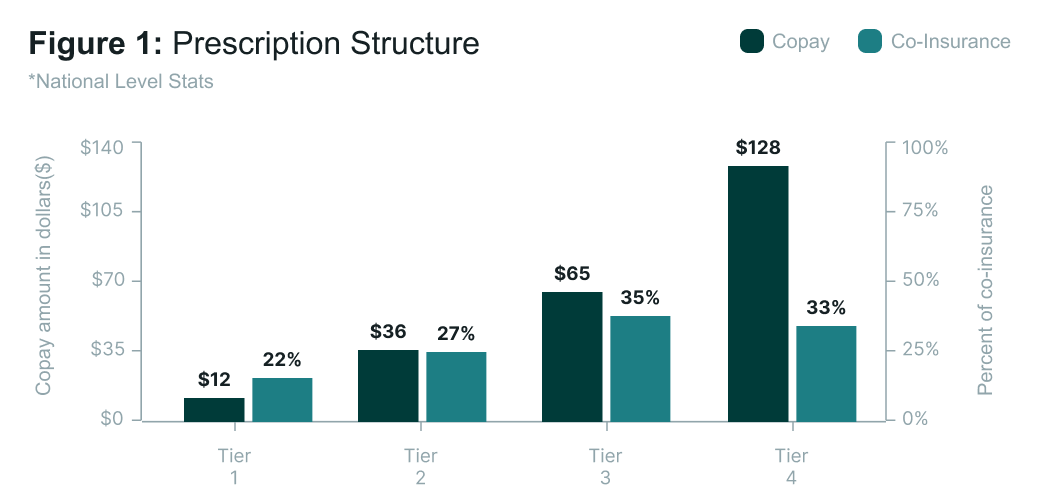
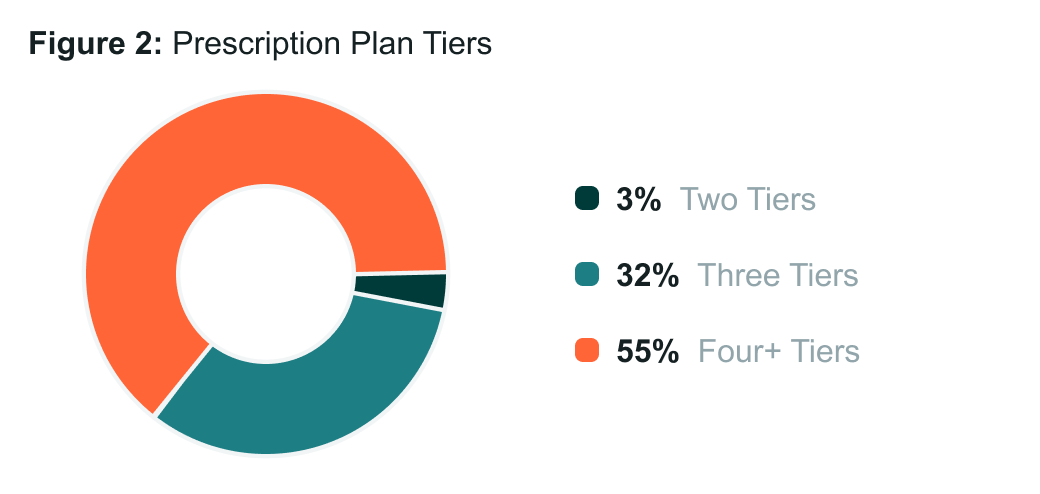
Most employer health plans organize prescription coverage into tiers, which determine both access and cost-sharing for employees.

  • Tier 1 (Generics): Lowest-cost drugs, usually just a $10–$20 copay. They are widely accessible and often encouraged as first-line therapy.
  • Tier 2 (Preferred Brands): Brand-name drugs that PBMs have negotiated discounts on. Employees typically pay $30–$50 copays or around 20% coinsurance.
  • Tier 3 (Non-Preferred Brands): Higher-cost brand drugs not favored on the formulary. Employees may owe 40%+ coinsurance, leading to hundreds in out-of-pocket costs.
  • Tier 4 (Specialty Drugs): High-cost therapies for serious conditions like cancer or hemophilia. These usually require coinsurance (20–30%), which can mean thousands of dollars per month. Although they make up less than 2% of prescriptions, specialty drugs drive nearly half of total drug spending.

Copays vs. Coinsurance

  • A copay is a fixed, predictable dollar amount per prescription.
  • Coinsurance is a percentage of the total drug cost until the deductible or out-of-pocket maximum is reached. While it helps share costs, it creates unpredictability—especially for specialty drugs, where 25% coinsurance could mean $250 on a $1,000 medication or much more on therapies costing thousands each month.

For employers, understanding how tiers and cost-sharing are structured is critical, since they directly affect both plan expenses and employee affordability.
High-Cost Drugs and Their Outsized Impact

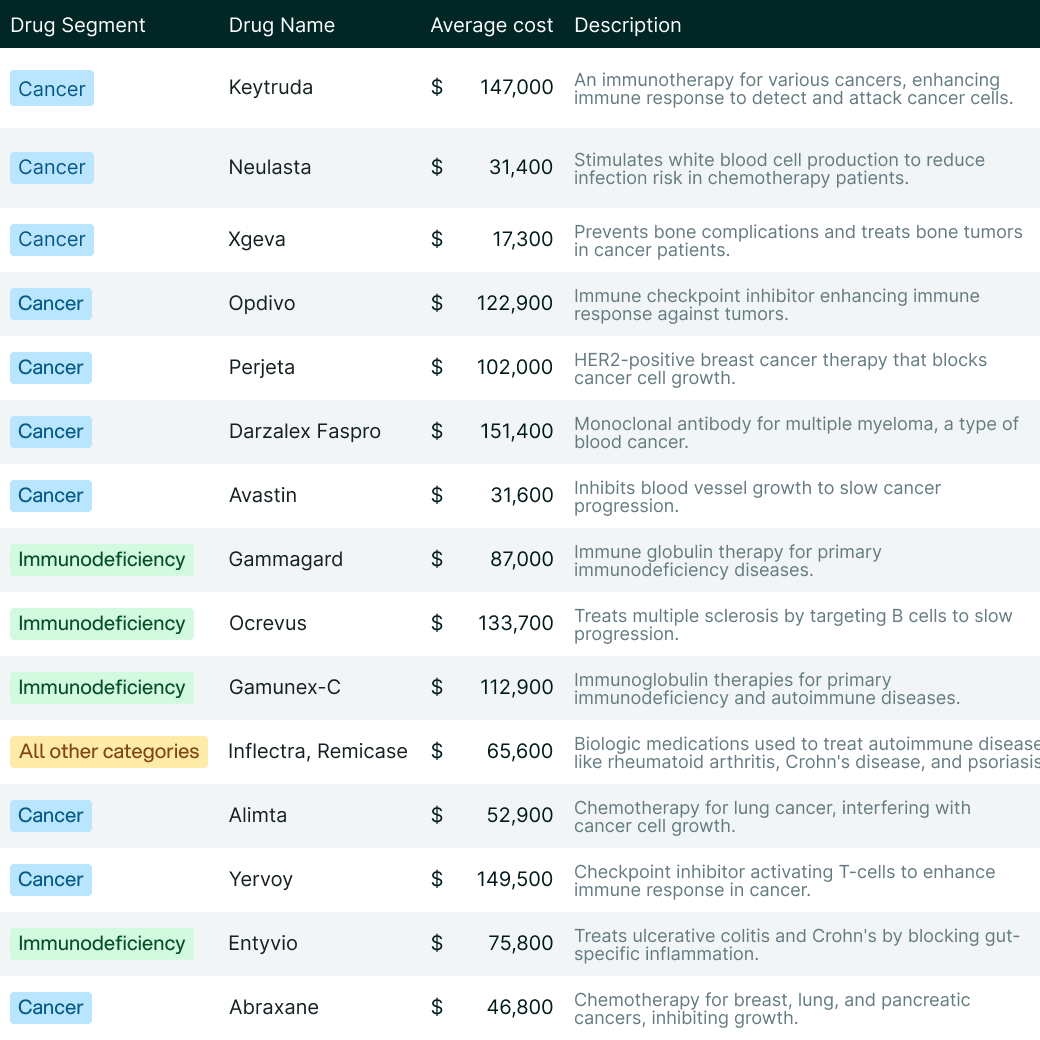
While high-cost drugs represent only a small fraction of total prescriptions, their impact on employer health plans is staggering. Specialty medications—such as those for cancer, hemophilia, and autoimmune disorders—account for less than 2% of prescriptions but drive close to 50% of all drug spending. Their costs have grown at double-digit rates year over year, fueled by new biologics, gene therapies, and infusion-based treatments that can run into hundreds of thousands of dollars annually. According to Sun Life’s High-Cost Claims Report, in many catastrophic claim categories like hemophilia or leukemia, prescription drugs make up more than 90% of the total cost of care. For employers, this means a single claimant on a specialty drug can dramatically shift overall plan spend, making pharmacy benefits one of the most volatile and financially significant areas to manage.
How Carriers Handle High-Cost Drugs

Carriers cover most FDA-approved specialty drugs but tightly manage access and cost. They use formularies to decide which drugs are included (and on what tier), require prior authorization or step therapy before approving treatment, and often restrict dispensing to their own specialty pharmacy networks. Coverage is generally limited to drugs deemed medically necessary, while experimental or non-formulary drugs are excluded unless appealed. For employees, this can mean higher coinsurance, delays in approval, and fewer choices on where prescriptions can be filled.

Who Controls the PBM Market—and Who’s Challenging It

Today, most carriers are tied to the “Big Three” PBMs, which together control more than 75% of the market:
  • Aetna/CVS → CVS Caremark
  • Cigna → Express Scripts
  • UnitedHealthcare → OptumRx
  • Anthem/Blue Cross (varies by region) → Caremark or Express Scripts

This consolidation means that for many employers, pharmacy benefits are automatically bundled with one of these large PBMs, leaving little room for visibility or flexibility.  

The remaining 25% is made up of disruptors offering more transparent models. Players like SmithRx (pass-through pricing with detailed reporting), MedOne (independent PBM with customizable formularies and full rebate pass-through), and Mark Cuban’s Cost Plus Drugs (a direct-to-consumer model selling drugs at cost plus a small margin) are challenging the status quo. For employers, knowing which PBM their carrier relies on—and whether a carve-out to one of these disruptors is possible—can be a critical step in controlling pharmacy costs.

Legislation and Reform Efforts

In recent years, lawmakers have increasingly targeted the opaque practices of PBMs, introducing multiple federal bills like the Pharmacy Benefit Manager Transparency Act (S. 127, 2023) and the PBM Transparency Act of 2025 (S. 526). These aim to ban spread pricing, require full rebate pass-through, and mandate detailed reporting—but none have passed into law yet. Similarly, a 2025 House bill dubbed the PBM Reform Act proposes greater transparency around Medicare Part D contracts and delinking PBM compensation from drug prices, but it remains pending in committee.

At the state level, all 50 states have enacted some degree of PBM regulation. Few states have gone further: for example, Iowa is considering a law imposing minimum pharmacy dispensing fees, and Arkansas passed legislation curbing PBMs’ ownership of pharmacies—though that law has been temporarily blocked by a federal judge

In short: there's plenty of activity at both federal and state levels—but no sweeping reforms have become law yet, leaving employers to manage PBM challenges proactively on their own.

Be Educated: Key Questions to Ask Your Broker

  1. Who is our PBM, and is it bundled with our carrier?
  1. Do we receive 100% of rebates, or are they retained?
  1. Can we carve out our PBM given our size and funding model?
  1. Which high-cost drugs are driving our spend?
  1. Do we get claim-level reporting from our PBM? (often not)
  1. What specialty drug management strategies are in place?
  1. How does our plan compare to industry peers?

Closing Thoughts

Prescription drug costs are no longer a side issue—they’re a central driver of employer healthcare spend. The combination of high-cost specialty therapies and the opaque role PBMs play in setting formularies, controlling access, and managing rebates makes this one of the most complex and consequential areas of benefit management. For employers, the path forward starts with awareness: knowing which PBM you’re tied to, how rebates flow, which drugs are shaping your spend, and what levers you have to push for transparency or carve out alternatives.

While legislation at the federal and state levels may eventually bring more clarity and accountability to the PBM market, employers cannot afford to wait. By asking sharper questions, exploring disruptive PBM models, and partnering with brokers who understand this space, employers can take meaningful steps today to control costs and support employees more effectively.

Bottom line: Prescription drug costs are only going up. Employers that engage now—by digging into the details and holding PBMs and carriers accountable—will be best positioned to protect both their budgets and their people.
Economy
The Employment Situation for February 2025
The latest economic release from the Bureau of Labor Statistics reports that the U.S. job market added just under 150 thousand jobs last month while unemployment ticked down one-tenth of a point to 4% to close out the last such economic report with data collected under the Biden administration.
February 7, 2025

Editor's Note: This report is based on survey data from January 2025 that was published in February 2025. This is the most recent data available. (Source: Bureau of Labor Statistics)

US employers added 143 thousand jobs last month, which fell a bit short from the almost 170 thousand that economists were forecasting.

At the same time, the national unemployment rate average ticked down by one-tenth of a point to 4% for the first time since May of 2024.

Beyond the slight movement in unemployment rate and increase in payroll figures, however, the labor market showed little movement whatsoever, with no significant change in labor force participation rate (62.6%) or in the number of people working part-time but who want full-time work (4.5 million). 

There was similarly little movement among the long-term unemployed (1.4 million) or the number of people who want a job but haven’t actively looked for one in the last 4 weeks (5.5 million) - only a relatively small portion of which had actively sought work in the last year (1.6 million) - all of which held steady from month to month.

Although the fewer than 150 thousand net jobs added across the US last month is down substantially from the more than 250 thousand net jobs recorded the month before, there were several industries that performed in line with expectations.

The healthcare industry reported the largest net increase in jobs last month with plus 44 thousand, which is slightly below the 55 thousand healthcare jobs averaged each month in 2024.

The retail industry had the next largest net job increase with plus 34 thousand, followed by government jobs at plus 32 thousand, then the social assistance industry, which grew by 22 thousand payroll entries.

Mining was the only industry that saw a net job loss over the month (minus 8,000), while the remainder of industries remained essentially unchanged, including the construction industry, the manufacturing industry, the wholesale trade, the information industry, the transportation and warehousing industry, the leisure and hospitality industry, the professional and business services industry, and the financial activities industry.

Average hourly pay rose by about 17 cents to $35.87 per hour (an increase of 0.5%), while the average workweek length fell slightly to 34.1 hours per week. 

Mployer’s Take

This BLS report contains the final batch of data collected under the Biden administration, which saw the US unemployment rate drop by 2.2% under its watch, down from 6.2% in February of 2021 to 4% as of January 2025.

This report also marks the 49th consecutive month of net job gains, which is the second longest streak of positive job growth since these numbers have been tracked. 

In fact, the only longer period of consecutive job growth in recorded US history occurred between October of 2010 and February of 2020, just as the pandemic was ramping up in the US, and were it not for the COVID employment dip which was accompanied by a historically quick recovery, the current ongoing streak of job growth and the last would be almost 4 times longer than the next longest streak.

Given that the 5th longest streak is 44 consecutive months of job growth, even getting to 40 consecutive months of growth is historically noteworthy and hitting 50 or more months of job growth has only happened once before, about 10 years ago. If the US maintains its current trajectory and achieves positive job growth again next month, that will be the second occurrence ever of more than 50 consecutive months of job growth, and those streaks have essentially occurred back to back.

All that to say, while the current job growth streak is not exactly unprecedented, it's pretty close and the streak does become more of an outlier with each passing month.

With the transfer of power comes questions about how trade agreement negotiations and immigration policy orders will ultimately play out, for example, and those outcomes will affect labor and employment issues both directly and indirectly.

While those outcomes remain to be seen, however, the uncertainty itself can in many cases have a negative drag on economic views, perhaps as evidenced in the notable downturn in consumer sentiment of late, but it’s likely that sentiment will rise or fall with economic performance, and those numbers will start coming in next month.

Check out the Mployer blog here.

HR Compliance
Legal/Compliance Roundup - February 2025
Each month, Mployer collects and presents some of the most relevant and most pressing recent changes in law, compliance, and policy in areas related to employee benefits, health care, and human resources.
February 3, 2025

Each month, Mployer collects and presents some of the most relevant and most pressing recent changes in law, compliance, and policy in areas related to employee benefits, health care, and human resources.

Form 300A Submission Due

From February 1st to April 30th, non-exempt (low hazard) employers who had at least 11 employees at some point in 2024 must post in a conspicuous place a copy of OSHA Form 300A, Summary of Work-Related Illness and Injury, certified by a company executive.

For non-exempt employers that had 250 or more employees at some point last year and employers with 20 or more employees in specified high risk industries, OSHA requires electronic submissions, which are due by March 2nd, 2025. 

You can find the electronic submission platform here

Executive Orders

In his first days since returning to office, President Trump has signed a series of executive orders dealing with labor and employment issues for federal employees and federal contractors, with more expected still to come.

While thus far these orders don’t apply to private employers in general - with the exception of those that accept federal funds and/or are federal contractors - these orders will not only affect a sizeable portion of the workforce directly, but they will also likely inspire some private employers to modify their practices and follow the example set by the executive branch.

The new rule that will most likely have the largest impact beyond the sphere of federal employees is Executive Order 11246, which makes it so that federal contractors no longer have to practice affirmative action in the hiring process for most protected classes. The only protected classes excepted from the order are veterans and individuals with disabilities, for whom affirmative action standards still apply. 

Although federal contractors will no longer be required to maintain affirmative action programs, Title VII of the Civil Rights Act remains in effect to prevent discrimination against protected classes like race, gender, sexual orientation, and national identity. 

You can read more here

Spence v. American Airlines

A Federal District Court Judge in Northern Texas ruled that American Airlines had breached its fiduciary duty by working with an investment manager that promoted ESG practices in a way that ran counter to the economic interests of the employee retirement fund beneficiaries.

The repercussions of this ruling could be industry-reshaping if upheld, although there were many additional conflicts of interest between American Airlines and their investment fund manager that may limit how broadly applicable the ruling will ultimately prove to be.

The judge has already found American Airlines in breach of their fiduciary duty, but he has yet to assess damages, which will influence the probability of appeal and the likelihood of copycat cases.

You can read more about this case here.

EAD Extension Formalized

As of January 13, 2025, the extension period for certain renewal Employee Authorization Document (EAD) applications filed on May 4, 2022 or later has been formalized at 540 days.

You can read more here.


IRS Mileage Reimbursement Rate Increased

As of January 1, 2025, the IRS mileage reimbursement rate for road miles driven for business purposes increased by 3 cents per mile from 67 to 70 cents per mile driven. 

PCORI Fee Increase

The IRS released a statement announcing a 25-cent increase in Patient-Centered Outcomes Research Institute fees for covered plan years ending on or after October 1, 2024, and before October 1, 2025. 

The new fee is $3.47 per covered life.

You can read more here

DOL Reinstates Simplified Tip Credit Rule

In response to a Federal Court of Appeals Decision that vacated the so-called 80/20/30 rule that was instituted in 2021, the Department of Labor officially reverted to the previous tip credit rule.

You can read more here.

Increased ACA Flexibility and Affordability Threshold

In the last weeks of 2024, the Paperwork Burden Reduction Act and the Employer Reporting Improvement Act both became law. 

The former will provide an alternative means for employers to distribute forms 1095-B and 1095-C to employees, and the latter extends the time employers have to respond to IRS notice of audit 226-J forms from 30 days to 90 days. 

In 2025, the threshold for what qualifies as affordable coverage also increases from 8.39% to 9.02%, which means that an employee’s required contribution to the plan can be no more than 9.02% of their salary in order for the plan to be considered affordable and to avoid potentially paying the penalty. 

You can read more about the affordability threshold here.

EAP & Highly Compensated Exception Update

A federal court in Texas determined that the Department of Labor exceeded its authority last summer by increasing the minimum pay thresholds for employees to qualify under the executive, administrative, and professional and highly-compensated employee exceptions to minimum wage and overtime protections. 

Those minimum pay thresholds have reverted to their prior levels - back to $684 per week for the EAP exemption (down from $844 per week under the now defunct rule), and back to $107,432 per year for the HCE exemption (down from $132,964 per year under the now defunct rule). 

State Updates

New York: Beginning March 4th, employers with 10 or more retail employees must have in place a written policy and training program for violence prevention measures. 

Further, as of January 1, 2025, New York employers are required to provide 20 hours of paid prenatal leave during a 52 week period. Also, as of the new year, the characteristics to which equal protection was extended via the New York State Human Rights Law and the resulting protections are formally enshrined in the New York State Constitution. Those characteristics include: age, disability, ethnicity, gender identity, gender expression, national origin, pregnancy, and anything else related to reproductive healthcare.

New York employers that receive criminal history records for applicants and employees must also now provide those applicants and employees with a copy of those records and a copy of the applicable New York corrections law as well as an opportunity to correct any inaccurate information that may be contained in those records. 

Colorado: The City of Boulder increased the minimum wage to $15.57 ($12.55 for tipped employees) as of January 1, 2025.

Oregon: As of January 1, 2025, Paid Leave Oregon provides leave for employees completing necessary legal steps associated with adopting and/or fostering children.

IRS Publishes 2025 Annual Retirement Plan Maximums

  • The 401(k) annual contribution limit increases from $23,000 to $23,500.
  • The catch-up contribution limit stays unchanged at $7,500 for participants aged 50 and over.
  • The SECURE Act 2.0 also instituted a new type of catch-up contribution, which enables participating people (age 60 to 63) to contribute up to $11,250 annually.

You can read more here

IRS Publishes 2025 Annual Benefit Maximums

  • The HFSA contribution max is $3,300 (maximum carryover is $650 for HFSAs with carryover features).
  • The QSEHRA max for total reimbursements is $6,350 for single coverage and $12,800 for family coverage.
  • The max employee tax credit for adoption assistance is $17,280, with additional conditions depending on employee salary range. 
  • The monthly parking and mass transit benefit max is $325.

You can find the complete IRS 2025 benefit contribution limit list here.

Minimum Wage Increases for Federal Contractors

As of January 1, 2025, the minimum wage for work conducted in association with federal contracts covered by Executive Order 13658 is $13.30 ($9.30 for tipped employees), while the minimum wage paid for work conducted in association with federal contracts covered by Executive Order 14026 is $17.75 per hour for both tipped and non-tipped employees.

Additional guidance about which kinds of contracts are covered by which executive order can be found here

ERISA Guidance for Long-Term Part-Time Employees

You can find guidance for ERISA 403(b) plan eligibility requirements for long-term, part-time employees according to the updated standards from the Secure ACT 2.0 here

ACA Affordability Threshold Increase

Large employers with an average of 50 or more full-time employees or the equivalent are required to either offer employees minimal, affordable health coverage or they must pay a penalty in the event that an employee secures health coverage with a premium tax credit via the exchanges. 

In 2025, the threshold for what qualifies as affordable coverage increases from 8.39% to 9.02%, which means that an employee’s required contribution to the plan can be no more than 9.02% of their salary in order for the plan to be considered affordable, which allows employers to avoid potentially paying the penalty. 

You can read more about the affordability threshold here.

Economy
The Market Employment Summary for January 2025
Each month, Mployer Advisor breaks down the Bureau of Labor Statistics’ most recent State Employment and Unemployment Summary to highlight some employment trends across various markets. This is an overview of January’s report.
January 30, 2025

Editor's Note: This report is based on survey data from December 2024 that was published in January 2025. This is the most recent data available. (Source: Bureau of Labor Statistics)

Despite the expectation-exceeding quarter of a million net jobs added last month across the US, unemployment actually increased in 6 states and only decreased in 2 states, with the remaining 42 states and Washington DC showing no significant movement in either direction.

Payroll figures were even more steady month-to-month, with 48 states and DC seeing almost no change in payroll during December while only 2 states saw a net increase in payroll figures.

Below is the breakdown of the Bureau of Labor Statistics’ (BLS) market employment summary for January 2025.

States With the Highest Unemployment Rates

Nevada had the highest unemployment rate for the second consecutive month, holding steady at 5.7%, followed by California and Washington DC at 5.5%, Kentucky and Illinois at 5.2%, and Michigan at 5.0% unemployment.

All other states have unemployment rates that are at or below the national average of 4.1%

Mississippi and Alabama had the largest jumps in unemployment rate last month - both climbing from 3.1% to 3.3%. Colorado, Maine, Massachusetts, and Pennsylvania each saw their state unemployment rate climb by 0.1%, as well.

Over the last year, 28 states in total have recorded an increase in unemployment rate, with the steepest rises occurring in South Carolina (1.7%), Rhode Island (1.2%), Colorado (1.1%), and Indiana and Kansas at 1.1% each.

States With The Lowest Unemployment Rates

South Dakota has maintained the lowest unemployment rate in the country for the last 12 months in a row, staying consistently at 1.9% unemployment for the last 3 months.

Vermont has the next lowest unemployment rate at 2.4% followed by North Dakota at 2.5%.

In total, 21 states have employment rates below the US average of 4.1%. 

Only 2 states recorded a decrease in unemployment over the last month - Minnesota, which saw its unemployment rate drop from 5.5% to 5.3%, and Montana, which saw its unemployment rate fall by 0.1% from 3.2% to 3.1%. 


Over the last 12 months, 6 states in total have seen net unemployment rate reductions, led by Connecticut, which saw its unemployment rate decrease by 1.2% over the year, followed by Wisconsin and Arizona at minus 0.4% each. 

States With New Job Losses

No state recorded net job losses over the last month or the last year.

States With New Job Gains

Texas and Missouri were the only states that had a net increase in payroll last month, adding about 37 thousand and 11 thousand jobs respectively. 

Over the last year, 33 states have seen an increase in their payroll figures, with Texas and California reporting the largest number of net jobs added while Idaho had the largest percentage increase in payroll figures at plus 3.6%, followed by Missouri and South Carolina at 2.8% each.

Mployer’s Take

Despite the downtick in the unemployment rate and huge over-performance of jobs reflected in this month’s Employment Situation release, there was relatively little evidence of those gains seen in the states, which were a model of stability nearly across the board.

Data from different labor surveys can and will often lead to results that don’t necessarily align, and that appears to be the case here.

Next month might provide some additional context that may help better interpret the disconnect between employment reports showing growth and those showing stability, but next month’s report will cover data collected on both sides of the transition from one session of Congress and one presidential administration to the next.

Whether there is much insight yet to be obtained about economic data at the close of the previous term will quickly become overshadowed by the potential economic implications of new policies that are proposed and enacted over these first few months of 2025.

With a flurry of activity both at the federal and state level already, including both legislation and executive orders that carry significant economic implications, that’s where we’ll be keeping an eye out in the months ahead as the economic and workforce impacts take shape. 

Looking for more exclusive content? Check out the Mployer blog.

Economy
The Employment Situation for January 2025
The latest economic release from the Bureau of Labor Statistics reports that the U.S. job market exceeded expectations by a significant margin to close out 2024, adding 256 thousand new jobs last month while unemployment ticked down one-tenth of a point to 4.1%.
January 10, 2025

Editor's Note: This report is based on survey data from December 2024 that was published in January 2025. This is the most recent data available. (Source: Bureau of Labor Statistics)

US employers added about 256 thousand jobs last month, which exceeded economists predictions of about 150 thousand jobs by nearly 79%.

The national unemployment dropping to 4.1% also bet forecasts, which were predicting the national unemployment rate from holding steady at 4.2%.

The number of people who permanently lost their job last month was down significantly from the month prior as well, down from almost 1.9 million people in November prior to 1.7 million as of the latest report.

There wasn’t much change in terms of the number of long-term unemployed and the labor force participation rate, which held steady at 1.6 million and 62.5%, respectively. 

People working part time due to economic reasons (4.4 million) and people who want a job but haven’t looked for one in the last 4 weeks (5.5 million) also was similarly unchanged over the month, as was the 1.6 million people who are categorized as marginally attached to the workforce, meaning they want a job and had looked for one at some point in the past 12 months but had not done so in the past 4 weeks.

Of the net 256 thousand net new payroll entries over the course of December, the healthcare industry was responsible for the largest portion at 46 thousand new jobs, with the retail industry close behind at 45 thousand net new jobs after suffering a net job loss in November’ report.

About 33 thousand and 23 thousand government and social assistance jobs were added last month, as well, while most of the remaining industries saw little change in payroll figures during the month, including leisure & hospitality, natural resource extraction, construction, manufacturing, wholesale trade, information, financial activities, and professional and business services as well as other services. 

Average hourly pay continued rising, this time by about 10 cents to $35.69 per hour (an increase of 0.3%), while the average workweek held steady at 34.3 hours per week. 

Mployer’s Take

This latest employment report marks the second consecutive month of job growth that far outpaces expectations, but those two strong months come on the heels of an especially weak one in October.

Still, given that strikes, natural disasters, and related data collection issues were significantly responsible for the down month, the two latest strong months look all the better by comparison. 

The recent job market strength, however, bolsters the Federal Reserve’s case for delaying additional rate cuts and makes it very unlikely that we’ll see any rate cuts over the next several months, especially in light of uncertainty about whether the incoming Trump administration will follow through with tariffs and if so, how broadly impactful they may be, which the Fed will monitor closely in relation to any inflationary pressure the tariffs may cause. 

While we won’t know much more about how the months and years ahead are primed to play out until power formally changes hands, it’s worth taking a look at some of the milestones from the past year as we wrap up some of the last data points from 2024.

Over the last year, US payrolls have increased by 2.2 million, for an average monthly net job gain of 186 thousand. Unemployment is up three-tenths of a point from a year ago, while average hourly wages are up almost 4%.

Other than comparing last year to 2023, when more than 3 million net jobs were added for an average monthly increase of more than a quarter million, it is hard to look at the 2024 numbers and not be impressed at the strength and resiliency of the labor market and economy generally throughout the year. 

With the new year comes new data, new milestones to mark, and in this case, new policies that will shape the labor market and economy going forward for years to come, but overperformance has become the new normal over the past several years, even when plenty of economists were expecting economic downturn, and overperformance is almost certainly unsustainable in the long run as expectations adjust to correct for previous errors.

We would be lucky to keep up the streak, to be sure, but regardless, we will continue keeping an eye on the labor market and economy as new developments come about. 

Check out the Mployer blog here.

HR Compliance
Legal/Compliance Roundup - January 2025
Each month, Mployer collects and presents some of the most relevant and most pressing recent changes in law, compliance, and policy in areas related to employee benefits, health care, and human resources.
January 6, 2025

Each month, Mployer collects and presents some of the most relevant and most pressing recent changes in law, compliance, and policy in areas related to employee benefits, health care, and human resources.

EAD Extension Formalized

Beginning on January 13, 2025, the extension period for certain renewal Employee Authorization Document (EAD) applications filed on May 4, 2022 or later is now formalized at 540 days.

You can read more here.

IRS Mileage Reimbursement Rate Increased

As of January 1, 2025, the IRS mileage reimbursement rate for road miles driven for business purposes increased by 3 cents per mile from 67 to 70 cents per mile driven. 

PCORI Fee Increase

The IRS released a statement announcing a 25-cent increase in Patient-Centered Outcomes Research Institute fees for covered plan years ending on or after October 1, 2024, and before October 1, 2025. 

The new fee is $3.47 per covered life.

You can read more here

DOL Reinstates Simplified Tip Credit Rule

In response to a Federal Court of Appeals Decision that vacated the so-called 80/20/30 rule that was instituted in 2021, the Department of Labor officially reverted to the previous tip credit rule.

You can read more here.

Increased ACA Flexibility and Affordability Threshold

In the final days before Christmas a few weeks ago, the Paperwork Burden Reduction Act and the Employer Reporting Improvement Act both became law. 

The former will provide an alternative means for employers to distribute forms 1095-B and 1095-C to employees, and the latter extends the time employers have to respond to IRS notice of audit 226-J forms from 30 days to 90 days. 

In 2025, the threshold for what qualifies as affordable coverage also increases from 8.39% to 9.02%, which means that an employee’s required contribution to the plan can be no more than 9.02% of their salary in order for the plan to be considered affordable and to avoid potentially paying the penalty. 

You can read more about the affordability threshold here.

EAP & Highly Compensated Exception Update

A federal court in Texas determined that the Department of Labor exceeded its authority last summer by increasing the minimum pay thresholds for employees to qualify under the executive, administrative, and professional and highly-compensated employee exceptions to minimum wage and overtime protections. 

Those minimum pay thresholds have reverted to their prior levels - back to $684 per week for the EAP exemption (down from $844 per week under the now defunct rule), and back to $107,432 per year for the HCE exemption (down from $132,964 per year under the now defunct rule). 

NLRB Says No Captive Audience Meetings on Unionization Issues

The National Labor Relations Board has issued a decision prohibiting employers from forcing employees under threat of punishment to attend meetings during which the employer will share views on unionization or its impacts. 

Employers are allowed, however, to convene employees and share their views on unionization and potential impacts so long as employees are not disciplined or adversely affected in any way for not attending (or leaving early). Employers should not even keep or maintain such attendance records.

You can read more here

State Updates

Colorado: The City of Boulder increased the minimum wage to $15.57 ($12.55 for tipped employees) as of January 1, 2025.

Oregon: As of January 1, 2025, Paid Leave Oregon provides leave for employees completing necessary legal steps associated with adopting and/or fostering children.

New York: New York employers that receive criminal history records for applicants and employees must now provide those applicants and employees with a copy of those records and a copy of the applicable New York corrections law as well as an opportunity to correct any inaccurate information that may be contained in those records. 

Further, as of January 1, 2025, New York employers are required to provide 20 hours of paid prenatal leave during a 52 week period. Also, as of the new year, the characteristics to which equal protection was extended via the New York State Human Rights Law and the resulting protections are formally enshrined in the New York State Constitution. Those characteristics include: age, disability, ethnicity, gender identity, gender expression, national origin, pregnancy, and anything else related to reproductive healthcare.

IRS Publishes 2025 Annual Retirement Plan Maximums

  • The 401(k) annual contribution limit increases from $23,000 to $23,500.
  • The catch-up contribution limit stays unchanged at $7,500 for participants aged 50 and over.
  • The SECURE Act 2.0 also instituted a new type of catch-up contribution, which enables participating people (age 60 to 63) to contribute up to $11,250 annually.

You can read more here

IRS Publishes 2025 Annual Benefit Maximums

  • The HFSA contribution max is $3,300 (maximum carryover is $650 for HFSAs with carryover features).
  • The QSEHRA max for total reimbursements is $6,350 for single coverage and $12,800 for family coverage.
  • The max employee tax credit for adoption assistance is $17,280, with additional conditions depending on employee salary range. 
  • The monthly parking and mass transit benefit max is $325. 

You can find the complete IRS 2025 benefit contribution limit list here.

Minimum Wage Increases for Federal Contractors

As of January 1, 2025, the minimum wage for work conducted in association with federal contracts covered by Executive Order 13658 is $13.30 ($9.30 for tipped employees), while the minimum wage paid for work conducted in association with federal contracts covered by Executive Order 14026 is $17.75 per hour for both tipped and non-tipped employees.

Additional guidance about which kinds of contracts are covered by which executive order can be found here

ERISA Guidance for Long-Term Part-Time Employees

You can find guidance for ERISA 403(b) plan eligibility requirements for long-term, part-time employees according to the updated standards from the Secure ACT 2.0 here

Economy
The Market Employment Summary for December 2024
Each month, Mployer Advisor breaks down the Bureau of Labor Statistics’ most recent State Employment and Unemployment Summary to highlight some employment trends across various markets. This is an overview of December’s report.
December 23, 2024

Editor's Note: This report is based on survey data from November 2024 that was published in December 2024. This is the most recent data available. (Source: Bureau of Labor Statistics)

Last month, the national unemployment rate rose to 4.2% (up one-tenth of a percentage point), but only 6 states saw their state-level unemployment go up while one state saw a decrease in unemployment and all the rest saw no significant change in state employment levels.

US employers added more than a quarter of a million jobs at the same time, but only 4 states plus Washington DC recorded a net increase in payroll figures, while the remaining 46 states saw no noteworthy change over the month.

Below is the breakdown of the Bureau of Labor Statistics’ (BLS) market employment summary for October 2024.

States With the Highest Unemployment Rates

Nevada had the highest unemployment rate last month at 5.7%, which is up almost one-tenth of a point over the month and about four-tenths of a point over the last year.

Washington DC has the next highest unemployment rate at 5.6%, followed by California at 5.4% and Illinois at 5.3% unemployment. 

Those are the only states that currently have unemployment rates above the national average of 4.2%, with Idaho having the next highest unemployment rate at 3.7%.

Last month, 6 states recorded a higher unemployment rate than the month before, led by Alabama, Maine, and Mississippi, which all saw their unemployment rates climb from 2.9% to 3.1% over the course of the month. Iowa (now 3.1%), Kansas (now 3.5%), and Vermont (now 2.4%) all saw the unemployment rates in their states increase by 0.1%. 

Over the last year, 26 states have experienced rising unemployment, with the largest percentage increases going to South Carolina (plus 1.8%), Rhode Island (plus 1.4%), and Colorado (plus 1.0%). 

States With The Lowest Unemployment Rates

South Dakota is now 1 month shy of hitting the 1-year mark of consecutive months with the lowest unemployment rate among states - this month holding steady month-to-month at 1.9%.

The next lowest unemployment rate was 2.4% - recorded by both North Dakota and Vermont - which is more than half of a percentage point above South Dakota’s level, which further reinforces just how strong South Dakota’s labor market has been.

Delaware was the only state that experienced a net reduction in unemployment over the month, dropping one-tenth of a point from 4.0% to 3.9%.

Over the last 12 months, 6 states have recorded a net decrease in unemployment, but the largest reduction by far occurred in Connecticut where unemployment fell by 1.2% over the last year, followed by Wisconsin and Arizona, which each fell by only half a point each.

States With New Job Losses

No state recorded net job losses over the last month or the last year.

States With New Job Gains

Employers in the state of Florida added more net jobs last month than any other state, increasing payrolls by more than 60 thousand, while Washington state had the next largest gain, adding a little more than 30 thousand net jobs over the month.

Washington also had the largest percentage gain, increasing their workforce by 0.9%, followed by Alaska and Washington DC at 0.7% each, Florida at 0.6%, and Kansas at plus 0.5%.

Over the last year, 33 states have recorded statistically significant increases in net jobs.

Texas and California had the largest net increase in raw job figures at about 274 thousand and 208 thousand, respectively, while Idaho had the largest percentage growth (3.1%) followed by Alaska (2.8%), Missouri (2.7%), and Montana (2.4%).

Mployer’s Take

Not much has changed on the surface, but several external factors are in flux that could significantly shift the economic outlook over the coming months (and years) depending upon how they resolve.

The current report is the third to last such dataset that will be compiled by the outgoing Biden administration, and there are still a number of uncertainties that remain about the priorities of the incoming administration and how the transfer of power will impact the economy and labor market, both in the short and long term.

While Congress was able to avert a government shutdown at the end of last week by passing a last-minute continuing resolution, that bill will only keep the government funded for a couple of months through the middle of March when Republicans will control all 3 branches of the federal government, and how they elect to respond to current inter and intra party disputes will have significant ramifications outside of DC, of course.

The end of last week also brought another quarter-point interest rate cut from the Federal Reserve, but that news wasn’t entirely well-received given that it was accompanied by statements from Fed Chair Jerome Powell indicating the Fed will probably only cut another half point from interest rates over the course of 2025, which is half of what many analysts were expecting.

The stock market ended the week on an upturn due to better-than-expected inflation data, but that upturn followed nearly 2 weeks of consecutive losses punctuated by an almost 3% drop on the day of the Fed’s announcement, and while the markets are up close to 10% over the last 6 months, they are down more than 2% over the week/month.

While there are certainly many questions up in the air about how the economic road ahead will unfold, we are unlikely to get many meaningful answers for at least another month and likely more.

Looking for more exclusive content? Check out the Mployer blog.