
.png)
%20(1).png)

.svg)
Leave Benefits
The Employers’ Guide To Consolidated, Non-Consolidated & Unlimited Leave Policies
Here's what you need to know about leave policies and how to make them work for your organization.
June 21, 2024


.jpg)
ARTICLE | The Employers’ Guide To Consolidated, Non-Consolidated & Unlimited Leave Policies
Leave practices and policies can be wildly inconsistent between states, industries, and organizations - even internally - and yet they are regularly one of the top factors employees consider when evaluating and taking stock of their prospective and/or current compensation packages and job situations, generally.
Further, according to Forbes’ best employee benefits of 2024 reporting, leave is one of the most notably undervalued benefit package components in terms of the gap between the importance ascribed to favorable leave policies by employees vs. the importance ascribed to favorable leave policies by employers.
The combination of the wide-ranging leave policies employees may have encountered over the course of their careers and the large number of employers that are overlooking the significance of leave from the employee perspective provides an opportunity for employers to better align leave policy with larger organizational goals while gaining a competitive edge over other players in their respective industries at the same time.
Despite that the idea for paid leave first started gaining steam globally around 1910 after President Taft proposed a law (that never came to pass) requiring 2 to 3 months of mandatory paid vacation for every American worker, the US has lagged behind its international, industrialized peers ever since in terms of ensuring its domestic workforce has access to paid time off from their labor.
In the years since, many state governments have stepped in to require private employers to provide some forms of paid leave in some situations, and many private employers have of course gone above and beyond state minimums as part of a compensation package designed to attract, retain, and optimize the output of talent, but the end result is a mess of policies and expectations that can vary considerably depending on a number of different variables.
The net effect of those varying policies is that a little less than 8 out of 10 workers on average in the US have access to some form of paid leave, with about 79% of US workers having access to paid sick leave, 77% of US workers having access to paid holidays, and 75% of US workers getting some form of paid vacation.
Even among similarly situated employers, there remains at least 3 distinct approaches for how best to navigate this shifting leave policy landscape - the standard non-consolidated leave approach, the growing consolidated leave approach, and the emerging unlimited leave approach.
There are, however, disadvantages and advantages to each of the potential leave approaches that comparably positioned organizations may weigh very differently and are best addressed on a case-by-case basis in light of the circumstances specific to a given employer.
Non-consolidated leave policies separate different potential types of leave into categories with a separate amount/tranche of leave time offered for each category. For example, in non-consolidated leave plans an employee is offered a set amount of paid sick days during a given term/year, as well as a set amount of paid vacation days, and a set amount of paid/personal time off (PTO) to be used for personal business, etc.
According to the most recent available data from the Bureau of Labor Statistics, about 56% of US employees are subject to non-consolidated leave policies, which, while still a majority, is down considerably in just the last few years and is hanging onto that majority status by a thread.
This kind of leave segmentation is in many ways more the natural evolutionary byproduct of paid leave plan administrators adding new types of leave piecemeal over time than it is a cohesive policy conceived in pursuit of some specific aims, but there are nonetheless advantages that non-consolidated leave policies can potentially wield over the newer, less-structured alternatives.
The main advantages that non-consolidated leave policies provide employers is a greater degree of hands-on control that may enable them to better tailor leave policies in line with the needs of both the organization and the employees.
For example, sick days can be deemed to rollover from one term to another in order to encourage employees to come to work when capable while knowing that those days aren’t lost if they find themselves experiencing a more significant, contagious, and/or long-term illness or injury down the road.On the other hand, vacation days may be deemed not to rollover, thereby encouraging employees to take the breaks that have been afforded them in order to relax, recharge, and return to work ready to produce at a high level, which is in all parties’ mutual interest.
Further, sick days, personal days, and vacation days can potentially be set to accrue at different rates based on different inputs in line with business needs, as well.The disadvantages to non-consolidated leave policies, however, are largely centered around enforcement difficulties and the additional administrative expenses incurred to manage them. While employers may have an interest in having their employees use sick days only when they are sick, the process for confirming and documenting proper leave utilization can be cumbersome, invasive, and/or lead to ill will between workers and management that is outsized relative to the perceived advantages that are attained.
In consolidated leave policies, time made available for employee leave - whether for vacation, illness, personal business, or otherwise - all comes out of the same collective pool (sometimes referred to as a PTO bank) with no need for segmentation into leave categories.
As of the most recent data available, about 44% of US workers who have some kind of PTO work under consolidated leave plans, although that number climbs to over 50% when measuring only workers who receive paid vacation days (as of 2023), in contrast to the fewer than 25% of workers with paid vacation who had consolidated leave plans back in 2010.
Clearly, consolidated leave plan adoption has been on the rise, and while they do not share some of the employer-tailoring potential that non-consolidated plans can offer, consolidated plans do have the benefit of allowing employees to tailor their leave utilization in line with their own motivations and interests, which is a selling point in its own right and a meaningful one from the vantage point of many employees.
Consolidated plans also immediately remove the sick-day skepticism that can poison working relationships between workers, managers, and coworkers alike, in addition to cutting down on costs associated with collecting, tracking, and storing certain leave utilization documentation.
The latest trend in leave policy takes consolidated leave flexibility one step further by not only consolidating the different types of leave into one PTO bank, but also removing the cap on the number of days in that bank so that the number of PTO days available to a given employee is technically unlimited.
According to a recent report from the International Foundation for Employee Benefit Plans, about 9% of private employers surveyed had adopted an unlimited PTO policy, which comports with the 8% of companies offering and 10% of employees being offered unlimited PTO as reported by Zippia.
Further, 87% of those employers offering unlimited-PTO have begun doing so within the last 4 years, and Indeed reports that the number of job listings referencing unlimited PTO grew by 40% between 2019 and 2023, so the growth trajectory for unlimited leave is even steeper than that of consolidated leave has been.
While an unlimited PTO model may sound like a dream to many workers and a nightmare to some employers, the reality so far has in many ways been the opposite.Workers who may envision themselves going on regular extended sabbaticals more often than not actually find themselves taking fewer days off work under the unlimited PTO model than they did with a set number of PTO days. Such employees often cite a heavy workload, social stigma, coworker/manager coordination, and not wanting to offload responsibilities to others as some of the main reasons for underutilizing the opportunity to take leave. In fact, workers with unlimited PTO take only an average of about 13 PTO days per year.
Employers, on the other hand, who may be reluctant to adopt the unlimited leave model for fear of mass employee absenteeism not only end up with employees working more than before, they also can eliminate carrying the liabilities associated with accrued vacation days on their accounting books and can avoid paying out on unused PTO to terminated employees (as is required in 19 states: CA, CO, IL, IN, LA, ME, MD, MA, MT, NE, NH, NM, NY, NC, ND, OH, RI, WV, WI) simply because there are no longer any PTO days that have accrued.
Those kinds of advantages may become increasingly hard for employers to ignore, even as employees adjust to the new system and begin to utilize it more to their own advantage, as well.
While a majority of states (27) have some form of PTO law on the books, the scope ranges from relatively small (as in Louisiana's requirement that each employee be given one day of PTO for jury duty or Virginia’s requirement that home health workers who work at least 20 hours per week receive one hour of paid sick leave for every 30 hours they spend on the job) to much more broad in application (like Nevada’s law requiring employers with more than 50 employees to provide 0.01923 hours of PTO (capped at 40 hours per year) for every hour worked, which employees can use for any purpose.
The following states have enacted at least one law with regard to PTO for private employers/employees, the vast majority of which focus on sick and family leave:
The following states have no current laws mandating any form of PTO:
While there are a few potential advantages to non-consolidated PTO, many of those advantages in terms of shaping employee PTO usage are often more theoretical than practical, whereas the additional burdens of verifying and administering non-consolidated PTO are very concrete.
Though non-consolidated PTO remains the majority position for the time being at least, all the momentum seems to be behind consolidation.
Whether that momentum will ultimately carry the unlimited leave model and its even greater levels of flexibility to become standard business practice and the majority approach among employers remains to be seen, but unlimited PTO certainly seems to have the necessary tailwinds behind it to make that outcome a real possibility.
Despite the practical downsides for employees with unlimited PTO - which employees will adapt to over time and which employers can mitigate through proactive efforts to help encourage culture shift and encourage optimized leave utilization - the idealized promise of unlimited PTO remains a strong draw for talent from a recruitment and retention perspective.
Further, employers would be ill advised not to consider the potential benefits that can be immediately realized from a liability perspective when the policy is implemented, especially if they operate in a state that considers accrued PTO to be equivalent to wages and/or mandates the payout of accrued PTO to employees that have been fired.
The right PTO arrangement may very well be a little different for any given employer based on what they do, where they are, and what they hope to accomplish via the policy, but consolidation and unlimited PTO offerings are clearly not only attracting the interest of a growing number of employers, but many of those employers who take a closer look are liking what they see and making a change.
.jpg)
Key Takeaways
ARTICLE | The Employers’ Guide To Juneteenth
Juneteenth is coming up on June 19th, 2024 - Here’s what you need to know.
Juneteenth - a celebration and commemoration of the end of slavery in the US - is the latest holiday to join the esteemed ranks of the 10 other federal holidays that can be found on the US calendar.
As with all other federal holidays, private employers are not federally mandated to provide paid time off or any other accommodations for employees with regard to Juneteenth under the Fair Labor Standards Act or otherwise, but the scope of the holiday’s impact will extend well beyond government employees getting the day off work.
In terms of practical impacts, most government buildings will of course be closed including, post offices, public schools, and courts. Banks and financial markets will be closed, as well.
Further, 38 states so far have declared Juneteenth as a state holiday, so many state workers will be off-duty too, and more than a few cities and local governments have also passed Juneteenth-related ordinances to varying effect that may be worth looking into in your geographic area.
This year, June 19th will be a Wednesday - but for those who do/will offer PTO for Juneteenth and want to stay in line with the federal holiday schedule protocol in the event that June 19th falls on a weekend - if it’s a Saturday the holiday should be observed on the preceding Friday and if it’s a Sunday the holiday should be observed on the following Monday.
Perhaps most impactful will be the growing number of private businesses that are choosing to make Juneteenth a companywide holiday.
According to a study from Mercer, about 39% of private employers in the US had adopted Juneteenth as a paid holiday as of last year (2023 - the most recent data available), which is up by 6% over the 33% adoption rate reported in 2022.
In 2021 - the year that Juneteenth was declared a federal holiday - only 9% of private employers had adopted Juneteenth as a paid holiday, so while the rate of adoption has slowed over time, the upward trajectory almost certainly continues as more organizations get on board and time off for the Juneteenth holiday approaches the tipping point from normalized to expected.
In some industries, to be clear, that threshold from Juneteenth PTO normalization to expectation has already been crossed, such as in the financial services industry for example. In 2023, nearly 2 out of 3 employers in the financial services industry (63%) were already offering employees paid time off for the Juneteenth holiday.
How does Juneteenth PTO adoption among private employers stack up compared with PTO adoption for the other holidays, federal and otherwise? It is about middle of the pack, which is especially impressive given how recently it attained federal holiday status.
Prior to gaining federal holiday status in 2021, the PTO adoption rate for Juneteenth was less than half of the PTO adoption rate for President’s Day and Good Friday, both of which have been adopted as company holidays by about 19% of private employers. Juneteenth was even below Veteran’s Day and New Year’s day at 11% and 14%, respectively, according to Indeed.
After becoming an official federal holiday, however, and being adopted by an additional 30% of private employers in the 3 years following that status declaration, the number of private employers offering Juneteenth as a company holiday now likely exceeds the number of private employers who do so for the Day After Thanksgiving (~39% PTO adoption), Christmas Eve (26% PTO adoption), or Martin Luther King, Jr. Day (24% PTO adoption).
While Juneteenth still has a long way to go to reach private employer PTO adoption rates comparable to the heavy hitter holidays like Christmas Day, Thanksgiving Day, Independence Day, Labor Day, New Year’s Day, and Memorial Day - all of which have approximately 90% or more adoption across private employers - those kinds of adoption figures are not outside the realm of possibility if the labor market remains tight and leave/benefits become an increasingly competitive battlefield in the fight for top talent.
Despite being a recent addition to the federal holiday list, there is a long history and tradition surrounding the Juneteenth celebration stretching back nearly 160 years, and a closer look at that history will serve to encourage further the adoption of the holiday for reasons beyond talent attraction and retention.
While slaves in secessionist states were technically freed upon Lincoln’s issuance of the Emancipation Proclamation on January 1, 1863, it wasn’t until 2 and a half years later - and more than 2 months after the war had technically concluded - that the Union army finally secured the physical release of the last remaining slaves from a Confederate stronghold in Galveston Texas (on June 19, 1865) that the promise of the Emancipation Proclamation was finally fulfilled.
It is also worth noting that the last remaining slaves in the US were not actually freed until the 13th Amendment was ratified on December 6, 1865 since the Emancipation Proclamation only addressed the slaves in secessionist states and had not covered slaves in Kentucky and Delaware, neither of which had joined the Confederacy despite allowing legalized slavery within their borders.
By the end of 1865, all slaves had been freed in the US, and the following year on June 19th, 1866, the first ever Juneteenth holiday was celebrated to mark the significance of the occasion and memorialize the gravity of what had taken place the year (and the years) before.
With the growth we’ve seen over the last few years in the number of employers recognizing Juneteenth and offering employees paid time off, it is probable that the holiday has already reached critical mass at which point observation of the holiday and company-wide holiday status for Juneteenth is more likely to continue growing than to recede.
We are, however, still in the sweet spot when Juneteenth PTO is becoming commonplace but has not yet become a majority position among private employers (in most industries), so the window of opportunity to gain a competitive advantage as an early adopter is still open for most organizations and enterprises.
Whether or not commemorating an important date in American history coupled with forward-thinking talent attraction and retention tactics is enough motivation to consider expanding PTO-covered holidays to include Juneteenth, it would be wise to recognize these dynamics at play in terms of how they are likely to induce additional adoption in the years ahead.
The downside for late adopters, of course, is that instead of getting ahead of the competition while signifying the importance of the occasion and making a positive connection, they end up coming around anyway just to keep up with the competition even as the benefits for doing so yield increasingly diminished returns.
Don’t miss out on the opportunity to call attention to the occasion and celebrate Juneteenth this year!
.jpg)
ARTICLE | The HR Professional’s Guide To The End of The Non-Compete Era
Last month, the Federal Trade Commission issued a new rule that invalidates non-compete agreements for the vast majority of employment contracts, reducing the percentage of the employees subject to non-compete agreements from almost 20% of the workforce to less than 1%.
For human resource professionals, executives, and organizational leadership, the impacts of these changes will be considerable - from talent acquisition and retention to employee health outcomes - and may be worth considering in advance of when the new rule takes effect this coming fall.
To be clear, it’s very possible if not more likely than not that at least one of the pending/forthcoming lawsuits challenging the new rule will succeed on some level, but the FTC makes a fairly compelling case - both against non-compete agreements and for the agency’s ability to regulate them - that is unlikely to go away even if the new rule in its current form doesn’t survive judicial review unscathed.
In the event that the current era of non-competes truly does come to an end, whether sooner or later, more than a few aspects surrounding common business practices for managing talent retention, intellectual property protection, and limiting competition will have to be rethought and reconfigured from the ground up, which will provide both significant challenges and meaningful opportunities.
How HR professionals and organizations in general respond to those challenges and adapt their way of doing business to adjust to the new non-compete normal, and more importantly how effective those adjustments prove to be, will likely reshape human resources management practices and business organizational structuring for decades to come.


The first thing that employers must do is notify all employees who will be affected by the new rule and inform them that their non-compete agreement will no longer be in effect as of September 4th (or whatever date in advance of September 4, 2024 that the company may choose). The FTC has provided model language to assist in the process that can be found on the agency website.
The next step must be quickly adjusting course in line with the new reality that non-compete agreements may soon be a relic of the past.To understand how the absence of non-compete agreements will affect business operations, it’s important to start with the main goals that non-compete clauses are typically utilized to meet - retaining talent, protecting IP/ trade secrets, and limiting competition.
These goals can all be pursued via a combination of other efforts, of course, but those efforts will not necessarily all be as effective as non-competes had been, nor will they all be equally effective for every employer that puts them to use.
While it remains to be seen what methods will and won’t be effective for a given employer/industry/goal, that process of trial and error in discovering what works and what doesn’t will likely have major consequences that will be felt across the labor market and economy as a whole in terms of how business is conducted going forward relative to the status quo.
Non-compete agreements have often been employed in order to ensure that in-house know-how and trade secrets stayed in-house.
Perhaps the most relatable of the justifications for restricting the free movement of employees within a market is the understandable desire for organizations to keep some information out of the hands of competitors, would-be market entrants, and others who may inhibit the ability of the business to grow and succeed.
To those ends, non-compete agreements were fairly effective, which is partly responsible for the widespread practice of routinely including non-compete agreements in employment contracts.In a post-non-compete world, one concrete measure organizations can undertake to better protect intellectual property and trade secrets is putting in place more clear and restrictive policies and procedures for using company equipment and for accessing, downloading, storing, and utilizing company data and work product.
These efforts can decrease the likelihood that confidential information gets outside of the building in the first place, in addition to potentially helping to determine if, when, how, and by whom that information was improperly accessed or disclosed in the event of a breach.
While laws that allow for the protection of trade secrets and IP remain in place even absent non-compete agreements, however, in practice it can be much more difficult to prove infractions than to prevent them.
As a result, to better reduce the leaking of valuable information without non-compete agreements to limit in-house knowledge from benefiting competitors, employers are likely to redouble their talent retention-efforts, especially for specialized roles with specific insight into the organization’s competitive advantages.
Regardless of the efforts taken to retain talent, however, some employees with access to trade secrets and valuable organizational knowledge will inevitably move on to work for another employer, in which case tighter, and more specific non-disclosure agreements with heightened penalties for term violations may be the best tools available for ensuring departing employees know both what information should not be revealed and the legal repercussions they may face if they do so.
Once non-compete restrictions are lifted, employees will be able to more directly test the market value of their labor by offering it to competitors.
At first, this newfound employee freedom of movement may lead to both increased turnover and increased wages/labor expenses. While some employees will take the opportunity to open their own business, the majority of the influx of talent on the market will likely look to move on and/or move up resulting in an industry-wide game of musical chairs.
As a growing number of companies begin adopting alternative means for achieving the goals they had previously pursued via non-compete agreements, however, that churn is likely to settle and may ultimately lead to a lower turnover rate overall.
For example, while non-competes provided a serviceable ‘stick’ to limit employees’ ability to leave their jobs, the absence of non-compete agreements suddenly makes the various ‘carrots’ that serve a complementary purpose all the more crucial.
While some other retention-aiding ‘sticks’ can still be put to use toward improved retention, including Training Repayment Assistance Programs (TRAPS) so long as those programs are not so severe as to constitute de facto non-compete agreements, ‘carrots’ like escalating bonus schedules, accumulating benefits, and longer vesting periods for stock options will have an increasingly important function in keeping top talent on board.
The threat of increased competition is two-fold when employees are suddenly more capable of either putting their skills to use for a rival organization or starting their own operation in the space.
In either case, non-solicit agreements can be effective in limiting that exposure by limiting the ability of employees to poach clients on their way out the door and for a period of time following their employment. Non-solicit agreements should also be put in place to restrict former employees from hiring your organization’s current staff, agents, and sales people for a set period of time following the former employee’s term of employment.
Non-disparagement and non-interference agreements may also be useful in similar situations with similar goals by preventing former employees from disparaging, disrupting, damaging, or otherwise interfering with their former employer’s business.
As for inhibiting competition from existing industry counterparts who benefit from talent your organization developed in-house, the best defense is to shore up your IP protection alongside reinforced talent longevity and retention efforts.
The best offense, on the other hand, may be to bolster your own organization’s ranks with some of the new talent who will be making their services available on the market in the near future.
Beginning September 4th, 2024 most non-compete clauses will be banned going forward, but not all.
Non-compete agreements involving the sale of a business will remain valid for both past and future business sales so that buyers can remain protected from competition from the seller.
Importantly, this exception applies to any bona fide good faith sale in which the seller has an ownership stake regardless of the size of that stake - which is a departure from the proposed rule which required a minimum 25% ownership stake for non-compete clauses to be valid. Though the final rule is an expansion of the exception form the proposed rule, the FTC is clearly aware of the potential abuse of this exception.
Further, the FTC notes that the invalidation of existing non-compete agreements isn’t retroactive, so violations of existing non-competes can still result in viable legal action if the violations or conditions enabling the violations occurred prior to the new rule taking effect.
Most existing non-compete agreements that don’t meet the business sale exception will also be invalidated as of September 4th, 2024, but there is an exception for existing non-compete agreements involving ‘senior executives’ - defined in the rule as employees who earned at least $151,164 in the last year and who have final authority to make policy-setting decisions that affect significant aspects of the business.
Non-profit organizations are also outside the scope of the new rule as beyond the purview of the FTC, but regulators note that they do retain jurisdiction over organizations who may be non-profit in name, designation, and/or tax status, but nonetheless operate as for-profit entities and/or primarily for the benefit of their operators, in which case the new rule will be applicable.
Given the prominent role that healthcare plays in workforce management, benefits administration, and worker productivity, human resources professionals should also be mindful of some of the healthcare-related changes that may result from banning non-compete agreements.
The two primary negative impacts that non-compete restrictions can have on the healthcare industry according to public commentary highlighted by regulators can be boiled down to reduced access to care and reduced quality of care.
While reduced quality or access to a product or service is generally considered a problem across most industries, the stakes are often significantly higher when health is involved, which is one reason that the FTC paid special attention to address some healthcare related issues and objections related to banning non-competes.
Further, the healthcare industry will be critically impacted by the new rule as a result of the large number of physicians currently subject to non-compete agreements, with as much as 45% of physicians at for-profit hospitals are currently constrained by non-compete agreements.
While the new rule has the support of the American Medical Association, there are still plenty of agents and organizations within the healthcare industry who are of the opinion that the rule will ultimately have a net negative impact.
In responding to those who oppose the new rule, regulators make it clear that they are very much aware of the relevant concerns held by some within the healthcare industry about how the new rule will affect their operations - including that the rule would worsen the existing healthcare worker shortage problem and would drive up healthcare worker wages and health care costs in general as a result - but the FTC largely dismisses those concerns as unsupported by the data.
It is not entirely clear whether or not regulators found those concerns to be without merit, however, or if the evidence in support of those propositions was simply insufficient while they found the data and commentary in opposition to non-compete clauses more compelling.
For example, a significant number of physicians commented that non-competes negatively impact the quality of care they can provide by forcing them to accept care-impacting decisions made by administrators at the institution with which they are contracted while depriving them of the opportunity to offer their skills and experience to a competing institution instead, which can ultimately lower the overall quality of care for both healthcare institutions in the example.
Further, while regulators conceded that tax-exempt organizations in general operate outside the realm of the FTC, they do notably claim jurisdiction over (and fired a shot across the bow of) the many nominally non-profit hospitals and healthcare organizations that nonetheless pay executives exorbitant salaries and contribute less to their communities than the value of the tax breaks they get as a result of their non-profit structure.
What will be the overall impact on healthcare? The FTC claims the new rule will lower healthcare expenses by an average of $20 billion per year over the next decade in addition to creating more competition and offerings to better meet patient needs/demand, while opponents believe freedom of movement for healthcare workers will result in higher wages that drive the cost of healthcare up.
Whatever the end result, there will almost certainly be healthcare-related confusions and complications that arise as the industry adapts to the changing environment, which will likely cause employees to lean on their employers further for guidance and help navigating the evolving healthcare landscape.

According to the Federal Trade Commission (FTC), about 30 million workers are currently subject to non-compete agreements, which means any problems that non-compete agreements may be causing or exacerbating are going to be felt economy wide.
Despite the widespread adoption and long history of non-compete clauses in employment contracts, the practice has long been the subject of controversy, with data analysis increasingly seeming to confirm some of the most common critiques of non-compete agreements, including that they are economically inefficient, lead to higher costs, result in worse quality product/service offerings, and stifle innovation.
One of the biggest arguments against non-competes embraced by the FTC is that they unnaturally inhibit free market forces that could potentially distribute labor more efficiently if non-competes weren’t restricting the free movement of talent within a market/geographic region.
Those restrictions affect not only the movement of labor and ideas among existing competitors within a given market, which affects the value of that labor in turn (i.e. wage suppression), but non-compete agreements also inhibit new entrants from accessing the market, which has a chilling effect on innovation by limiting the availability of expertise and experience to would-be innovators and their organizations, whether preexisting or brand new.
Interestingly, data indicates that non-competes not only depress wages and earnings for workers whose contracts contain non-compete clauses, but also for workers who aren’t directly subject to non-compete clauses, as well, by lowering wages across the entire category.
Quality of product and service offerings is another victim of non-compete agreements highlighted by the FTC, noting that employees who are unable to take their services elsewhere are less capable of pushing back against excessive workload, job requirements, or cost-saving measures that are likely to result in a lower quality of work output.
Given these findings, it is no surprise why the FTC decided that the use of these kinds of restrictions should be banned.
Not everyone agrees, however, with opponents challenging both the wisdom of the new rule and the FTC’s authority to issue it, which is a position supported by many stakeholders across a range of industries who believe that regulators at the FTC have overstepped their regulatory bounds with the new rule and grossly misunderstood and/or mischaracterized the potential effects that banning non-compete agreements may have.
As of this writing, there are at least 2 separate lawsuits that have been filed against the FTC with regard to this rule.
The most prominent plaintiff thus far is the US Chamber of Commerce, which claims that the FTC lacked the authority to issue such a broadly-sweeping rule, amongst other claims. The suit was filed in the US District Court for the Eastern District of Texas, which the Chamber presumably believes to be a district friendly to the cause and somewhat increases the chances that the challenge will be heard favorably, at least in the short-term.
In making its case, the Chamber specifically pointed to the substantial costs that companies would have to undertake to protect their investments in terms of both developing talent and safeguarding intellectual property if non-competes are no longer permissible.
The FTC counters those complaints by claiming that the agency is specifically mandated to regulate unfair methods of competition, which they have concluded includes non-compete agreements.
The Chamber has not yet said whether it will move for a temporary injunction blocking the enforcement of the rule pending their legal challenge, but as September approaches, that motion for injunction becomes increasingly likely unless another legal challenger to the new rule (of which many more are anticipated) takes that action first.
Despite having the final rule in hand and just a few months before it is scheduled to take effect, the general consensus is that legal challenges to both the rule banning non-competes and the FTCs right to enact the rule will succeed in delaying implementation at the very least.
How those cases play out remains to be seen for the time being, but given the current makeup of the federal judiciary, substantial changes to the rule if not a de facto gutting of it seem more likely than not prior to the rule taking effect.
Even if the non-compete ban is severely diminished if not invalidated by the time it has been terminally adjudicated, given the clarity of the case they present and the resolution in their actions, regulators at the FTC may very well attempt to achieve the same ends via different, more judicially palatable means should they still be in position to do so next year following the elections this fall.
One way or another, the spotlight has been shone on non-compete clauses, and a return to the era of widespread, default non-compete agreement use is unlikely to happen regardless of the fate of the current legal challenges to the new rule.In justifying the ban, the FTC noted that there were a number of less-intrusive ways for employers to achieve the benefits they’ve come to expect from non-compete agreements including talent retention and IP protection, including some of those discussed above.
Further, the FTC pointed to the experience of several early adopter states like California and Oklahoma that paved the way for the new rule via heightened non-compete regulation above and beyond the national standards at the time. Those early adopter states not only provide evidence that banning non-competes won’t result in the worst outcomes predicted by those opposed to the new rule, but they are also home to thousands of companies that can serve as case studies that can benefit out-of-state companies addressing these issues for the first time with how best to adapt to the new, more competitive environment.
Forward-thinking organizations might be wise to begin looking toward those models, exploring their options, and making the transition away from relying on non-compete agreements before being directly faced with a swiftly approaching the legal deadline for doing so, whether that deadline ends up being this coming September or a little farther down the road.
.jpg)
Key Takeaways:
ARTICLE | To ICHRA or Not To ICHRA?
Individual Coverage Health Reimbursement Arrangements (ICHRAs) have been getting an increasing amount of attention in recent years and are being touted as a potential next evolution in how employers support employee healthcare.
While the rate of adoption has been quite impressive in the little more than 4 short years since ICHRAs were first legislated into existence, however, the question remains as to whether the reality of what ICHRAs can deliver lives up to the hype they have been generating.
Thus far at least, the heightened attention surrounding ICHRAs and the resulting meteoric rise has only translated into a tiny sliver of market share, and although that market share has been obtained over a relatively short amount of time, the types of companies that are best suited to capitalize on the advantages that accompany ICHRA adoption are too few in number to make widespread adoption seem likely.
Essentially, ICHRAs provide employers of any size the opportunity to set aside a fixed amount of money each month/year that employees can use to cover healthcare expenditures like premiums, deductibles, copays, and other qualified medical expenses.
There are several aspects of ICHRAs that are very appealing to employers for obvious reasons, including that they enable employers to satisfy Affordable Care Act requirements via tax-deductible contributions as long as cash available for reimbursement meets or exceeds the minimum affordability standards.
Also, these accounts can be offered as standalone health benefits, or they can be offered in tandem with traditional employer-sponsored insurance, and there is no upper limit on reimbursement levels, which allows for significant flexibility in tailoring these arrangements to the needs of the talent pools that your organization hopes to attract and retain.
Further, compliance and administration for ICHRAs are theoretically simplified relative to traditional group-plan coverage, and risk/cost is limited due to the predetermined amount of reimbursement available each term.
At face value, the potential ICHRA appeal is immediately clear - risk limitation for employers and freedom of choice for employees - but a deeper analysis reveals a considerably more complex dilemma than may be apparent on the surface.
The story of the ICHRA can not be told without acknowledging the Health Reimbursement Arrangement (HRA) from which it evolved.
The IRS first recognized HRAs in 2002, and though the popularity of HRAs swelled throughout the early part of the century, in 2013 an interpretation of the Affordable Care Act effectively outlawed them for failure to comply with the new credible coverage rules.
Because many companies (especially those on the smaller side) were unable to provide any employee healthcare spending support at all in the wake of the HRA ban, however, Congress created the QSEHRA in 2016 to allow small employers to offer HRAs if they met certain conditions that made providing traditional health insurance coverage less feasible.
In 2019, the Department of Labor took the additional step of enacting rules to expand the access to HRAs to companies of all sizes, enabling the first ICHRAs to come online in 2020 and bringing the HRA adoption trend line full circle.
And while HRAs continue to be a major factor in employer-sponsored health coverage today, and make up a core component of most high-deductible health plans, which in turn make up about 45% of all employer-sponsored health plans, it is ICHRAs that are currently dominating the spotlight, with the number of companies offering ICHRAs last year increasing by more than 60% over the year before.
Supporters like to compare the current shift toward ICHRA adoption and away from traditional health insurance coverage offerings as analogous to the shift away from defined benefit retirement savings offerings toward defined contribution retirement savings plans.
In short, plenty of ICHRA proponents think that ICHRAs will eventually replace traditional healthcare benefits similar to how pensions have been largely replaced by 401ks and other investment vehicles over the last 40 years, and based on the year-over-year changes between 2022 and 2023, that possibility seems quite plausible.
As the chart below shows, there were about 2,500 employers offering ICHRAs in 2022, but that number jumped up by about 64% to an approximated 4,100 employers in 2023.
The QSEHRA adoption tells a somewhat different story, however, with only about an 8% increase between 2022 and 2023 in the number of small employers offering QSEHRAS bringing that figure from 6,000 up to an approximated 6,500.
Of course, QSEHRA adoption had a few years-long head start on ICHRA under the latest regulatory rules, which can partially explain the slower adoption rate for QSEHRAs relative to ICHRAs.
More importantly, however, the additional flexibilities built into ICHRAs have made QSEHRAs relatively obsolete for all but a small slice of qualifying small businesses, so the disparity in pace of growth between ICHRA and QSEHRA adoption is more likely to grow than shrink at this point.
For context however, even with this kind of significant levels of year-over-year adoption, ICHRAs went from accounting for 0.08% of employer-sponsored healthcare expenditures in 2022 to 0.1% of employer-sponsored healthcare expenditures in 2023, so the impact on the overall market still remains incredibly small for the time being at least, and that may not be a bad thing.

- Nearly two-thirds of employers (64%) that offer ICHRAs or QESHRAs have 5 or fewer employees;
- Only 6% of employers that offer ICHRAs or QESHRAs have 50 or more employees;
- The fastest growing segment of ICHRA adoption is by employers with 50 or more employees, which grew by more than 140% between 2022 and 2023; and
- The number of employers offering ICHRAs grew by 170% between 2022 and 2023 while the number of employers offering QSEHRAs grew by about 100% over the same period.
- 55% of employees insured via ICHRAs or QSEHRAs in 2023 were age 44 or younger.


It’s important to note that there are some understandable reasons driving interest in and adoption of ICHRAs. In fact, there are a number of situations in which ICHRAs or QSEHRAs may be the best available option for employers to support employee health care coverage.
First and foremost, employers that don’t intend to contribute at least 50% contribution toward total employee healthcare spending may be well-served by offering ICHRAs, which allow employers to specify and cap in advance the maximum amount of reimbursement available to each employee each one-year term.
This type of risk-limiting arrangement can be appealing to employers, especially those on the smaller side who may not have sufficient resources to fund traditional employer-based health insurance coverage.
Further, despite requiring employees to submit monthly any healthcare bills for which they are seeking reimbursement, ICHRAs are also considerably less complex and labor-intensive to administer than traditional employer-sponsored health plan management, which appeals to employers that may lack the necessary human resources or finance department/professional(s) capable of handling the workload.
ICHRAs also can be a good idea for employers with high turnover and/or whose employees primarily qualify as low-income and therefore can still obtain substantial discounts on health insurance through the public marketplace as a result, even after accounting for the ICHRA reimbursement funds available to them.
As the above example under the Advantages of ICHRA header makes clear, having a relatively small business and a small number of employees is the primary common factor linking the situations in which ICHRA adoption is most optimal, which seems to remain the case for both ICHRAs and the QSEHRAs that were designed specifically to accommodate the needs of small employers.
Interestingly, however, employers with 50 or more employees were the fastest growing segment in terms of ICHRA adoption between 2022 and 2023 nonetheless, even though employers with more employees and greater resources are often going to find that the disadvantages associated with ICHRAs outweigh any advantages they may have hoped to gain via implementing an ICHRA program.
For example, while it is true that ICHRAs set a hard limit on employer healthcare costs, that limit is only meaningful for employers that intend to provide less than market-competitive employee health benefit spending.
In reality, almost all employers covering 80% of an employee’s healthcare costs (which is the market average) are going to get a much better group rate for their employee pool than what individual employees would be able to obtain on their own through the ACA exchange, with the only exceptions being employers that have a very small number of low-income employees, as noted above.
The alternative, of course, is offering healthcare benefits that are below market rate, which is a strategy that comes with tangential disadvantages of its own, including productivity loss, higher turnover rates, and other talent acquisition and retention issues.
There are also some other potential - though relatively minor - issues with ICHRA administration that aren’t necessarily baked into the system but can be problematic nonetheless. ICHRAs rely on employees to submit their medical expense bills in a timely and consistent manner, for example, which doesn’t always result in lightening the administrative workload as much as expected.
Perhaps the main problem with ICHRAs, however, is that they are simply not currently designed to work in a complementary fashion with the current insurance broker model that undergirds the weight of the US healthcare system.
Similar to Medicare Advantage enrollment, initiating an ICHRA or QSEHRA program requires each employee to be enrolled individually. Currently, however, most brokers don’t really have an ICHRA enrollment vehicle to efficiently facilitate that process, so many traditional brokers who currently own employer accounts will no longer be able to collect the health commission and fees associated with those accounts, which would instead go to the Medicare-Advantage-type of enrollment broker.
Those Medicare-Advantage-type brokers, on the other hand, are unable to facilitate enrollment in dental and vision plans as well as other employee benefits that traditionally sit in the traditional insurance broker wheelhouse, further scrambling the division of responsibilities and the incentive structure as they currently exist in the insurance and employee benefits markets.


While there are clearly advantages that can be gained by implementing an ICHRA program, those advantages appear to be primarily applicable to a much smaller subset of employers than the current interest in ICHRAs and the accompanying expectation for their impact on employer healthcare provision norms in the future seem to indicate.
At the end of the day, however, for most employers other than those with only a small number of low-income employees, the disadvantages that come with ICHRAs will amount to more on balance than the advantages.
Although the ICHRA adoption growth rate still looks impressive, those rates are already slowing year-over-year just a handful of years after their introduction on the market.
Further, employers utilizing ICHRAs still make up an infinitesimal portion of overall market share at one-tenth of one percent, and with brokers and carriers both disincentivized to help expand the size of that market, adoption rates seem likely to continue slowing in the next few years.
Despite any clamor about a potential future in which ICHRAs play a much more prominent role in supporting employee health coverage, the numbers as they currently exist and the forces likely to shape those numbers going forward largely don’t support those conclusions.
.webp)
The average US employee costs their employer about $45.42 per hour in total compensation expenses, excluding members of the armed forces. A little less than 70% ($31.29) of that total compensation was earned in salary and/or wages while a little more than 30% ($14.13) of that expense covered employee benefits and perks according to the BLS.
Benefits and perks cross a number of segments. Below is the full breakdown but as you can imagine, the majority comes from medical, social security, leave, and retirement. While life, disability, dental and vision are all important, the only represent a small percentage of the full medical.
Employers each year invest over $1T into their employee's benefits, this is over 5% of the US GDP. Your firm does the same, employee benefits are often one of the top five expenses each year for an employer, in some industries it is in the top three.
Going one level deeper, the average hourly wage/salary costs were nearly identical between service employees and goods producing employees at $30.34 and $30.31 hours, respectively, whereas the average hourly employee benefits expense was a couple dollars higher for goods-producing employees at $14.44 an hour per employee than for service employees at $12.44 an hour per employee.
Expenses derived from leave, however, whether paid time off or sick leave, were slightly higher for the service industries at $3.34 per hour relative to the $2.82 per hour average leave expense for employees in industries that produce goods.
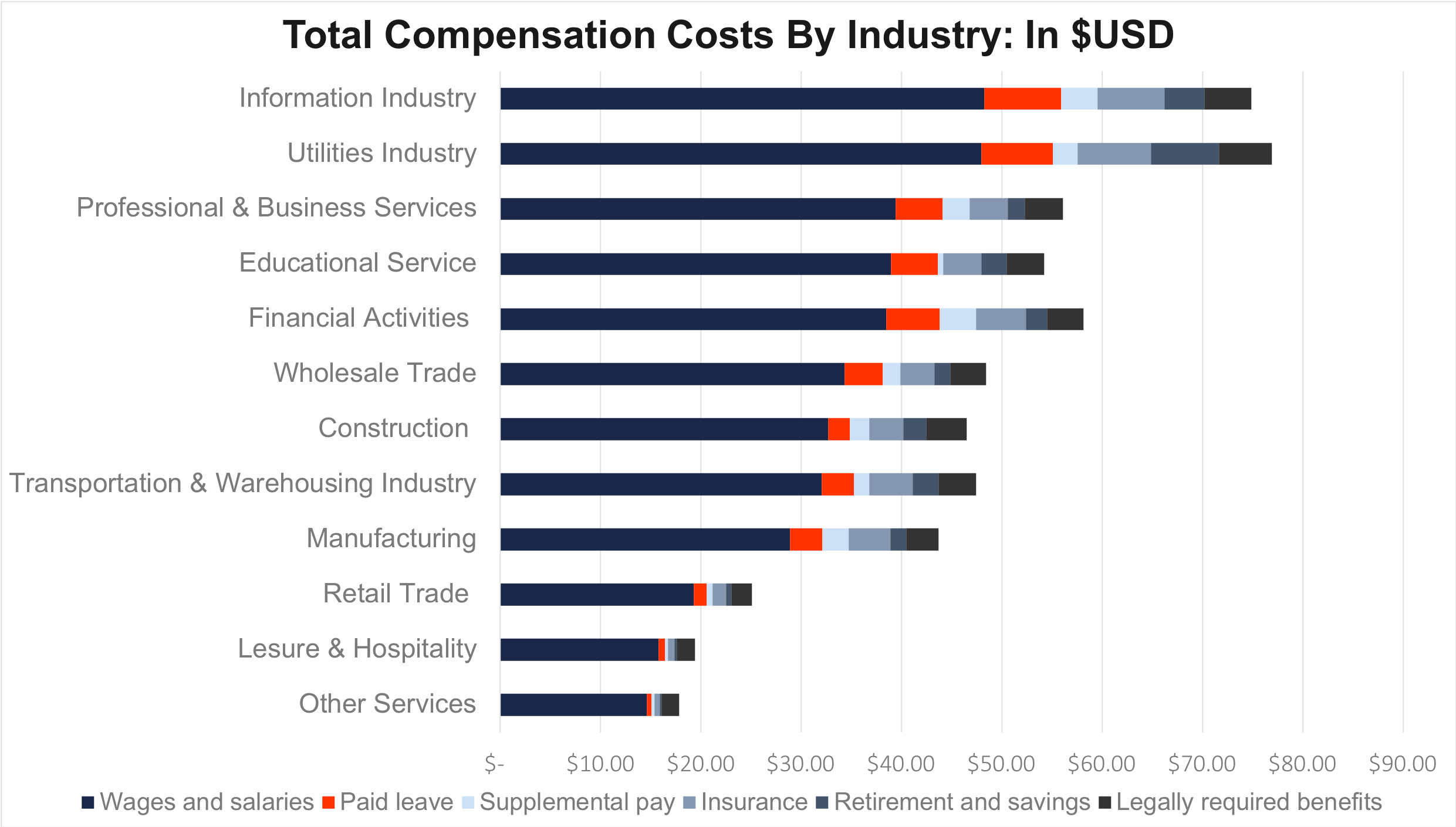
First, lets take a look by industry. As the following chart illustrates, the information industry had both the largest wage/salary expense at $48.25 per hour and the largest employee benefits expense at $26.60 per hour, for an average total compensation expense of $74.85 per employee per hour.
Despite paying a slightly lower average wage/salary expenses per employee at $47.95 than the information industry’s $48.25, the utilities industry nonetheless has the highest average hourly total employee compensation expense at $76.91 as a result of boasting the largest average hourly employee benefits expense of $28.96.
The other services industry had the lowest average total employee compensation costs of just $17.82, followed by leisure and hospitality at $19.44, and the retail industry at $25.08 before making the jump up to the manufacturing industry, which spends an average of $43.68 on employee compensation per hour.
Interestingly, despite paying the lowest wages and salaries, the other services, leisure and hospitality, and retail industries pay the largest proportion of total employee compensation in the form of wages and salaries. In short, the pay is relatively bad in these industries and the benefits are even relatively worse.
As noted above, the split between wages/salary expenses and employee benefits expenses was about 70% to 30%.
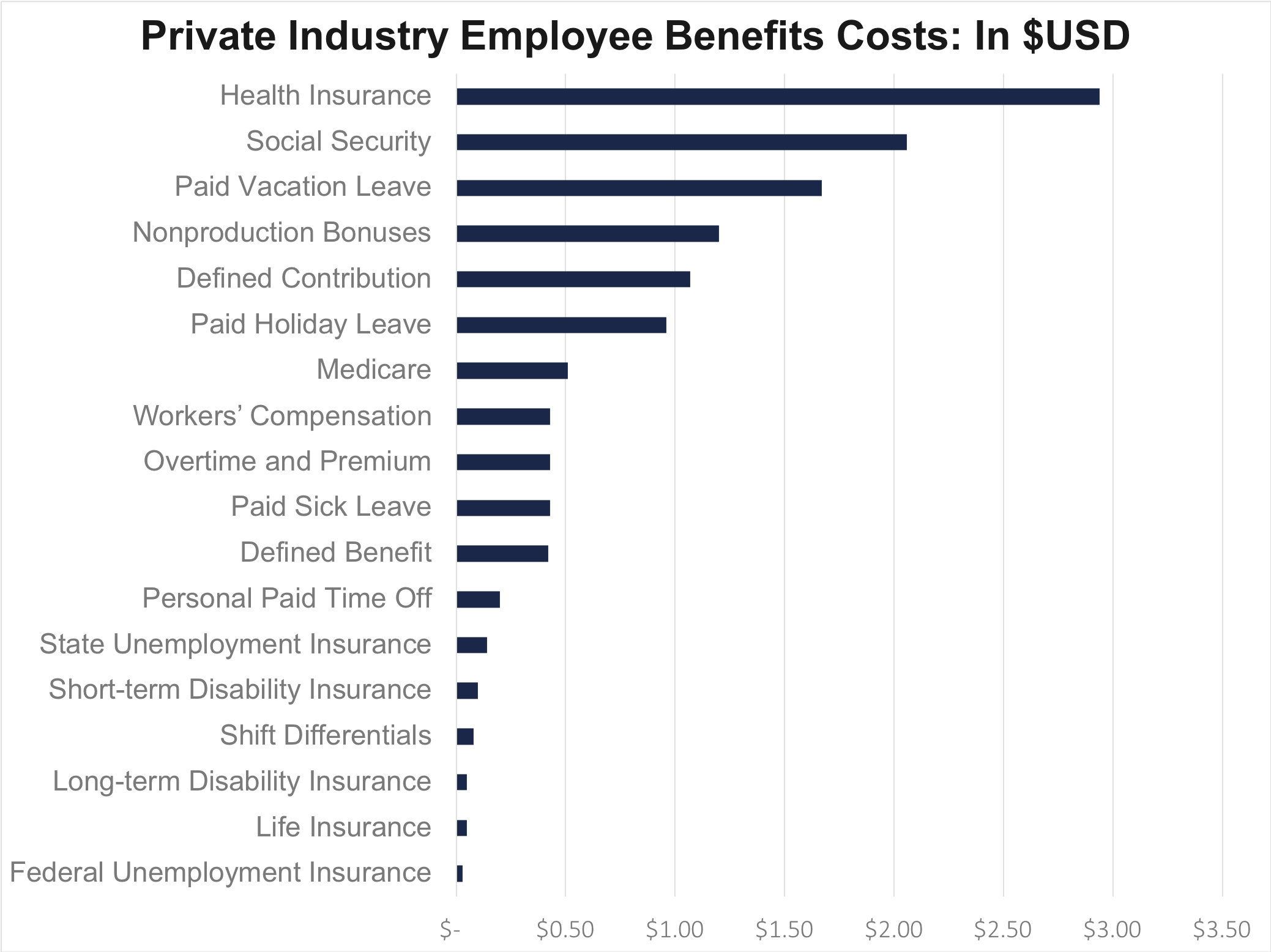
The 30% of total employee compensation expenses that went toward employee benefits can be further broken down, the largest portion of which went to health insurance of course, which cost private employers about $2.94 per hour per employee on average.
Social Security contributions were the next largest expense at $2.06 per employee per hour, followed by paid leave at $1.67, non-production bonuses at $1.20, and defined contribution benefits which cost employers an average of $1.07 per employee per hour in 2023.
Those 5 employee benefit expenses alone (totally $8.97 per employee/hour) accounted for more than 70% of the average total hourly employee compensation expense of $12.77 per hour.
The least expensive eight benefits expenditures combined to equal a little more than $1 in total cost per employee per hour, or a bit over 8% of the total average employee benefits expense.
While the list stacks up for the minor benefit offerings, with a negligible impact on cost. some of them are the most important to certain segments of employees. As noted above, the split between wages/salary expenses and employee benefits expenses was about 70% to 30%.
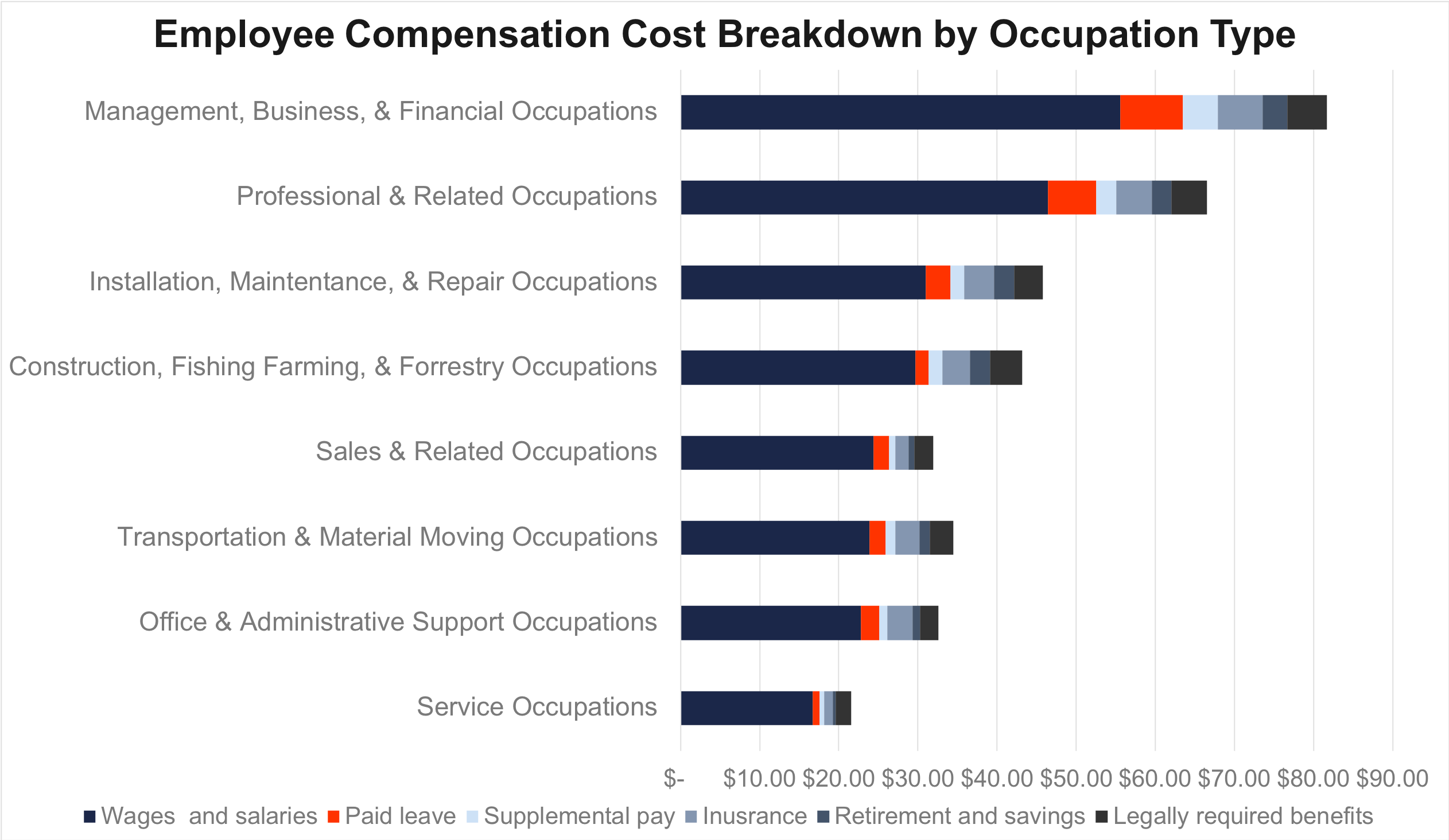
Next, lets look at the specific occupation. While workers in private industry cost their employers $43.11 per hour in total compensation expenses, those figures unsurprisingly varied quite significantly based on occupation type.
Management, business, and financial occupations had the highest average hourly compensation costs at $81.72, followed by professional and related occupations at $66.53.
Construction, fishing, farming, and forestry employees cost their employers an average of about $44.50 per hour in compensation expenses, while sales, transportation, and office and administrative employees had an average compensation expense of about $33 per hour. Service industry employees came in at the bottom of the list costing just $21.55 per hour in total compensation.
It is worth noting that the benefits expenses incurred for sales employees is surpassed by all other occupations outside service occupations, and although sales occupations pay higher wages and salaries than transportation and office/administrative jobs, transportation and office/administrative jobs are nonetheless more expensive in total compensation because of their relatively more substantial benefits offerings.
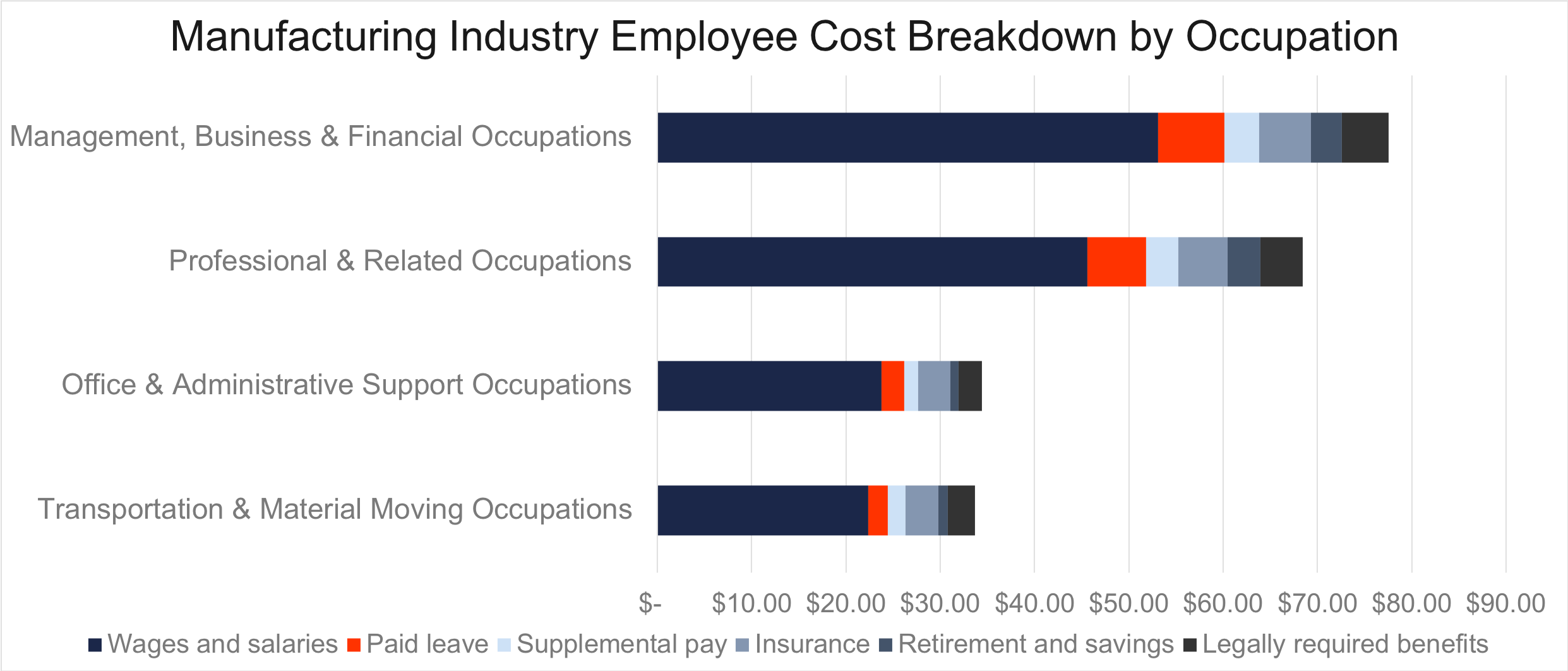
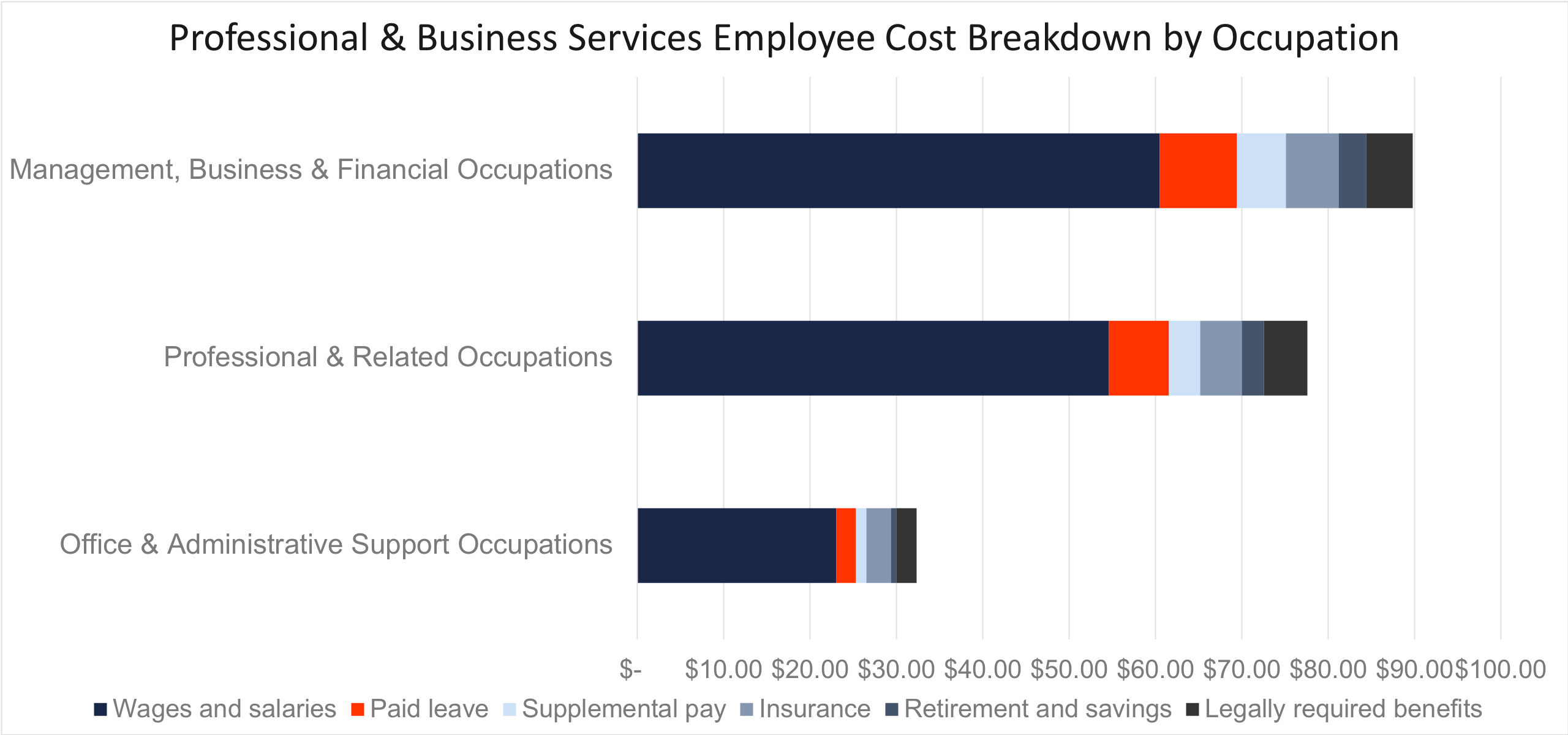
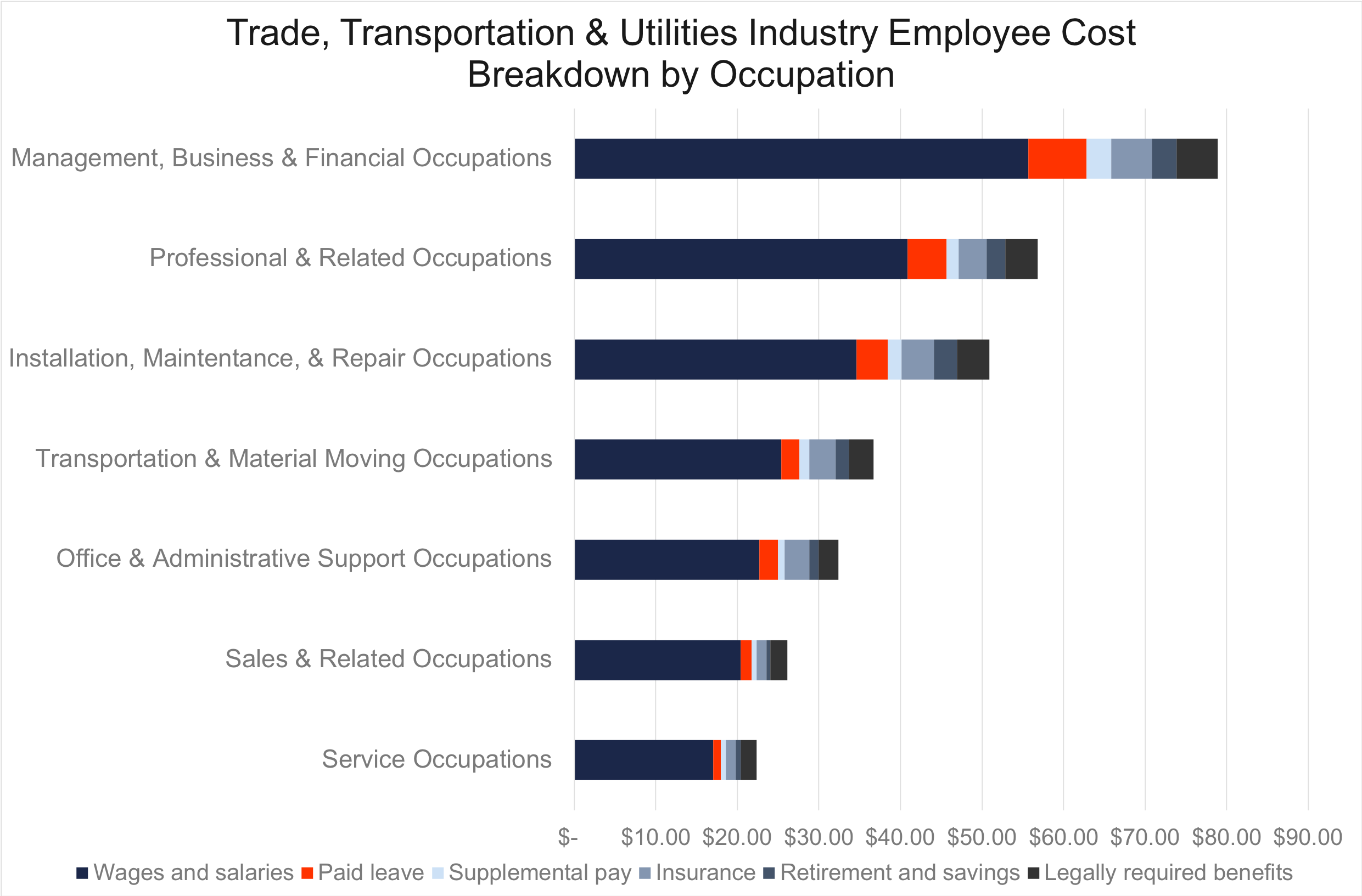
When accounting for both industry and occupation type at the same time, the combined effect that these independent factors have on average employee compensation expenses can be seen even more clearly, as in the following charts outlining employee compensation costs by industry, further broken down by occupation type.
For example, management, business, and financial jobs in the professional and business services industry cost their employers ($89.79 per hour) more than $12 more an hour in total compensation expenses than employees in the same field that work in the manufacturing industry ($77.56 per hour).
On the other hand, office and administrative support jobs compensation expenses were slightly more expensive in the manufacturing industry, albeit largely consistent across industries - $34.4 per hour in the manufacturing industry, $32.31 in the professional and business services industry, and $32.38 per hour in the trade, transportation, and utilities industries.
In a future installment, we’ll take a look at how these employee compensation expenses also vary by company size and region as well as how occupation and employee headcount combine to affect average hourly employee compensation cost.

While the concept of a living wage has become an issue of increasing importance to both employers and employees in recent years, the number of workers actually earning a living wage has been steadily decreasing at the same time - though that decrease has not been experienced across industries and/or geographies in equal measure.
It may once have been easy to confuse minimum wage standards with living wage standards. In fact, the federal minimum wage was initially devised in part to ensure a living wage, those standards long ago diverged with cost of living significantly outpacing minimum wage increases on balance since the 1950s.
That said, the chasm between minimum wage and living wage seems to have become all the more stark in recent years, especially during the pandemic recovery when workers paid well above minimum wage found themselves unable to keep up as cost of living climbed faster than rising wages despite (and because of?) the historically labor-friendly labor market.
Inflation has largely been under control for the better part of a year now, with the last 9 months holding steady below 4% annualized, but cost of living remains high and the minimum wage remains exactly where it has been for the last 15 years - 7 dollars and 25 cents an hour.
That $7.25 an hour in 2009 would be worth $10.58 today accounting for inflation, etc. Meanwhile, as of 2022, the average living wage in the US according to MIT was just over $25 dollars an hour at the time, or $27.53 in today’s dollars.
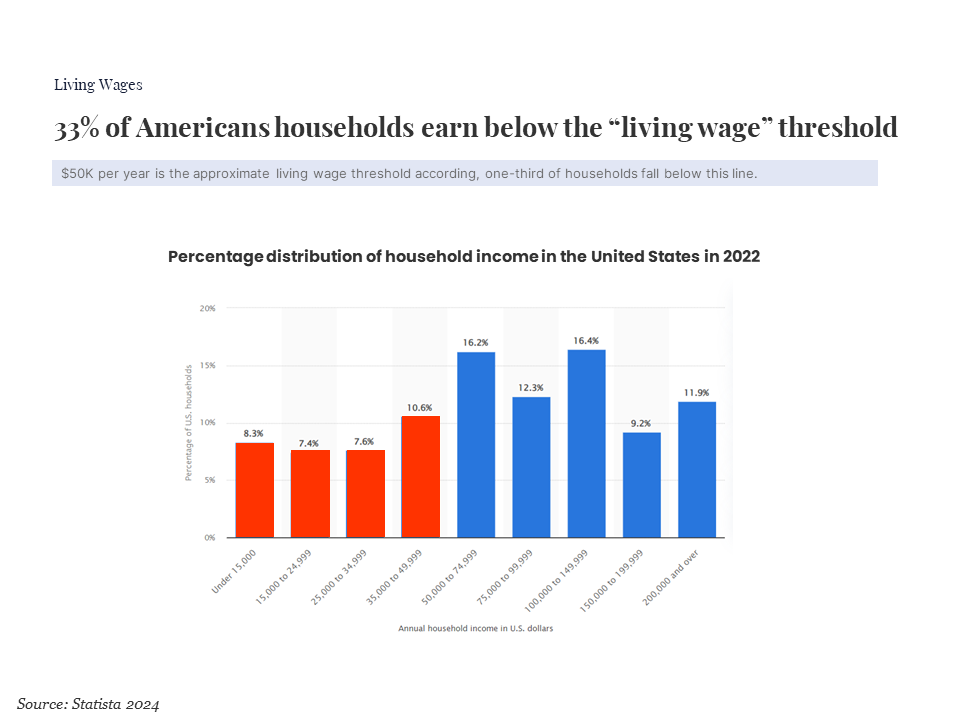
With more workers than ever failing to secure a living wage, the repercussions of this situation are likely to be felt far beyond those who are personally affected, though not all industries are contributing equally to the issue nor are all cities/states/regions responding passively to the growing problem.
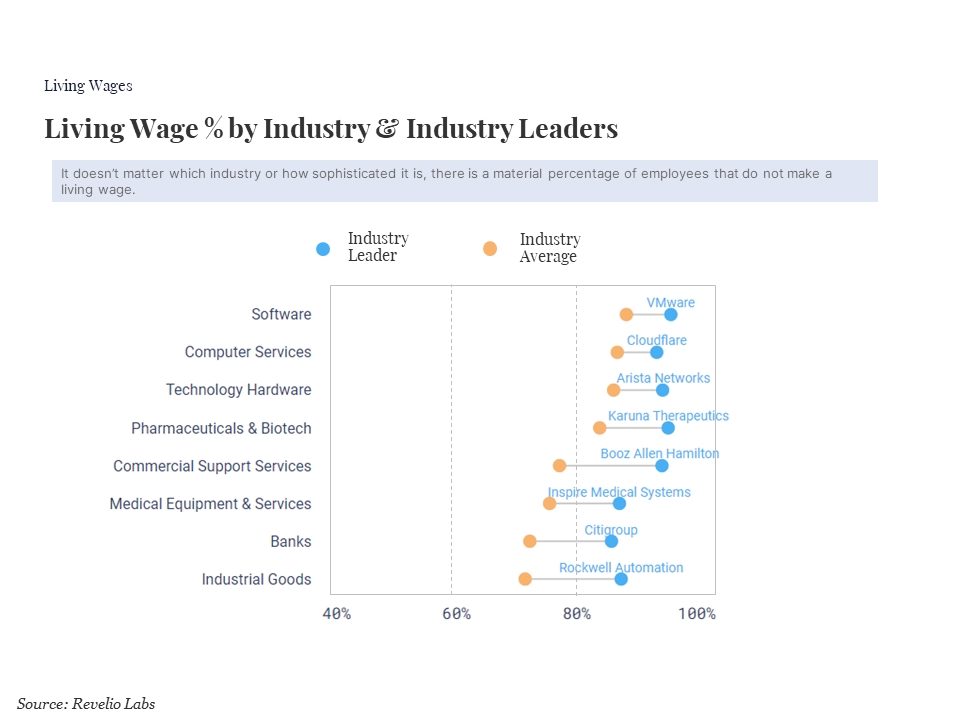
According to data from Revelio Labs, more than one third of workers (36%) employed by the top one thousand companies in the US are paid less than a living wage, defined here as a wage sufficient for two full-time workers to support themselves as well as two dependents. Even worse, nearly 1 out of 5 of those employees (19.2%) does not make enough money to meet basic needs.
As the following graphic illustrates, among the 10 largest industries in terms of total number of employees (which collectively account for 10% of the US workforce), the industries involving technology development dominate the upper end of the scale, with the software, computer services, technology hardware, and pharmaceuticals/biotech industries all paying more than 80% of their employees at or above the living wage threshold.
On the other extreme, both the restaurant and leisure as well as the retail industries pay living wages to fewer than 40% of their employees, while the commercial support services, medical equipment, banking, and industrial goods industries all pay living wages to about 70% to 80% of their employees.
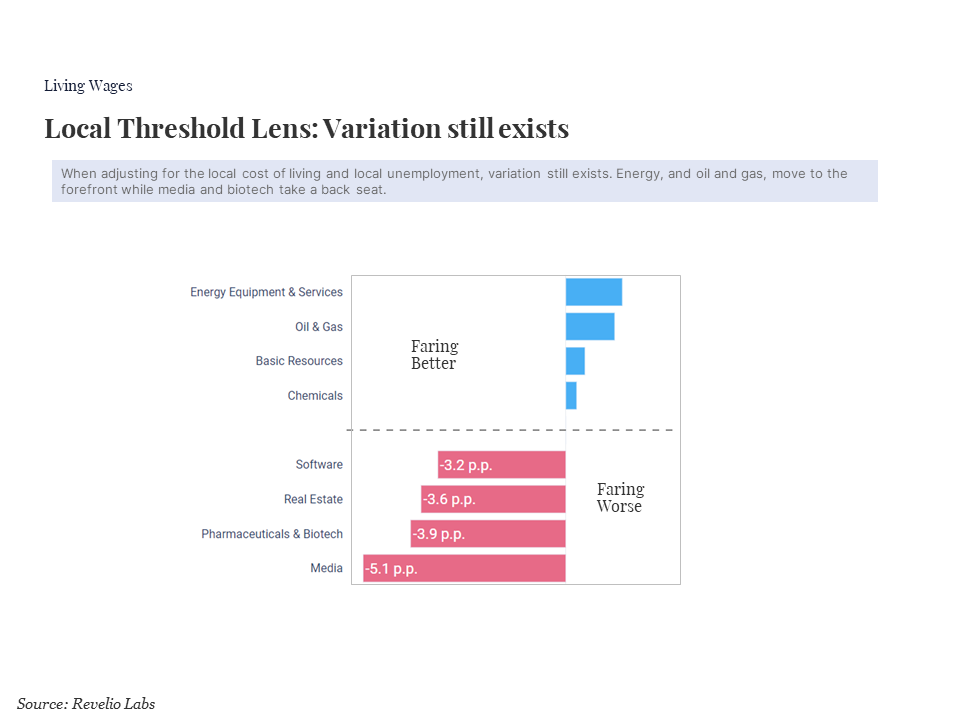
Even when taking into account geographic variance in cost of living, the big picture doesn’t change much, although the following graphic seems to indicate a somewhat less favorable view of the tech industry’s propensity toward paying living wages when factoring for local cost of living, with the total percentage of employees that are paid a living wage in the software and pharmaceuticals/biotech industries dropping by between 3% and 4%, respectively.
Mostly, however, the information best illustrated by this graphic may simply be that industries like tech and media tend to gravitate toward areas with a relatively higher cost of living while the more industrial industries tend to be located in areas with a relatively lower cost of living compared to the national average.
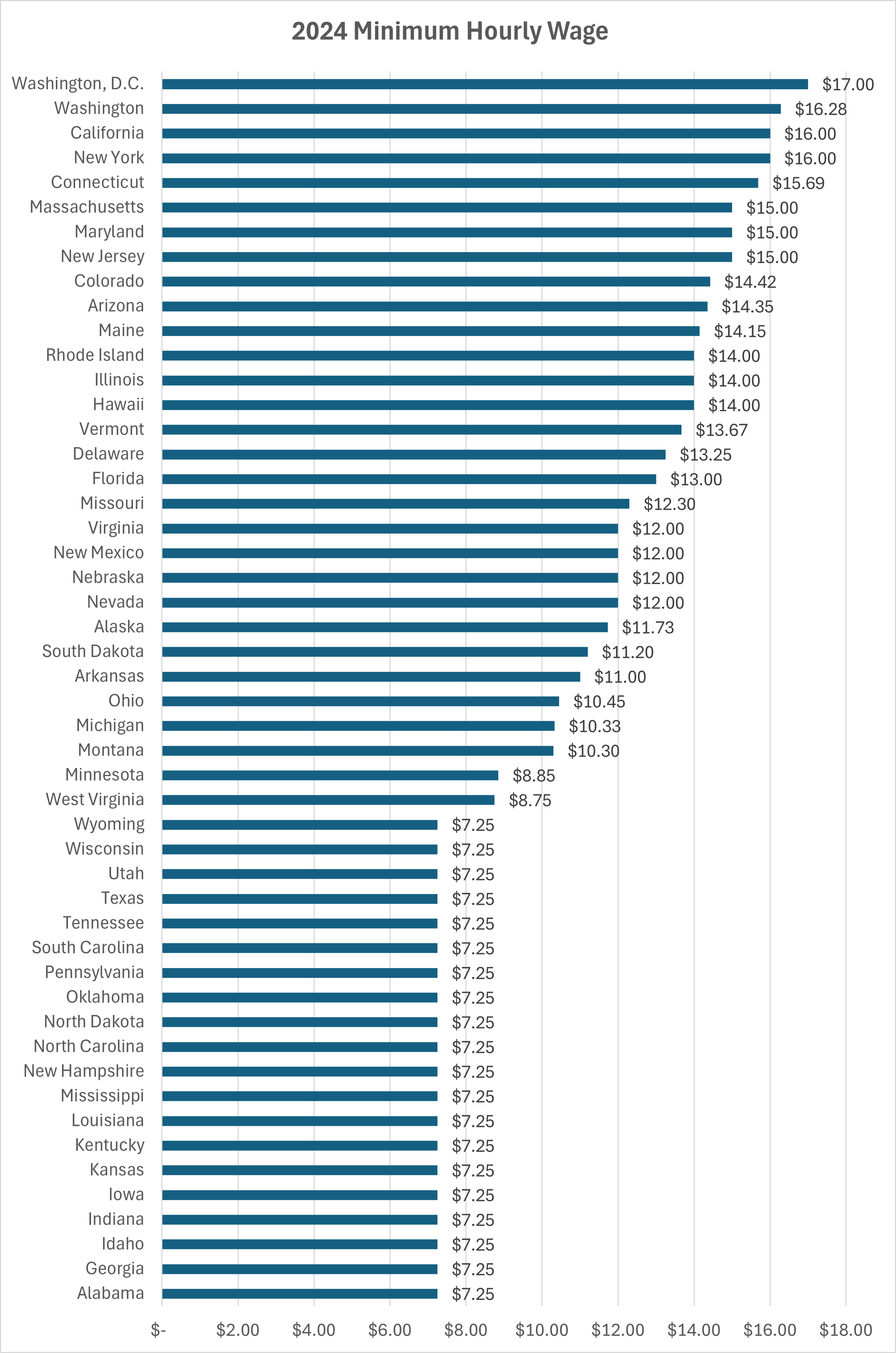
According to the National Conference of State Legislatures, Washington DC currently has the highest minimum wage among ‘states’ at $17 per hour, followed by Washington state at $16.26, then California and New York at $16 each.
Beyond the 5 states that have no internally legislated minimum wage and are therefore subject only to the federal minimum wage standard (Alabama, Louisiana, Mississippi, South Carolina, Tennessee), there are 15 states that have set their minimum wage to the current federal level of $7.25 per hour - Georgia, Idaho, Indiana, Iowa, Kansas, Kentucky, New Hampshire, North Carolina, North Dakota, Oklahoma, Pennsylvania, Texas, Utah, Wisconsin, and Wyoming.
Average minimum wage across the remaining states is about $13 per hour.
There are 9 states that currently have enacted increases to their current minimum wage thresholds that have not been enacted yet:
It’s been almost 12 years since fast food workers launched the Fight for 15 movement to push for better pay (specifically $15 per hour) as well as better/safer working conditions. Currently, the US average living wage is about $27 per hour - nearly double the lofty (and obviously unachieved) goal that $15 per hour represented little more than a decade ago.
In the 85 years since the federal minimum wage was first introduced, it has been raised at least 23 times - most recently in 2009 - with an increase on average more than once every 4 years, but never in the past had more than 10 years passed in between increases, which makes the current 12 year pause all the more noteworthy. Perhaps even more concerning is that the previous record gap between federal minimum wage threshold increases was between 1997 and 2007, which indicates a troubling trend.
Some states are evidently trying to take up the mantle in lieu of waiting for further federal action, but even among the states with the highest planned minimum wages, those thresholds fall significantly short of the living wage standard.
It is also worth noting that all of the states that currently have minimum wage increases set on the books also already have a statewide minimum wage threshold that is meaningfully higher than the current federal standard.
With 40% of states effectively mirroring the federal minimum wage standard, this problem will likely only worsen in the near term and become exacerbated on a regional basis, until some kind of federal solution is enacted.
Still, whenever Congress eventually gets around to increasing the federal minimum wage again, based on current conditions there is virtually zero chance that the increase will close much of let alone all of the gap between the minimum wage and living wage in a given area.
Of course, failure to raise minimum wage standards to meet base standard of living expectations does no preclude other factors and/or market forces from reversing the trend toward larger proportions of the workforce earning unlivable wages, but whatever those factors may be they have yet to emerge, and the long-term implications of these conditions remain unclear.

One recent lawsuit is testing uncharted legal waters when it comes to determining exactly what fiduciary duty employers owe employees with regard to the provision of employee health plans.
On February 5th, a class action lawsuit was filed against Johnson & Johnson in US District Court alleging the company breached its fiduciary duty to employees by egregiously overpaying for prescription drugs.
The plaintiffs, or employees and former employees, support their claim by citing the seemingly exorbitant sticker prices that the company plan appears to be paying for certain medications - prices that supposedly far exceed the cost that uninsured customers pay for the same medication.
Interestingly, in addition to naming Johnson & Johnson as a defendant in the case, the plaintiffs also filed suit specifically against the Johnson & Johnson Planning & Benefits Committee as well as each of the individual fiduciaries that make up that committee, which may be the first time that such fiduciaries have been personally named as defendants in a case like this for employee benefits.
ERISA Fiduciary Liability
The Employee Retirement Income Security Act of 1974 (ERISA) governs primarily two components for an employer - their retirement and employee benefits.
Retirement - As a corollary, about 10-15 years ago, with new ERISA requirements for retirement plans, a number of lawsuits were filed against employers for violation of fiduciary duty. These lawsuits have primarily focused on allegations that plan fiduciaries failed to uphold their duties, leading to significant repercussions for plan participants and beneficiaries. The core issues at the heart of these legal battles include:
The outcomes of these lawsuits have varied, with some resulting in substantial settlements or judgments against fiduciaries, while others have been dismissed. The legal landscape surrounding ERISA fiduciary liability has evolved, with courts increasingly setting higher standards for fiduciary conduct. These cases have led to greater awareness and changes in how retirement plans are managed, including more transparent fee structures, improved investment option monitoring, and the adoption of best practices in plan governance.
Fast-forward to benefits - It remains to be seen how receptive the judicial system will be to the plaintiffs’ claims given that the excessive list prices plaintiffs are highlighting in the suit may be more a reflection of bundling practices common among pharmacy benefit managers (PBMs) than an indication of price gouging or negligent administration.
Perhaps regardless of the ultimate outcome, however, any validation of the underlying premise that the fiduciary duty owed to employees by employers and health plan fiduciaries may extend to these matters will likely bring with it a surge in employees suing their employers for excessive medical care costs and fees.
These suits could come in a variety of forms as it relates to employee benefits, which span not only medical but also cover dental through disability and voluntary. Key items that attorneys may be considering include:
Strategy vs. Duty
Company leadership is hired to run a company effectively. They have a duty to shareholders to run the business to the best of their ability. Senior officers, directors and officers have insurance to protect themselves. When a company performs below expectations, are they liable to shareholders? Only if there are egregious and potentially illegal errors.
The same line is drawn here. You cannot sue someone for implementing a strategy that was ineffective, but you can sue someone if they were negligent.
How to Reduce Your Company’s Risk
In order to minimize the risk exposure that the expansion of fiduciary duty in line with the plaintiff’s perspective presents, here are 3 steps employers can take to ensure that they are properly exercising their fiduciary duty with regard to employee health plan administration.
Organize and Authorize a Health Plan Committee: In the complaint against Johnson & Johnson, the fact that they did not have a health plan committee in place to oversee health benefit plan issues may end up working against the company, especially in light of their implicit acknowledgment of the potential value of a such a committee as evidenced by the existence of their pension plan committee, which serves a similar function with regard to employee retirement benefits.
Request Disclosures From EBCs and PBMs: According to the Johnson & Johnson complaint, federal law requires contract service providers like employee benefits consultants and pharmacy benefits managers to disclose in writing any compensation of more than $1,000 that they receive for their services, whether that compensation is acquired directly or indirectly. Further, failure to obtain such written disclosure prior to entering into, renewing, or extending a contract with a contract service provider makes that contract a de facto ERISA violation, so fiduciaries responsible for these matters should insist that such disclosures are documented before those contracts and renewals are signed.
Take Personal Responsibility: With each member of the benefits committee being named individually as a defendant in the Johnson & Johnson class action suit, proper oversight of health plans as well as the associated costs and administration is no longer any single fiduciary’s job - it is every fiduciary's job - which further underscores the value of health plan committees that are organized in part to provide accountability for these kinds of health-plan related issues.
***
Although the outcome of the lawsuit has not yet been determined at this point, the ripples across the benefits industry are already being felt, and with rising medical costs trending in the opposite direction of many people’s ability to afford them, employers and benefits managers are almost certainly going to be targeted as possible recipients of the blame with increasing regularity going forward.
You can read more about this case here.

In the digital age, where transparency and corporate reputation are increasingly scrutinized, the significance of an employer's Glassdoor rating has become a topic of much debate. Glassdoor, a platform where current and former employees anonymously review companies, has transformed into a crucial tool for job seekers and a barometer for companies' workplace cultures. But does this rating genuinely matter, especially in the context of hiring new people and retaining current employees? Moreover, how does it compare with other metrics like the 'Best Places to Work' awards in the United States, which, intriguingly, have shown a strong correlation with organizational success?
Firstly, Glassdoor ratings play a pivotal role in shaping a company's image in the eyes of potential hires. In an era where candidates often research a company as rigorously as their potential employers scrutinize them, a low Glassdoor rating can be a red flag. It can deter top talent from applying, as these ratings are perceived as reflections of employee satisfaction, management style, and company culture. Conversely, a high rating can enhance an employer's brand, making it more attractive in a competitive job market. This aspect is particularly crucial in industries where talent is scarce and highly sought after.
However, it's essential to approach these ratings with a nuanced understanding. They can be subject to bias, as disgruntled employees might be more inclined to leave reviews than satisfied ones. Therefore, while these ratings offer valuable insights, they should be considered alongside other factors like company achievements, industry reputation, and direct feedback from current employees.
Regarding employee retention, Glassdoor ratings can serve as a useful barometer for internal health. A sudden drop in ratings can be an early warning sign of underlying issues, such as poor management practices or declining job satisfaction. Proactive companies monitor these ratings not just for external branding but also to gauge internal sentiment and address potential problems before they escalate.
Interestingly, when it comes to predicting a company's success, the 'Best Places to Work' awards in the United States offer a surprisingly accurate metric. These awards, determined through comprehensive employee surveys and an audit of company policies and practices, provide a more holistic view of an organization. They consider factors like employee engagement, job satisfaction, benefits, and work-life balance, which are crucial for long-term organizational success.
Companies that consistently rank high in these awards often demonstrate strong financial performance, lower employee turnover, and higher levels of innovation. This correlation suggests that a positive work environment is not just beneficial for employee morale but is also a critical driver of business success. For potential employees, these awards offer a reliable insight into a company's culture and values, often more so than standalone reviews on platforms like Glassdoor.
In conclusion, while an employer's Glassdoor rating is an important metric in the modern job market, influencing both hiring and retention, it should be viewed in context and supplemented with other information. The 'Best Places to Work' awards, on the other hand, provide a more comprehensive overview of a company's workplace environment and are a surprisingly effective predictor of organizational success. As the corporate world evolves, these tools and metrics will continue to shape the landscape of employment, emphasizing the growing importance of transparency and employee satisfaction in the quest for business excellence.
.webp)
My mom was an airline stewardess in the glory days of PanAm. People would dress up to go on the plane. That is a distant memory if you have flown in the past two decades. The rise of hybrid work has been well-documented both here and elsewhere, but often less publicized is the massive effect that the proliferation of off-site work arrangements has had on work attire expectations, taking an already occurring evolutionary trend and massively accelerating it.
Where a worker is conducting their work can make a substantial difference in how they dress, of course, and it is no surprise that nearly 4 out of 5 employees (79%) who work hybrid schedules dress differently depending on their work location - whether that be at home, on-site, or in a third place.
Perhaps more interesting, however, is how on-site and in-office dress codes are becoming increasingly more casual at the same time. For example, the most recent polling data from Gallup indicates that only about 3% of US workers wear a suit to work - down 4% from the 7% of respondents who did so in 2019.
Another survey indicates that the proportion of offices with formal dress codes in the US has fallen from 1.2% to just 0.2% over the last 4 years.
What was once a widely observed professional standard across an array of industries has now become an outlier, and the trend lines for business casual wear in the workplace, while not nearly as drastic, may ultimately lead to a similar fate.
This recent piece from BizWomen takes a broad look at some of those trends that are emerging with regard to workplace attire:

Benefits PRO recently released a piece that highlights an interesting perspective on the likely influence and prevalence of Diversity, Equity, and Inclusion initiatives in the year ahead.
The article notes that there has been a significant reduction in the scope and number of DEI programs across US companies over the past 2 years - in part in response to the additional calls for oversight and negative attention coming from some policymakers and legislators, as we have covered in previous blog entries.
Even beyond the direct action that has been taken in opposition to some DEI initiatives, the resulting uncertainty surrounding the legal foundation and limitations set on diversity-encouraging efforts has had a chilling effect that has likely discouraged additional DEI exploration and investment more than just staying in line with the letter of the law.
The author’s premise, however, is that these dynamics have resulted in a gap in the market, which creates an opportunity for forward-looking companies to bolster their DEI efforts and potentially not only reap all the benefits that diverse thinking, experience, and representation can bring to cooperative problem-solving, but reimagined and reinvigorated DEI programs can better position your organization to attract and retain a more diverse and currently underserved talent pool.
Three of the top ways that DEI initiatives are expected to adapt and change over the coming year are through an increased focus on inclusion and equity, better integration into the overall business in a way that can be apparent from both internal and external perspectives, and increased adoption of AI to open up enable more opportunities for people with disabilities.
You can read more about DEI initiatives and which ones your company should be prioritizing here.

Non-profit research organization The Integrated Benefit Institute recently conducted an in-depth study in order to better understand some of today’s most pressing issues in workforce management.
The research involved more than 300 human resources professionals and collected survey data in addition to less quantitative information and insights, largely focusing on the following topics:
One of the most interesting insights that the research data revealed is that more than half (51%) of respondents claimed that improving employee job satisfaction was their organization’s top goal heading into the new year, which underscores the continuing resilience of the labor market and a power balance that remains relatively favorable to labor.
Mitigating expenses and boosting revenue was the top priority for the vast majority of the remainder of study participants, accounting for 41% of survey responses.
According to the survey results, participants ranked the following employee benefits as top priorities for their organizations:
There were of course generational discrepancies in benefit prioritization, for example employees age 46 and older were most interested in preventative health screenings and retirement related financial concerns, whereas employees under 30 placed the highest priority on work-life balance and fitness/wellness initiatives.
The study also revealed that while the adoption of better data collection and management practices is becoming fairly widespread across industry in general, there are still significant opportunities to improve internal processes and gain competitive advantages through better/broader data capture and analysis.
Perhaps unsurprisingly given the employee-job-satisfaction focus that many organizational leaders are emphasizing in the new year, the highest rate of adoption among data categories in the survey responses was the collection of employee job satisfaction data, which nearly 3 out of 4 (72%) survey respondents reported collecting.
Only a little more than half of responding organizations gather data on employee retention or productivity (57% and 52%, respectively), which may reflect the continuing prevalence of outdated presumptions about diminishing returns in the quality of these kinds of measures that have not kept up with recent advancements in data analytics.
Interestingly, when it comes to health care, 64% of survey participants conduct a formal review of their health programs every year, but only 44% of respondents gather the necessary health data from their employee population to optimize the effectiveness and utilization of those health programs.
Based on their analysis, the authors make the following recommendations as to how employers can best adapt to the changing market conditions outlined above:
You can read more about this study and the resulting analysis here.

This article from Bloomberg highlights an often overlooked employee benefit that most employees hope to never have to use but will ultimately prove to be invaluable in the unfortunate albeit nearly inevitable event that it becomes applicable - bereavement leave.
In a resiliently tight labor market, enhanced grief and loss-related offerings are not only a means of differentiation in the competition to attract top talent, they also provide an opportunity to display meaningful support, flexibility, and generosity in a time when those efforts are likely to be appreciated, remembered, and reciprocated by way of loyalty in return.
Interestingly, the piece included two examples of companies that expanded their bereavement leave policies in response to executives who each had to navigate their company’s earlier bereavement policy in the wake of personal tragedy, found those policies to be lacking to say the least, and were able to embody the case for expanded bereavement leave in a way that clearly resonated.
One of those examples was an executive with Johnson & Johnson who unexpectedly lost his teenage son and discovered that the 5 days of PTO the company offered at the time was insufficient to complete the funeral arrangements.
Ultimately, after being faced with a first-hand case study that 5 days was simply not enough time for people to adapt to changes in life and family circumstances of this magnitude, Johnson & Johnson increased their number of bereavement leave days from 5 to 30.
As for outcomes, the executive who lost his son and catalyzed these changes in the first place claims that he’ll “never” leave the company in light of how responsive leadership proved to be when he raised these issues, and the chief human resources officer who ushered the new bereavement policy into effect says that he received more positive feedback for this particular bereavement policy change than for any other HR policy shift he’d seen in his 16 years with the company.
Much of the conversation surrounding bereavement leave and potential enhancements to bereavement policies involves 2 questions: How many days of paid time off should be allotted following the death of a loved one, and who qualifies as a loved one?
Some noteworthy companies that have expanded their bereavement leave policies up to 20 days of PTO include Adobe, American Express, Bank of America, Goldman Sachs, and JPMorgan Chase.
You can read more about bereavement policies and the surrounding issues and enhancements here.

‘Quiet quitting’ is to work productivity what ‘Coffee badging’ is to work presence.
While doing essentially the bare minimum at work is by no means a new phenomenon, the post-pandemic years gave quiet quitting a name that appears to have stuck.
The actual practice of quiet quitting seems to have more than just a toehold across the workforce, as well, with at least 50% of workers admitting to being quiet quitters themselves.
In light of the the impact that the pandemic has had and continues to have, it is understandable why so many people reevaluated their relationship with their employer and their resulting obligations in the midst of such a profound disruption to their and most everyone's lives - both on a macro scale with regard to the economy and society in general, but also on a human scale as people as individuals and households navigated the changes to their routines.
Coffee badging, while a somewhat more recent phenomenon than quiet quitting, seems to also grow in part from a similar disruption and reevaluation cycle, except the disruption catalyzing coffee badging isn’t the result of being required to stay at home and work from there, but instead by being forced back to the office.
The current routine being disrupted is the now the entrenched remote/hybrid work schedule that is being challenged via the back-to-office pushes that many organizations have conducted with mixed results over the last year, and coffee badging is the pushback to those updated work requirements.
Coffee badging in the literal sense refers to an employee that uses their identification card to enter work premises just to have coffee before leaving again without staying for a full day of work, but the phrase applies more broadly to any situation where an employee makes an appearance on-site for less time than they are supposed to, primarily for the sake of appearances.
The goal with coffee badging seems to be at worst giving the impression that one is complying with in-office work commitment expectations without actually fulfilling those expectations, and at best taking advantage of uncertainties and gray areas that have arisen as companies continue to experiment and adapt to a seemingly ever-shifting new normal when it comes to work scheduling.
Whereas quiet quitting typically involves employees doing that which is explicitly required of them and no more, however, coffee badging is often more explicitly insubordinate in practice given that many ‘coffee badgers’ are likely knowingly falling short when it comes to the amount of time they are spending on-site.
At least one recent survey indicates that coffee badging has become even more widespread than quiet quitting, with 58% of hybrid workers claiming they have participated in coffee badging while another 8% reported that they had not yet done so but would like to give coffee badging a try at some point.
And the practice isn’t limited to those workers occupying the lower rungs of the ladder, for that matter, with an even larger percentage of managers (64%) claiming that they have personally coffee badged already while another 6% of managers intend to do so at some point in the future.
While noting that coffee badging is but one of many obstacles and hurdles that employers must overcome when competing for talent in a competitive labor market, one managing director for HR specialists Insperity recommends addressing coffee badging via:
You can read more about coffee badging and how best to handle it here.

Recognizing and honoring important national holidays is key to fostering a supportive and culturally sensitive workplace. Armed Forces Remembrance Day in Nigeria, observed on January 15th, is a solemn occasion dedicated to honoring the sacrifices of the country's military personnel. This guide provides US employers with insights on the significance of Armed Forces Remembrance Day, ways to observe it in the workplace, and considerations for legal and compliance matters.
Armed Forces Remembrance Day is observed annually on January 15th.
Armed Forces Remembrance Day holds a high level of importance in Nigeria. It is a day of reflection and tribute to the Nigerian military personnel who have made sacrifices for the nation.
The day was set aside to honor members of the Nigerian Armed Forces who lost their lives in the line of duty, particularly during World Wars I and II, the Nigerian Civil War, and various peacekeeping missions. It also serves as a reminder of the ongoing efforts to maintain peace and security in the country.
Subject: Honoring Armed Forces Remembrance Day - A Day of Reflection
Dear [Team/Company] Members,
As Nigeria observes Armed Forces Remembrance Day on January 15th, we join our hearts in solemn reflection to honor the sacrifices made by the brave members of the Nigerian Armed Forces.
To commemorate this day, we encourage everyone to observe a moment of silence during our [meeting/event] as a gesture of respect for the fallen heroes. Additionally, we are initiating [insert planned activities] to contribute to charities supporting veterans and their families.
Let us come together as a team to recognize and appreciate the dedication and sacrifices of our military personnel.
Best regards, [Your Company]
Ensure that any workplace activities comply with legal requirements and adhere to company policies.
By acknowledging Armed Forces Remembrance Day, US employers contribute to fostering a workplace culture that values and respects the sacrifices made by military personnel. This inclusive approach creates a supportive environment for employees of diverse backgrounds and experiences.

As global workplaces become increasingly diverse, it's essential for US-based employers to recognize and respect the cultural holidays of their employees. One such significant holiday in Japan is Golden Week, a period marked by a series of public holidays that allows for extended time off. In this guide, we'll delve into the specifics of Golden Week, its cultural importance, traditions, and how US employers can navigate this holiday to foster a harmonious workplace.
Golden Week typically spans from late April to early May, with several public holidays closely packed together. The specific dates may vary slightly each year but often include Showa Day (April 29), Constitution Memorial Day (May 3), Greenery Day (May 4), and Children's Day (May 5).
Golden Week holds immense importance in Japan. It is a time when many Japanese citizens take advantage of consecutive public holidays to travel, spend time with family, or engage in recreational activities. Understanding the significance of Golden Week is crucial for employers seeking to accommodate and respect their employees' cultural traditions.
Golden Week originated as a way to celebrate a cluster of national holidays and create an extended period of rest and relaxation. The name "Golden Week" reflects the pleasant weather during this time, making it an ideal period for outdoor activities and travel.
Subject: Embracing Golden Week - A Time for Rest and Reflection
Dear [Team/Company] Members,
As we approach Golden Week, we want to take a moment to acknowledge and respect the cultural significance of this holiday for our team members from Japan. Golden Week is a time when many individuals celebrate various public holidays, and it holds great importance in Japanese culture.
We encourage everyone to be mindful of our colleagues who may be observing Golden Week, and we support flexible scheduling to accommodate their plans. If you have specific traditions or customs you'd like to share with the team, we welcome the opportunity to learn and celebrate together.
Wishing you all a wonderful Golden Week filled with rest, relaxation, and joy!
[Your Company]
Be aware of any legal considerations regarding time off or flexible scheduling during Golden Week.
In conclusion, recognizing and respecting Golden Week contributes to a workplace culture that values diversity and promotes understanding among team members. By embracing the cultural traditions of Golden Week, US employers can create a more inclusive and supportive work environment.


.svg)
.svg)
.svg)

.svg)