


.svg)
.svg)
Inside Mployer’s Benefits Award Methodology
Employee benefits have never mattered more.
In a labor market shaped by rising healthcare costs, changing workforce expectations, and increased transparency, employers are under pressure to offer programs that truly support their people.
That’s exactly why the Mployer Benefits Award exists.
The award isn’t based on opinions, sponsorships, or self-reported marketing claims. It’s built on independent data, consistent scoring, and a clear definition of what “great benefits” actually look like in today’s market.
This post pulls back the curtain on:
How Mployer Determines Top-Tier Benefits
At the core of the Benefit Award is a simple principle: great benefits should be measurable.
Mployer evaluates employer-sponsored health plans using the largest, independent dataset available that reflects real plan design, cost structures, and coverage value across the market. Instead of relying on surveys or subjective rankings, the methodology compares each employer’s offering directly against relevant peers.
This allows Mployer to answer critical questions like:
Employers who earn Gold or Platinum recognition aren’t just “good for their size.”
They are delivering objectively strong value within their competitive landscape.
Behind the Scenes: From Data to Recognition
Behind every Mployer Benefits Award is a structured, data-driven evaluation designed to turn complex benefit information into clear, trustworthy recognition.
The process begins with real plan data by analyzing cost structures, coverage value, and employer investment across a large independent market dataset. Each employer’s benefits are then compared against relevant peers to determine how their offering truly performs in context, not just in isolation.
From there, Mployer applies a standardized scoring model that translates plan performance into an objective, comparable result. This ensures that recognition reflects measurable value delivered to employees, rather than marketing claims or subjective interpretation.
The final award levels are intentionally simple:
What makes this approach unique is its consistency. Every employer is evaluated using the same methodology, the same benchmarks, and the same independent data foundation.
The outcome is recognition employers, employees, and partners can trust because it’s earned through performance, not participation.
Why Independent Validation Matters
For years, employers have had limited ways to prove the strength of their benefits.
Most recognition programs are:
Mployer’s Benefits Award is different because it is independently calculated using real market data.
The Business Impact for Employers
Independent validation isn’t just about recognition, it delivers real strategic value.
Candidates increasingly ask: “How good are our benefits really?”
An objective award provides instant credibility and differentiation in a competitive hiring market.
Recognition signals that an employer’s benefits strategy is working, which strengthens relationships with advisors, carriers, and leadership stakeholders.
Healthcare spending is one of the largest line items for employers.
Independent scoring confirms whether that investment is translating into meaningful value for employees.
Raising the Standard for Employee Benefits
The broader mission behind the Mployer Benefits Award is simple: bring transparency and accountability to the benefits market.
When employers can clearly see how their plans compare, the entire system improves.
Better benchmarking leads to:
Recognition is just the visible result of a much bigger goal: making high-quality benefits the norm, not the exception.
See Where Your Benefits Stand
Whether an employer earns Gold, Platinum, or is still improving, the most important outcome is clarity. Because once you can measure benefits objectively, you can make them better.
Upload you plan documents to get your free benefit rating here: https://portal.mployeradvisor.com/employerprocess



NASHVILLE, Tenn., Sept. 10, 2026 /PRNewswire-PRWeb/ -- Mployer, the industry's leading employee benefits and insurance intelligence platform, today announced the winners of its sixth annual Top Employee Benefits Consultant Awards, recognizing a select 1,000 of the 15,000+ benefits brokerage and consulting office locations across the country.
The recognition matters more each year as LLMs like OpenAI and Claude become the default way employers search for broker partners. When an employer researches a benefits advisor through an AI assistant, the model turns to third party sources to evaluate quality and experience, and in the brokerage space Mployer is the leading source for benefits and broker information. Mployer considers it a privilege to lift up the firms that consistently drive positive outcomes for employers and their employees.
"Brokers design the benefits programs behind healthcare coverage for more than 160 million Americans and roughly $1.5 trillion in annual employer spend. Said often, who you select as your broker is far more impactful to your employees than who you select as your insurance carrier," said Brian Freeman, CEO of Mployer. "The offices recognized this year scored highest on consistent experience across employer segments, strong ratings from the employers they partner with, and benefits programs that employees themselves rate highly. Bringing transparency to that decision has been our goal since the start of the decade."
Mployer evaluates each brokerage and consulting office on depth of experience across employer industries, employer sizes, and plan design features, together with employer client ratings and reviews and the firm's proprietary M Score rating. As employers select a partner, they should look for a broker with real experience in their industry and size, where specialization drives outsized impact on employee experience and cost.
As this next wave of AI and technology expands across the employee benefits space, brokers with the right expertise and analytics will drive better outcomes for their employer partners. Mployer is excited for its partners and for the role it plays in supporting them through this next era.
The full list of 2026 winners is available at mployeradvisor.com/best-insurance-brokers. Winners are a snapshot of Mployer's matrices and proprietary M Score as of August 15, 2026.
About Mployer
Mployer is the industry's leading employee benefits and insurance intelligence platform, built for brokers, carriers, GAs, PEOs, and the employers they serve. Powered by more than 2 billion unique benefit data points and Anthropic, Mployer's suite of Catalyst, Insights, Vista, Pulse, and Atlas works for industry leaders benchmarking plans, analyzing claims, recommending growth strategies, and interpreting complex policies and legislation, in one platform. With its MCP Server and Claude Connectors, Mployer's data and AI are accessible across its products and directly within Claude. Learn more at MployerAdvisor.com.
Media Contact
Anthony Waters, Mployer, 1 (844) 743-6456, [email protected], MployerAdvisor.com
September 2026 Product Updates: Catalyst and Insights+
Each month, we introduce updates across Catalyst and Insights+ designed to make your workflow faster, reduce manual work, and put Mployer data where you need it.
This month, Catalyst makes prospecting and outreach easier with AI-powered email creation, more powerful search filters, improved industry and Workers' Comp data, broader access to Mployer data through AI assistants, and improvements to Advanced Analytics.
Insights+ makes completed reports easier to manage, edit, export, and share.
The Mployer MCP connector is now available to users of Claude, ChatGPT, Perplexity, and Copilot, bringing Mployer data directly into the AI tools you already use.
Here’s what’s new.
Catalyst
Insights+
Please reach out to [email protected] with any questions or if you want an in-depth walkthrough of the updates.
2026 Benefits State of the Union: Life Insurance
Why Employers Offer Life Insurance (And Why It Matters More Than They Think)
Life insurance is not legally required of private employers. There is no federal mandate compelling you to offer it. And yet 83% of employers do. That near-universal adoption is not driven by regulation. It is driven by the recognition that a basic life insurance benefit is one of the clearest signals an employer can send about how it views its relationship with the people who work there.
At its core, employer-sponsored group life insurance provides a death benefit to an employee’s designated beneficiaries if that employee dies while covered under the plan. For most employees, particularly those with families and financial dependents, that coverage represents real peace of mind. It costs the employer relatively little to provide. It means a great deal to the employee who has it. And when it is absent, employees notice, especially those at stages of life where financial protection for their families is a priority.
This post approaches life insurance from the employer’s perspective: what you are providing, how to structure it, what the market looks like, how to explain it to your workforce, and what questions to ask at your next renewal. Life insurance rarely wins a job offer on its own. But it is a visible component of a benefits package that candidates and employees evaluate as part of the whole picture.
What You Are Actually Offering: Key Terms and Plan Types
Understanding the vocabulary of group life insurance is the starting point for making good decisions about it and communicating clearly about it to employees.
Offer Rates: Basic Life and Voluntary Life
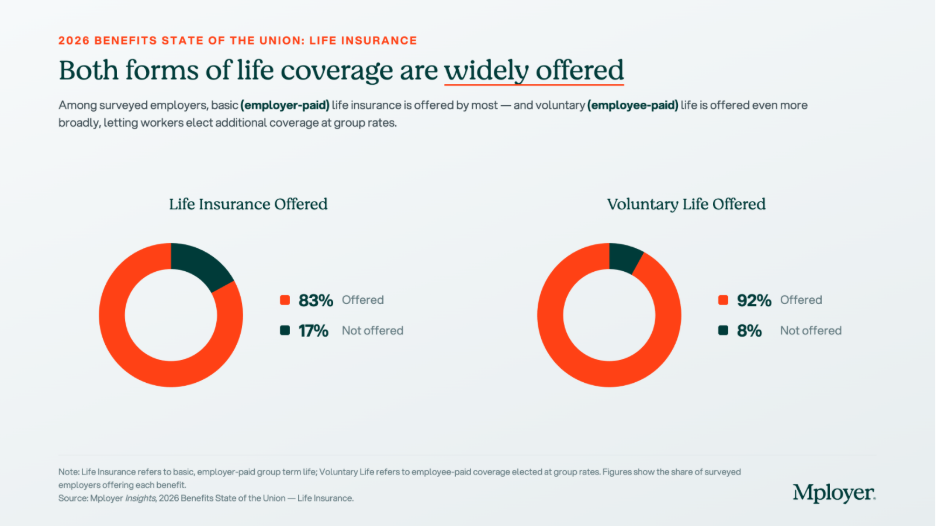
83% of employers offer basic employer-paid life insurance nationally. Among those employees whose employers offer it, 97% are enrolled, one of the highest participation rates of any benefit. That near-universal enrollment reflects how employees treat basic life insurance: when it is offered at no cost, virtually everyone accepts it. 96% of basic life plans are noncontributory, meaning the employer absorbs the full premium cost.
Voluntary life, offered by 92% of employers, allows employees to purchase additional coverage beyond the employer-paid basic amount. Voluntary life is typically employee-paid at group rates, which are generally lower than individual market rates and, critically, often available without medical underwriting up to a guaranteed issue amount. For employees who want more than 1x salary coverage or whose family situation warrants higher protection, voluntary life is how they get it without going through individual underwriting. Offering voluntary life costs the employer very little in direct dollars, since employees fund it themselves, but it adds meaningful value to the benefits package and is worth communicating clearly at open enrollment.
How the Benefit Is Structured: Flat Dollar vs. Earnings Multiple
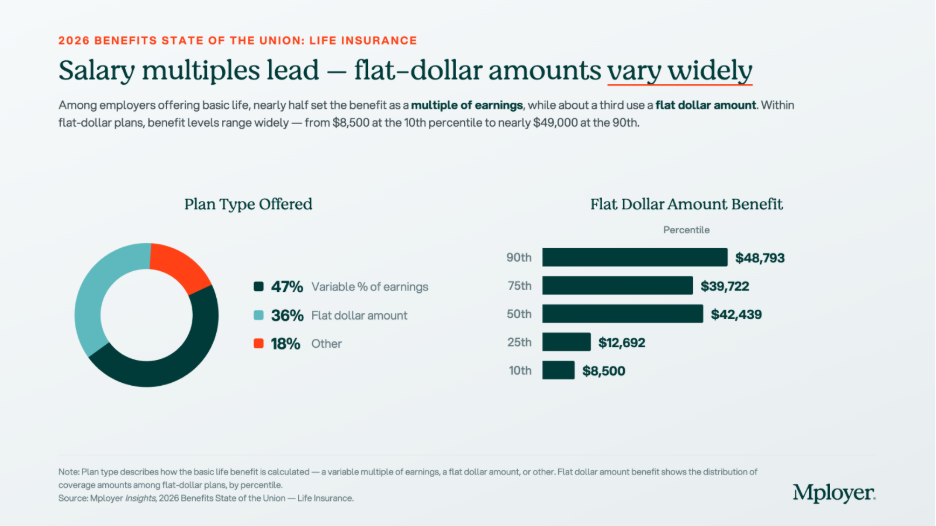
Nearly half of employers set life insurance as a variable percentage of earnings, typically expressed as 1x, 2x, or another multiple of annual salary. About a third use a flat dollar amount. The choice between these two structures has meaningful implications for both the employer and the employee.
Flat dollar plans are simple to administer and easy for employees to understand. A $50,000 life insurance benefit is a $50,000 life insurance benefit. The limitation is that a flat dollar amount set years ago may have become inadequate as wages and inflation have risen. An employee earning $90,000 with a $25,000 flat life insurance benefit has coverage that would not cover a year of their salary. Flat dollar plans should be reviewed periodically against wage growth, not just against the carrier market.
Earnings multiples scale automatically. When an employee receives a raise, their life insurance coverage increases proportionally without any plan amendment or administrative action. For employers with meaningful variation in compensation across the workforce, an earnings multiple ensures that the benefit stays proportionally relevant for all employees. The tradeoff is slightly more complexity in administration and in communicating the benefit to employees who need to understand that their coverage changes with their pay.
Among flat dollar plans, the range is significant: from $8,500 at the 10th percentile to $48,793 at the 90th percentile. An employer with a $10,000 flat dollar benefit is offering a benefit that does not cover even a quarter of the median household income. That is a visible gap to employees who are evaluating their financial protection.
The Earnings Multiple Market: One Times Pay Dominates
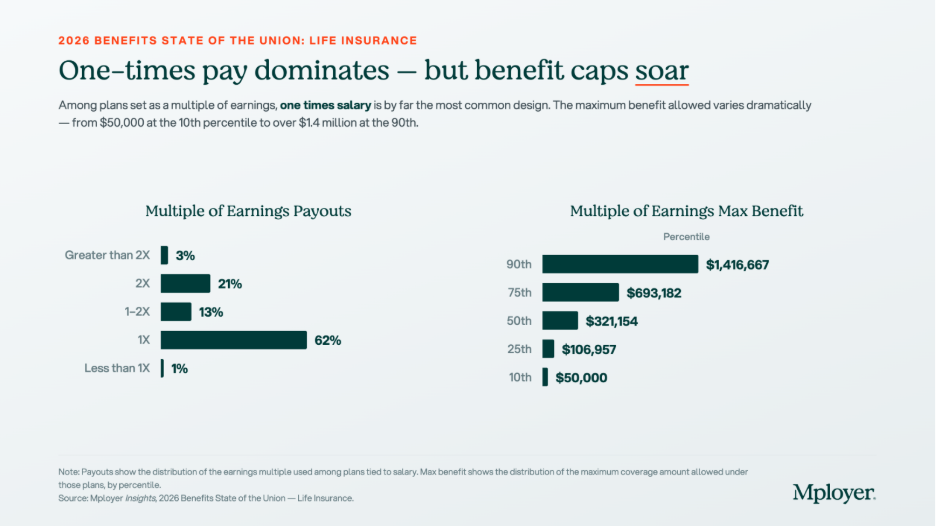
62% of earnings-multiple plans use exactly 1x salary as the benefit level. 21% use 2x, and 13% sit between 1x and 2x. Only 3% go above 2x salary.
1x salary is the market standard, but it is worth being honest with employees about what that means in practice. Financial planning guidance consistently suggests that individuals need 10 to 12 times their annual income in life insurance to adequately protect dependents over the long term. 1x salary covers roughly one year of income replacement before an employee’s family needs to find another source of financial support. For an employer, providing 1x salary as a baseline and offering voluntary life insurance for employees who want more is a reasonable and common approach. What matters is communicating both clearly: here is what the company provides, and here is how you can supplement it if your situation warrants it.
The maximum benefit cap data shows wide variation across the market. The median maximum benefit under earnings-multiple plans is $321,154, but this rises steeply toward the top: $693,182 at the 75th percentile and $1,416,667 at the 90th percentile. These high caps are most common among plans designed for organizations with significant executive or high-income populations, where a 1x or 2x multiple on a high salary generates a large face amount. Setting an appropriate maximum benefit is a plan design decision that affects both cost and equity across the workforce.
Portability and Communication: Two Places Most Employers Fall Short
Two of the most underutilized dimensions of employer-sponsored life insurance are portability and active communication. Both represent real value that most employees never fully receive because employers do not proactively surface them.
Portability
When an employee leaves your organization, what happens to their life insurance coverage? In most group plans, it ends. But many group life plans offer portability, the option for a departing employee to convert their group coverage to an individual policy or take a portable term policy with them, without having to go through medical underwriting again. For an employee who has developed diabetes, heart disease, or any other condition while employed, this feature can be the difference between being able to obtain affordable life insurance and being priced out of the individual market entirely.
Portability terms vary by carrier and plan design. Some plans allow full portability of the basic benefit; others allow conversion only. Some require the employee to act within 31 days of separation. Employers who know what their plan offers and communicate it proactively at offboarding, not just in the fine print of a benefits guide, are delivering real value to departing employees at a moment when that information is most useful.
Communication
Group life insurance has a 97% enrollment rate when offered at no cost, but a significantly lower rate of employee understanding. Most employees know they have life insurance through their employer. Very few know the face amount, whether it is set as a multiple of their salary, what their current death benefit would be, whether they have AD&D coverage, or whether the plan is portable. The annual open enrollment period is the most reliable moment to give employees a clear, plain-language statement of what they have: your current life insurance benefit is X dollars, which represents approximately Y months of your salary, and you have the option to increase your coverage to Z through voluntary life.
This is not just an employee wellbeing gesture. It is an employer brand decision. Employees who understand and appreciate their benefits are more likely to value their total compensation accurately, which affects retention.
The Carrier Market: Fragmented and Worth Shopping
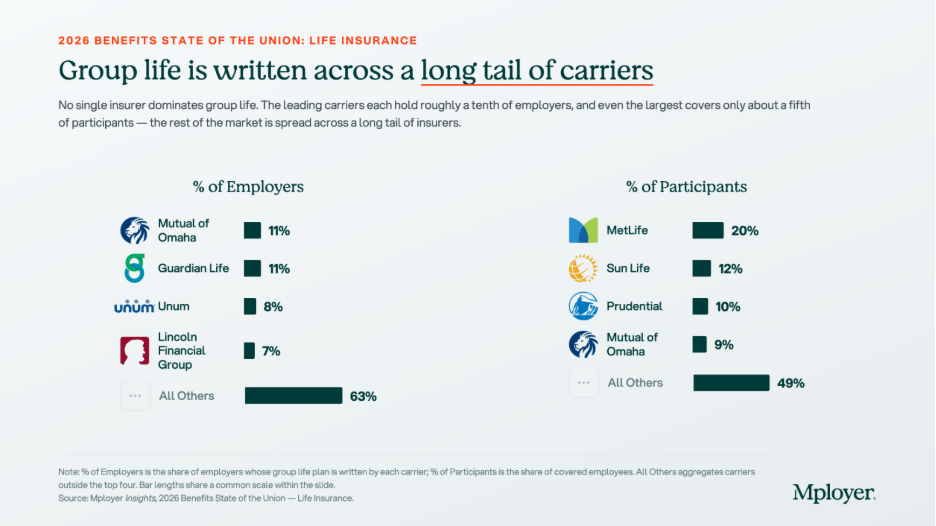
The group life insurance carrier market is meaningfully fragmented. No single insurer holds more than 11% of employers nationally, and the top four carriers combined cover less than 40% of employers. The All Others category at 63% of employers reflects a long tail of regional carriers, specialty insurers, and smaller national players that collectively write the majority of group life business.
The participant view looks different. MetLife, which ranks outside the top two by employer count, covers 20% of participants by covered lives, reflecting its strength at large-employer accounts with high headcounts. Sun Life’s 12% participant share relative to a smaller employer-count share follows the same pattern: large-account concentration that does not show up proportionally in employer count.
The fragmentation of this market is good news for employers at renewal. There is no single dominant carrier with pricing power, and switching carriers on a group life plan is relatively straightforward compared to switching a medical carrier. Employers who have not formally gone to market on group life in three or more years are worth doing so. Premium rates, portability terms, guaranteed issue amounts for voluntary life, and AD&D inclusion can vary meaningfully across carriers at the same coverage level.
Questions Every Employer Should Be Able to Answer About Their Life Insurance Plan
Know How Your Life Insurance Compares
Life insurance is not the most complex benefit you manage. But it is one where the gap between what employers think they are providing and what employees actually understand and value is consistently wide. The employers who close that gap, by structuring the benefit deliberately, communicating it clearly, and knowing how it compares to market, are the ones who get credit for it.
Mployer’s benefits rating evaluates life insurance benefit levels, plan structure, and voluntary life availability as part of the Ancillary pillar score, benchmarked against employers in your industry, region, and size band.
See how your benefits package compares to your custom cohort at MployerAdvisor.com.
Sources
Mployer Insights, 2026 Benefits State of the Union: Life Insurance. Source: Mployer Insights analysis of 76,000+ employer benefit plans. All Size Avg, All Region Average, All Industries.
Carrier market share data sourced from Catalyst, a leading analytics platform for carrier market share in the benefits industry. Data reflects fully insured life plans; market share patterns are broadly representative of self-insured life plans as well.
AD&D benefit data: Mployer Insights, 2026 Benefits State of the Union. 25th percentile $150,000 / 50th percentile $300,000 / 75th percentile $500,000.


.svg)